UX case study · Emotional eating · MIT Institute of Design, 2026
Between feeling somethingand eating something,there is a moment.
A three week study of how people eat, the analysis that narrowed it to emotional eating, and the app I designed for that moment.
Overview
A group study of why people eat when they are not hungry, my own analysis that narrowed it to emotional eating, and an app designed for the moment before the bite.
- 113survey responses
- 19interviews
- 10people in a food reel experiment
- 208interview quotes coded by hand
The problem
People reach for food when they feel something, not when they are hungry. Knowing this does not stop them in the moment.
What I did
Took the group's data further on my own, found emotion behind it, and designed for the moment of the urge instead of the meal after it.
Where it stands
A clickable prototype, not yet tested with users. The last chapter says plainly what that leaves open.
Where it started
Eating looks like a choice.Most of the day, it is a reflex.
Our group set out to study everyday eating: when, what and why people eat, and what decides it on the days hunger is not the reason.
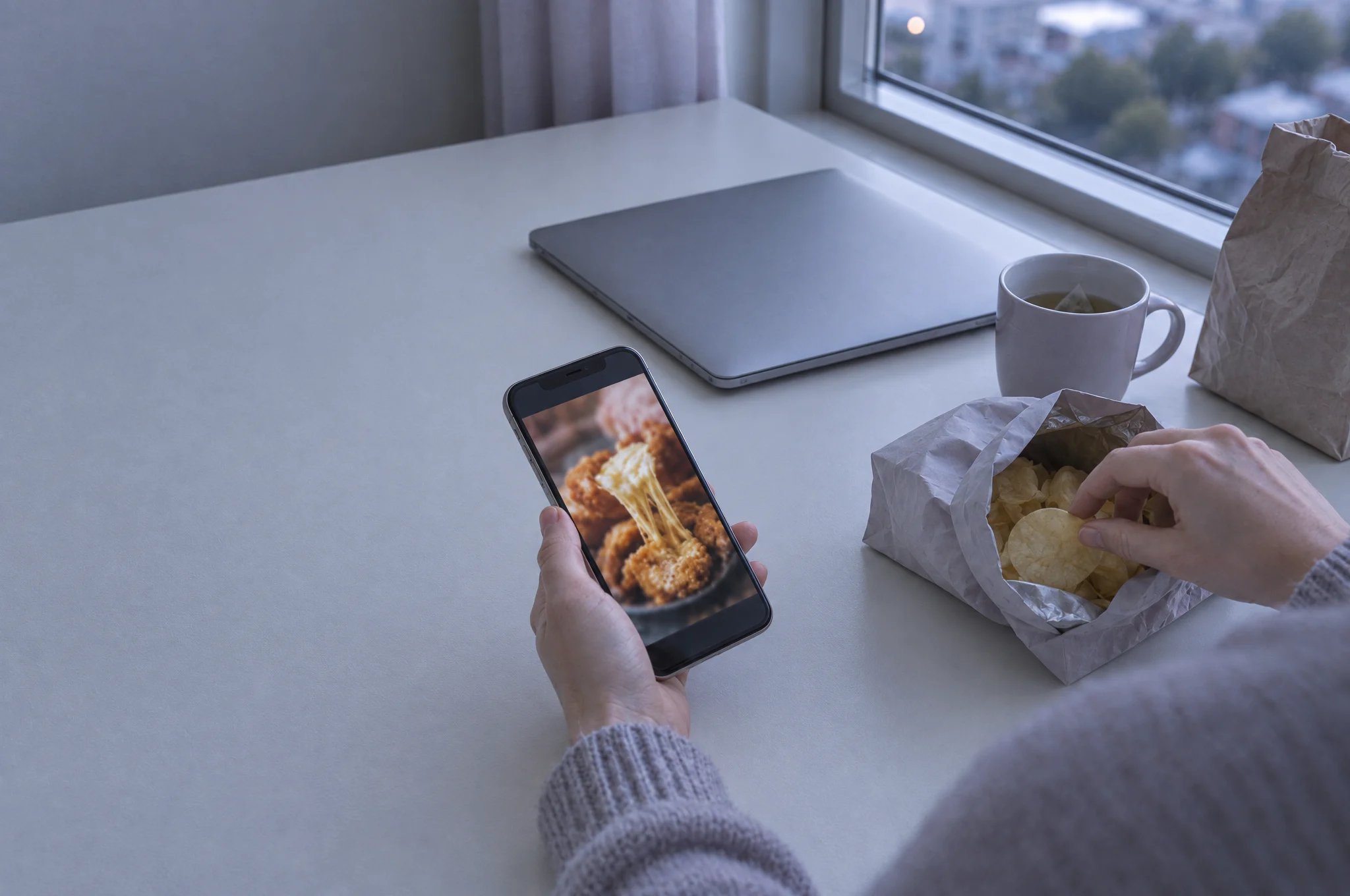 1234
12341Work closed
Tired, not hungry
2A cheesy reel
Seen, not searched for
3A delivery bag
Two taps away, any hour
4A hand in the packet
Before anyone decided to eat
Choosing the topic
Three topics were on the table.We chose the one everybody does, every day.
The candidates
- 01Frustration as a human behaviour, while using digital and physical systems
- 02How environment shapes everyday eating behaviourChosen
- 03Increasing dependence on AI in daily decision making
Framing the study
We wrote down everything we noticed.Then argued it into four clusters, and dropped one.
Notebook pages, hand drawn maps and a wall of sticky notes, before any data. What survived set the questions we took to people.
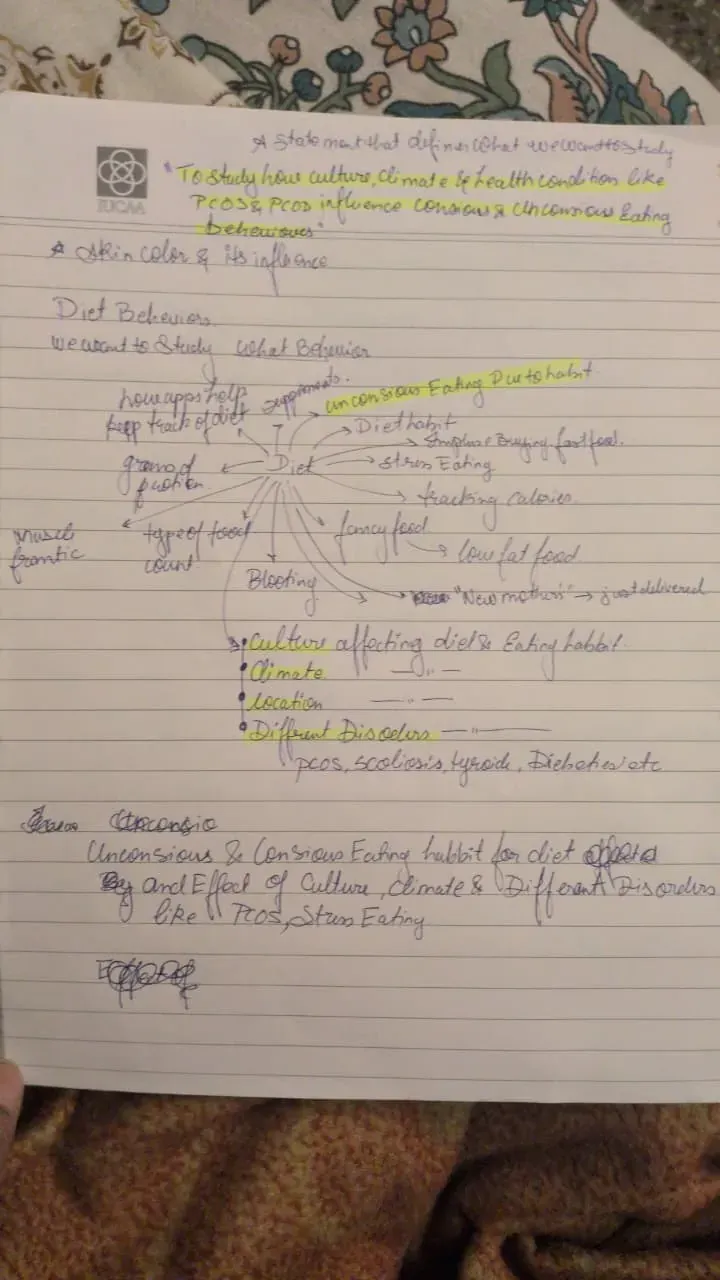
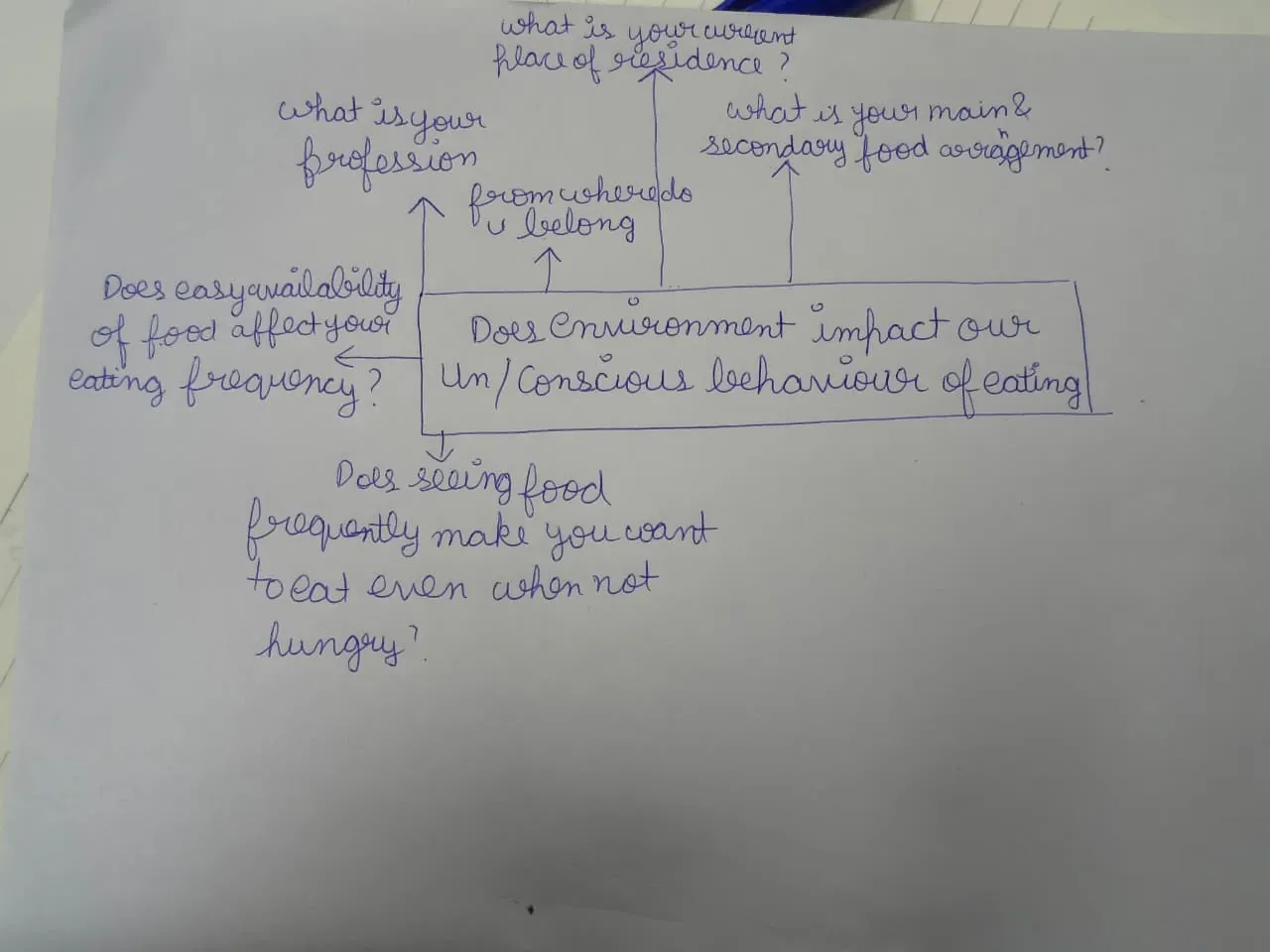
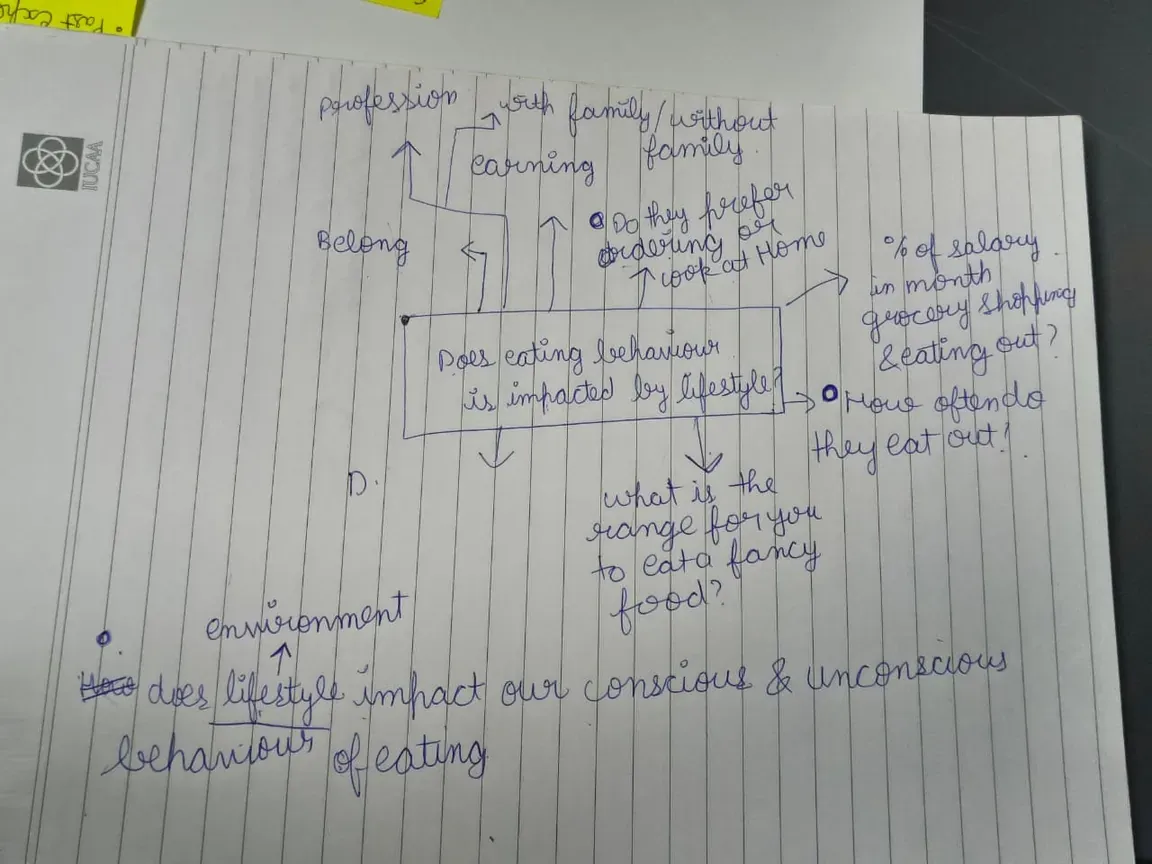
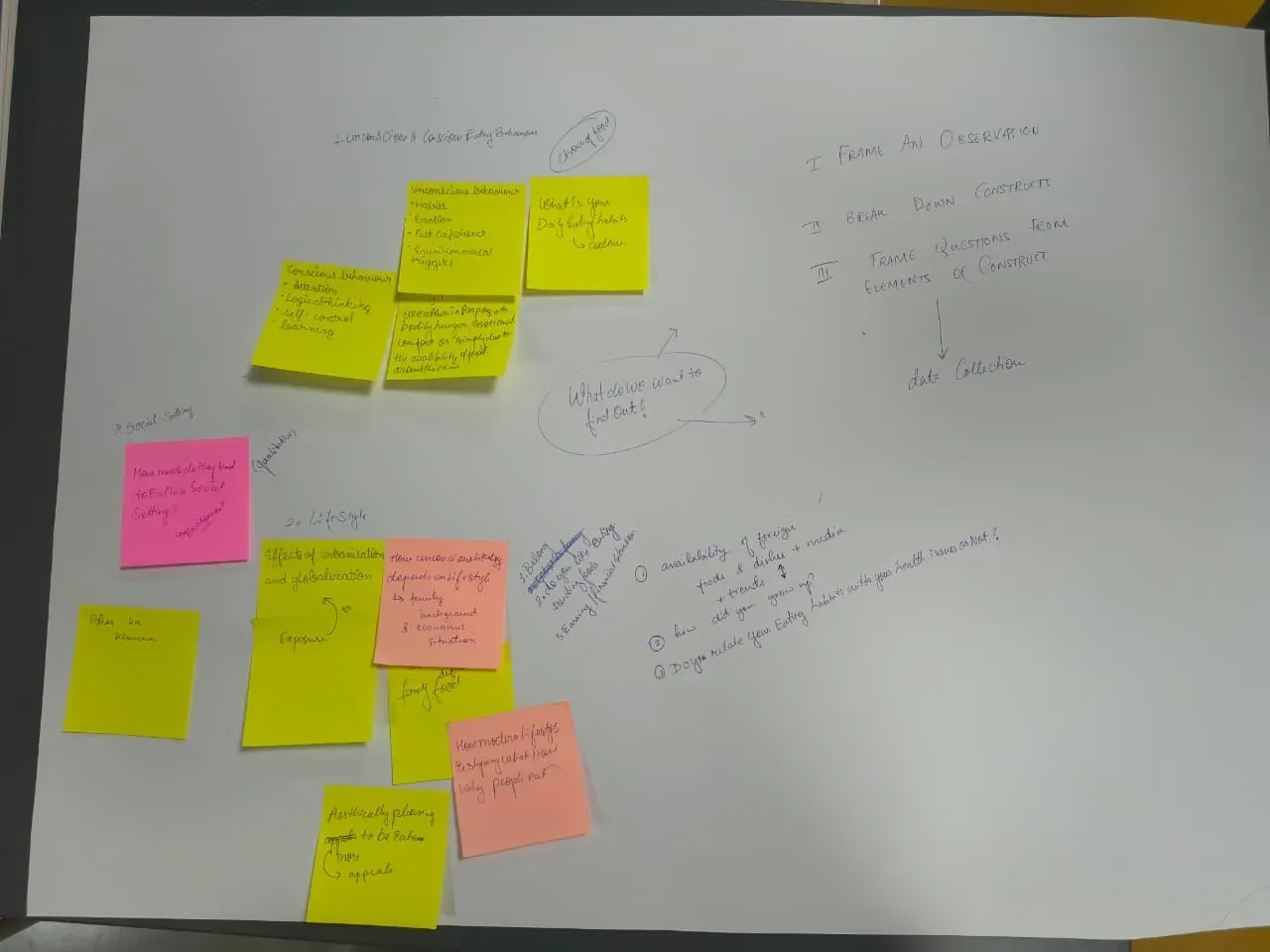
The team's own pages, January 2026.
Kept
Emotional eating
Emotions, unconscious habits, past experiences, triggers around us
Kept
Social eating
Who we eat with changes how much and what
Kept
Globalisation and lifestyle
Exposure, modern routines, visual appeal, access
Dropped
Fitness-concerned eating
Pulled the study toward nutrition and the gym
What we expected to find: eating shaped by five forces
Environment
- Availability
- Visibility
- Daily routine
Social influence
- Friends
- Peers
- Shared meals
Media exposure
- Food reels
- Advertising
- Delivery apps
Habits
- Repeated patterns
- Routine eating
Emotional state
- Conscious decisions
- Unconscious triggers
Three research questions, and what answered each
| Question | Survey | Interviews | Experiment |
|---|---|---|---|
| RQ1How do availability, visibility and routine shape eating for students and professionals aged 18 to 30? | Survey | Interviews | Experiment |
| RQ2How do people, media and mood push eating beyond physical hunger? | Survey | Interviews | Experiment |
| RQ3How does awareness sit between a cue in the environment and a habit? | Survey | Interviews | Experiment |
Methods
Four ways of asking,because people do not always do what they say.
01
113responses
Survey
How often it happens, across many people.
A decision
Asked what people do after seeing food content, not whether it influences them, so nobody had to admit to anything. Four experts reviewed it first: content validity 0.90.
02
19people
Interviews
Why people eat what they eat, in their own words.
A decision
Run in pairs, one asking and one taking notes, with a Marathi speaker in each pair so any interview could switch language.
03
10people
Experiment
What people do, not what they say they do.
A decision
Half watched food reels, half a neutral video, so any change could be put down to the reels and not to the room or the hour.
04
2groups
Focus groups
How people explain what they just did.
A decision
Run straight after the experiment, opening with one line to react to: “I consciously plan my meals, but my surroundings often decide what I eat.”
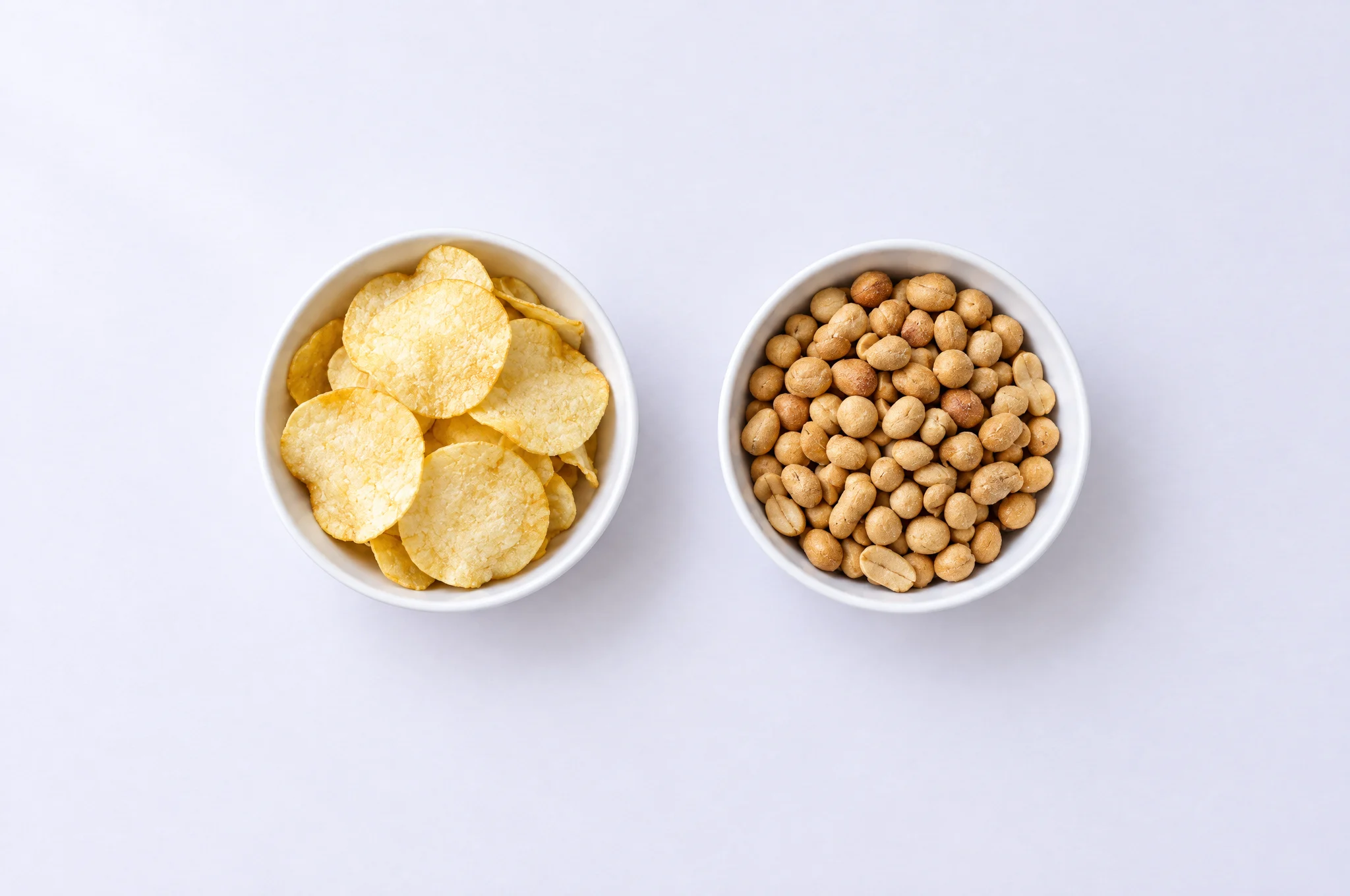
The experiment, step by step
Do food reels make people hungry when they were not?
- 1BeforeTime since the last meal, hunger, craving
- 25 minutesFood reels, or a calm video with no food in it
- 3Right afterHunger and craving again
- 4Two bowlsCrisps or peanuts, same size, same table
- 5TalkThe focus group
Each person was also tagged by how they usually eat: foodie, moody, diet conscious, health issue or neutral. Generated image of the setup.
What we found
Everyone said they were in control.What they did said otherwise.
said seeing food makes them want to eat, even when not hungry
Survey, 61 of 111 answers
felt tempted by food content and did nothing. Only 4 ordered.
Survey, reactions to food reels and posts
After food reels
After a neutral video
got hungrier after five minutes of food reels. After the calm video, nobody did.
Experiment, 10 people
eat what they usually eat, even when out with others
Survey, 80 of 107 answers. Peer pressure was weaker than we expected.
What people said
- “I plan my meals.”
- “I eat what I usually eat.”
- “I know what I should eat.”
What we saw
- Only one of five in the reels group agreed their surroundings decide. Then two of the five got hungrier.
- Focus groups explained choices after the fact: “taste and money” came first.
- “I know what I should eat, but it’s not available when I need it.”
The group report's own conclusion: the gap between what people say and what they do. Not everything we expected held up either. Social pressure barely registered.
The group study ended here.The analysis and the app are mine.
5 to 17 January
Group research
Topic, framing, survey, interviews, experiment, focus groups
17 to 23 January
My analysis
Cleaning, testing, coding, the question
After the course
The app
Secondary research, decisions, design, prototype
Research with Aanchal Pruthi, Asawari Sakharkar and Shrestha Sinha. Course mentor: Asst. Prof. Suvodeep Misra.
Cleaning and testing
Before trusting a number,I checked how it was made.
113 survey answers became 107 analysable rows. The step that mattered most was the last one: a single answer like “sweet food, fried food” had to become something that could be counted.
One answer, before
When stressed, I eat“Sweet food, Fried / junk food”
After, one column per food
- Sweet 1
- Junk 1
- Spicy 0
- Home 0
- Snacks 0
- Less 0
- 01Answers that did not apply marked NA, rows kept
- 02Cities standardised, grouped by state
- 03Meals turned into a number, snacking into yes or no
- 04Unnamed health conditions grouped as unidentified
- 05Spelling and format variants made consistent
- 06Each mood answer split into one yes or no column per food
What people reach for, by mood
107 people, more than one answer allowed. Circle area is the count.
| Food | Stressed | Sad or low | Happy | Bored | Relaxed |
|---|---|---|---|---|---|
| Sweet food | 28 | 36 | 36 | 12 | 24 |
| Home cooked | 13 | 15 | 26 | 16 | 45 |
| Fried or junk | 18 | 17 | 13 | 27 | 7 |
| Spicy food | 14 | 12 | 25 | 21 | 13 |
| Do not eat much | 24 | 21 | 3 | 4 | 11 |
| Snacks | 8 | 5 | 3 | 18 | 4 |
| Sour or tangy | 2 | 1 | 1 | 9 | 3 |
36of 107 reach for sweets when sad. Sweet food is the top answer in three of the five moods.
24barely eat when stressed. Emotion moves eating in both directions.
Two results looked too strong to be true. They were.
When I re-ran the tests for this case study, two of the headline chi-square results turned out to be artefacts. Each crossed a mood answer with a column built from that same answer, so a perfect score was guaranteed.
- Stress and sweet foodχ² = 107.0, V = 1.00Dropped
- Sadness and sweet foodχ² = 107.0, V = 1.00Dropped
- Sweet food across five moods, same peopleCochran’s Q = 23.48, p = 0.0001Holds
- Health conscious people and junk food under stressχ² = 8.34, p = 0.08Not significant
What survives is modest and honest: sweet choice really does change with mood. Stress alone against relaxed showed no difference (McNemar p = 0.60), so this page never claims stress makes people eat sugar.
Thematic analysis
208 quotes, each coded three times over.One theme came back more than any other.
Ten interview transcripts, read line by line. Every quote went from what was said, to a short code, to a pattern, to a theme.
Quote
“Stress influences my eating. 100%.”
Open code
Stress affects eating
Axial code
Stress and food relationship
Theme
Emotional influence on eating
Where it all pointed
- 20vs 11
quotes: emotion, nearly twice any other interview theme
- p = 0.0001
sweet choices change with mood, within the same people
- 24
of 107 barely eat when stressed: emotion moves eating both ways
Emotional eating.
My first question, from the analysisHow might we design alternatives to emotional eating that provide immediate comfort without increasing guilt or cognitive effort?
What I took from it
Five things the data kept saying.Every decision later on points back to one.
- 01
Eating follows emotion, not just routine.
Emotion was the most frequent interview theme, 20 quotes against 11 for the next. Sweet choices changed with mood within the same 107 people (Cochran's Q, p = 0.0001).
- 02
Knowing does not mean stopping.
People said they plan and know better, then reached anyway. A marathon runner described eating two or three vada pav a day. “I know what I should eat, but it's not available when I need it.”
- 03
Emotion moves eating both ways.
Under stress, 28 of 107 reach for sweets and 24 barely eat. Some interviewees binge when sad, others skip meals until they feel dizzy.
- 04
The pull is common. Acting on it is not.
37 of 105 felt tempted by food content and did nothing; 4 ordered. A gap between the urge and the action already exists. It is just not made use of.
- 05
When people act, it is on a delivery app.
63 of 107 named online delivery apps as where they buy after being influenced, far ahead of street food (17) or cooking it themselves (12).
What studies already knew
My data said when people eat emotionally.Published research said how the moment works.
Stress switches on autopilot.
SoAsk for no decisions in the moment.
Schwabe and Wolf, 2009
Stress pulls toward sugar and fat.
SoThe moment is predictable. Arrive early.
Adam and Epel, 2007
An urge rises, peaks and passes.
SoA short pause can be enough.
Bowen and Marlatt, 2009
A plan made in advance beats willpower.
SoHave the response ready before it is needed.
Gollwitzer and Sheeran, 2006
Stress takes the thinking brain offline.
SoOne tap. No typing, nothing long to read.
Arnsten, 2009
Emotions change eating in more than one way.
SoAsk what the person feels, not what they ate.
Macht, 2008
Automatic. Predictable. Temporary.So it can be interrupted.
What already exists
Other apps ask for effort, or fight the food.None meets the feeling, in the moment.
I sorted the apps I tried by two questions: does it work on the food or the feeling, and does it step in after, or in the moment? Nothing I found reached the top right.
AfterWhen it steps inIn the moment
Blockers and diet rules
“Don’t eat that.”
Fights the food, not the feeling
Nobody here
Meets the feeling, at the moment it happens, without asking for effort
Food and calorie logs
“Log every meal.”
Too much effort, and after the fact
Streaks and rewards
“Come back tomorrow.”
A new habit to feed
Mood journals
“Write down how you feel.”
Too much effort, and after the fact
The foodWhat it works onThe feeling
Who this is for
Emotion moves eating both ways.This design is for the people it moves toward food.
Three patterns came up across the interviews. They are behaviours, not personas, and one person can move between them.
Eats more when they feel something
“When I’m stressed or sad, I end up binge eating, especially sweets.”
Knows, and still reaches
“Even when I’m not hungry, if I don’t feel good, I end up eating something.”
Primary userStops eating when they feel something
“My eating changes with emotions, sometimes I eat a lot, and sometimes I don’t feel like eating at all.”
Problem statement
Even when we are not hungry, we still reach for food, not because we need it, but because we feel something. And even when we recognise it, it is hard to stop in the moment.
The first question
How might we design alternatives to emotional eating that provide immediate comfort without increasing guilt or cognitive effort?
Asked what to offer instead of food. The research kept pointing to when: the pull is common and acting on it is not (insight 04), and an urge passes on its own (S3).
The question I designed for
How might we create a moment between urge and action to enable a more conscious response?
What a solution has to do
Before any screen, six rules.Each one traced back to the evidence.
- 01
Proactive, not reactive
Step in before or at the urge, not after the meal.
FromInsight 04, S2
- 02
Reduce cognitive effort
One tap. Nothing to type, nothing long to read.
FromS5
- 03
Focus on emotion, not action
Ask what the person feels, not what they ate.
FromInsight 01, S6
- 04
Support, not restrict
Never block. Offer a pause and let the person choose.
FromInsight 02, what already exists
- 05
Even a small pause matters
Seconds, not minutes. Timing over complexity.
FromS3
- 06
Solve, don’t hook
No streaks, points or badges. The app is not the new habit.
FromWhat already exists
Ideation
Three answers looked obvious.None of them survives a craving.
- 01
Track what people eat
A log asks for effort at the exact moment there is none (S5), and it only ever arrives after the meal.
Fails rule 02
- 02
Block the delivery app
Treats the food as the problem when the data says it is the feeling (insight 01), and turns a moment of care into a fight.
Fails rule 04
- 03
Reward a streak of good days
Swaps one habit for another. People would come back for the streak, not because it helped.
Fails rule 06
The turn
An urge has a shape.It builds, peaks quickly, and passes.
So the question stopped being what to offer instead of food, and became when to step in, and how lightly. Each part of the curve asks for something different.
Before the urge
It builds
It may feel sudden, but it often follows a pattern. Predictable enough to check in first.
Awareness · Patterns · Nudges
During the urge
It peaks
Fast and automatic, with no room to think. One tap, a short pause, a choice.
Pause · Check · Respond
After the urge
It passes
Quietly, often unnoticed. A look back, without judging, so patterns become clear.
Reflect · Learn · Notice
Cognitive load
Designed for a mindwith no room left.
Even mild stress takes the thinking brain offline (S5). So the design asks for almost nothing, at the exact moment most apps ask for the most.
| Most apps ask | This design asks |
|---|---|
| Open the app | Nothing. It comes to you |
| Type how you feel | Tap one of seven |
| Log what you ate | Nothing to log |
| Read the advice | One line |
| Decide what to do | The response is ready |
| Minutes of practice | 15 seconds |
Left out on purpose
- Streaks
- Points
- Badges
- Daily goals
- Leaderboards
- Come back nudges
Kept
- 6 paused this week
- 3 chose not to eat
A mirror, not a scoreboard.
Hooked on the app instead of the food is not a fix.
The harsh decision
No one opens an app mid craving.So it has to come to them.
That means asking for a lot of access, from someone who may already feel judged about eating. The rule: every permission has to earn its place, and all four start switched off.
| Permission | When | What it costs the person | Why it earns its place |
|---|---|---|---|
| Floating pause button | During | Always on screen | One tap at the urge, from anywhere, with nothing to open (S5). |
| App overlay | During | Can appear over other apps | Meets the moment where it happens: the delivery app (insight 05). |
| Lock-screen reminders | Before | Shows up uninvited | The urge often follows a pattern, so a check-in can come first (S2). |
| Notifications | BeforeAfter | Another ping | A check-in at the usual hour, and a quiet look back after. |
Introducing
Creates a gap between the urge and the action, giving people a moment to respond more consciously.
The dot at the top of this page was the moment. This is what sits in it.
Before the urge
Awareness · Patterns · Nudges
Learns when urges tend to come, and checks in gently before the moment begins.
During the urge
Pause · Check · Respond
A short pause, a check on hunger and feeling, and a response that fits.
After the urge
Reflect · Learn · Notice
A look back without judging, so patterns become clear without tracking.
User flow
Three ways into the same moment,and a different response for each feeling.
Before, during and after map onto one path. Dashed boxes are gaps I left open in this prototype, said here rather than hidden.
On a phone, slide sideways to see the whole flow.
01 · Before the urge
Setup names the feelingbefore it names the app.
Onboarding, the permissions, and the check-in that arrives before the moment does.
The order follows the research.
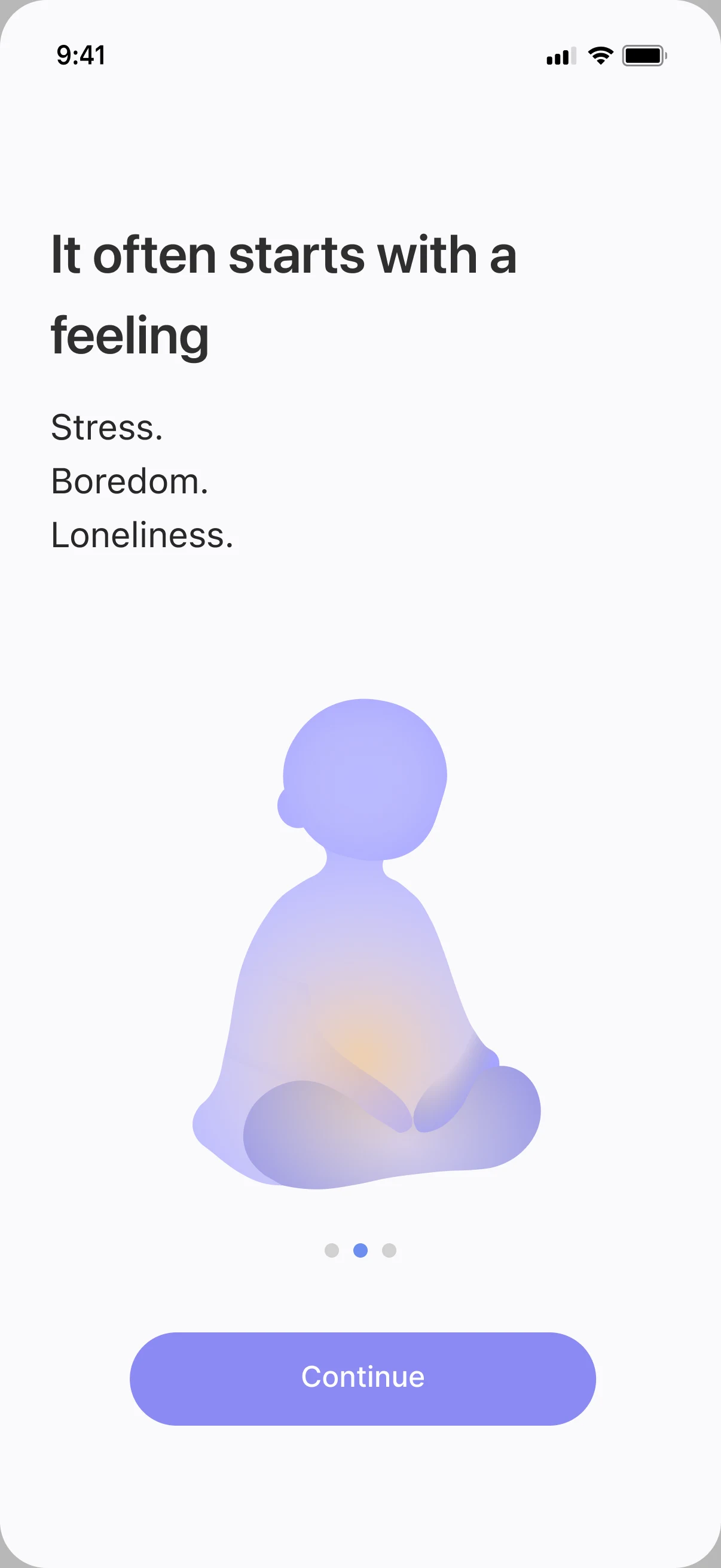
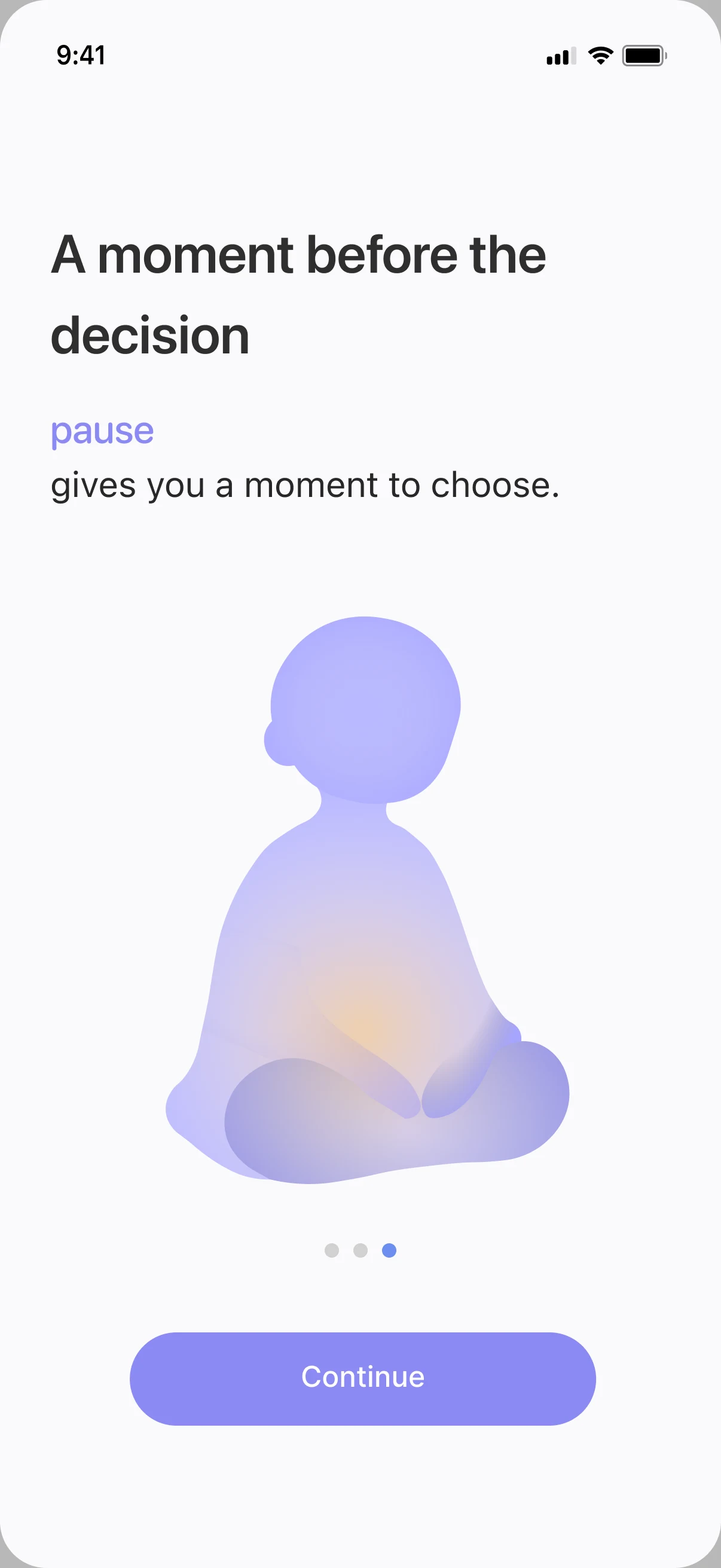
Three cards walk through what the study found, in the order it found it: we eat when we feel something, it often starts with a feeling, and there is a moment before the decision. The app's name appears only on the third.
Nothing to fill in.
No goals, no weight, no food preferences. Get Started, three cards, permissions, done. The first real interaction is the pause itself.
WHYKnowing does not mean stopping (insight 02), so the app explains the moment instead of asking for a target.
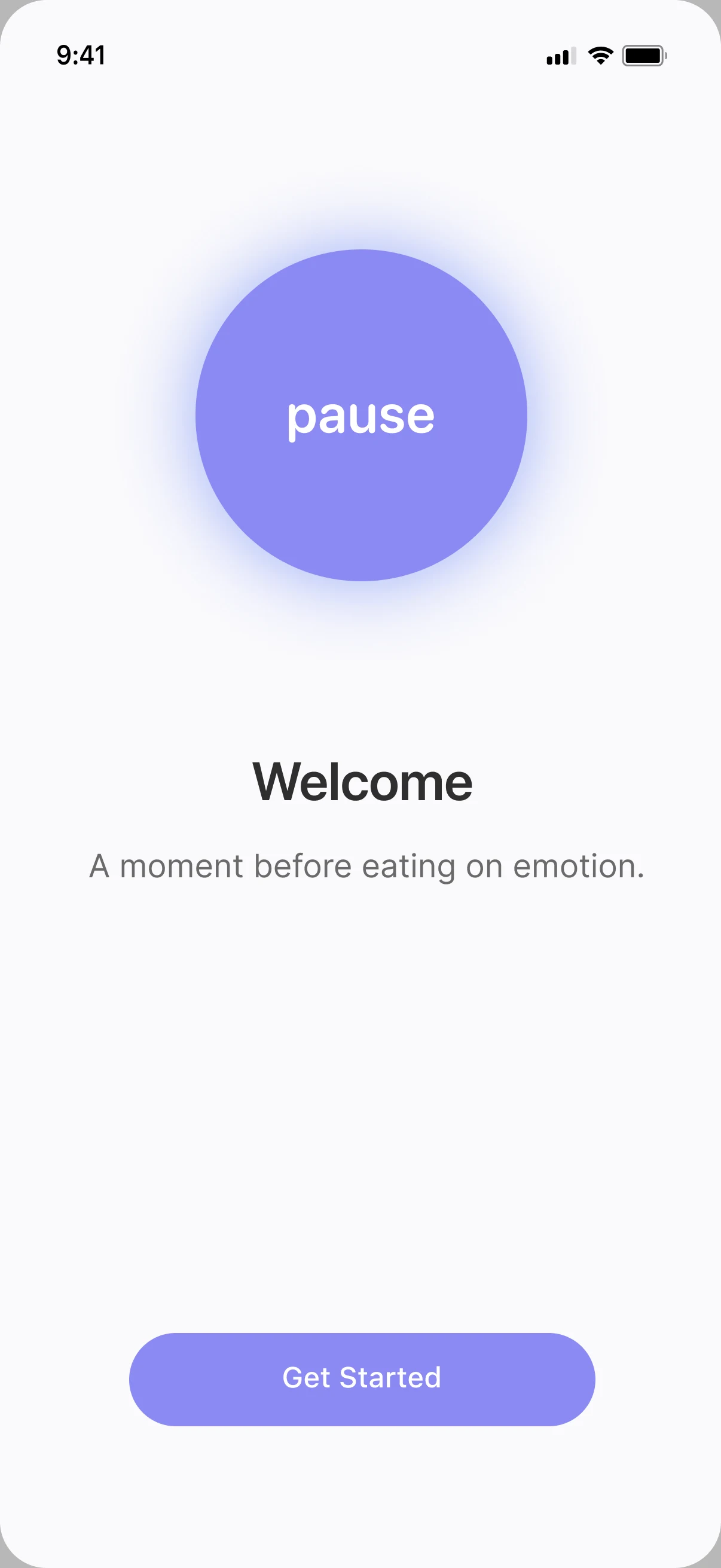
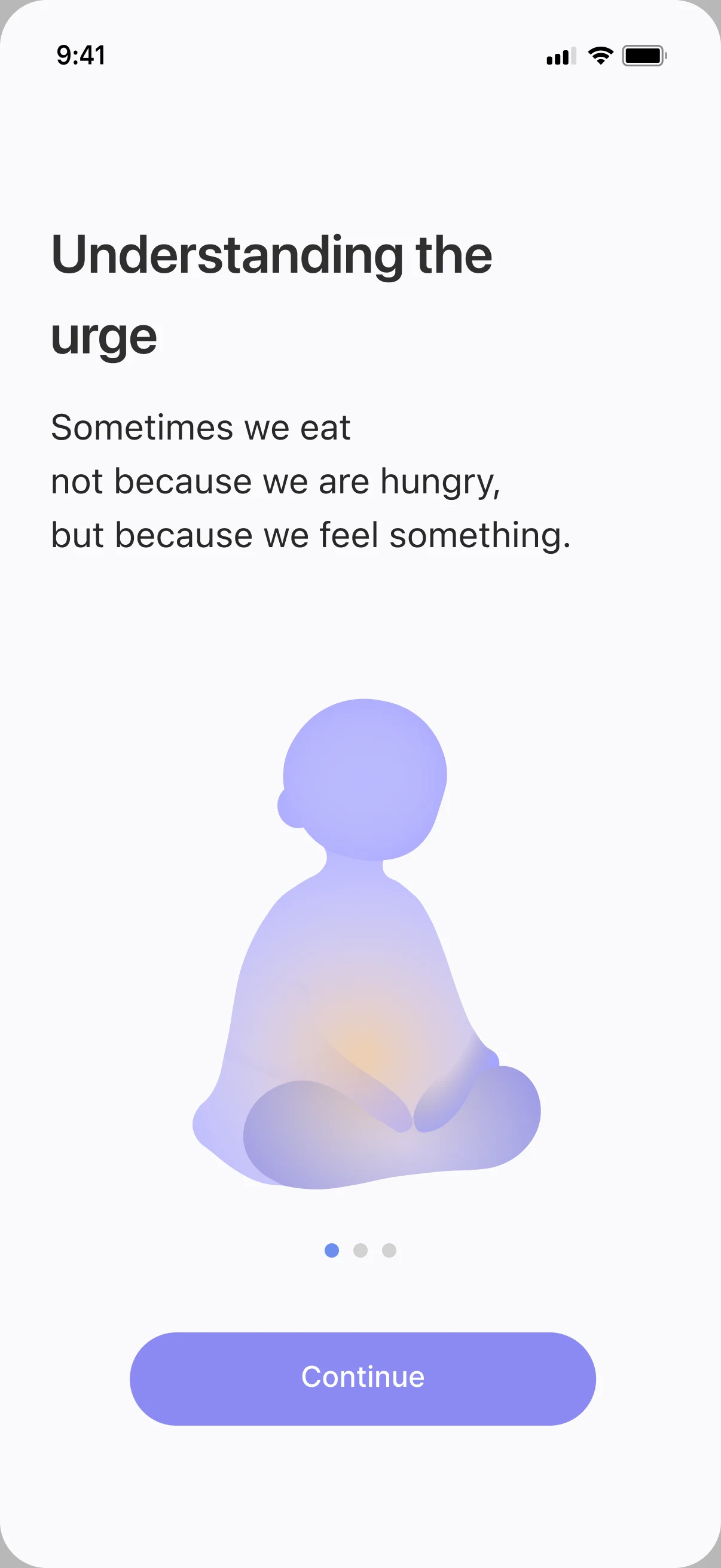
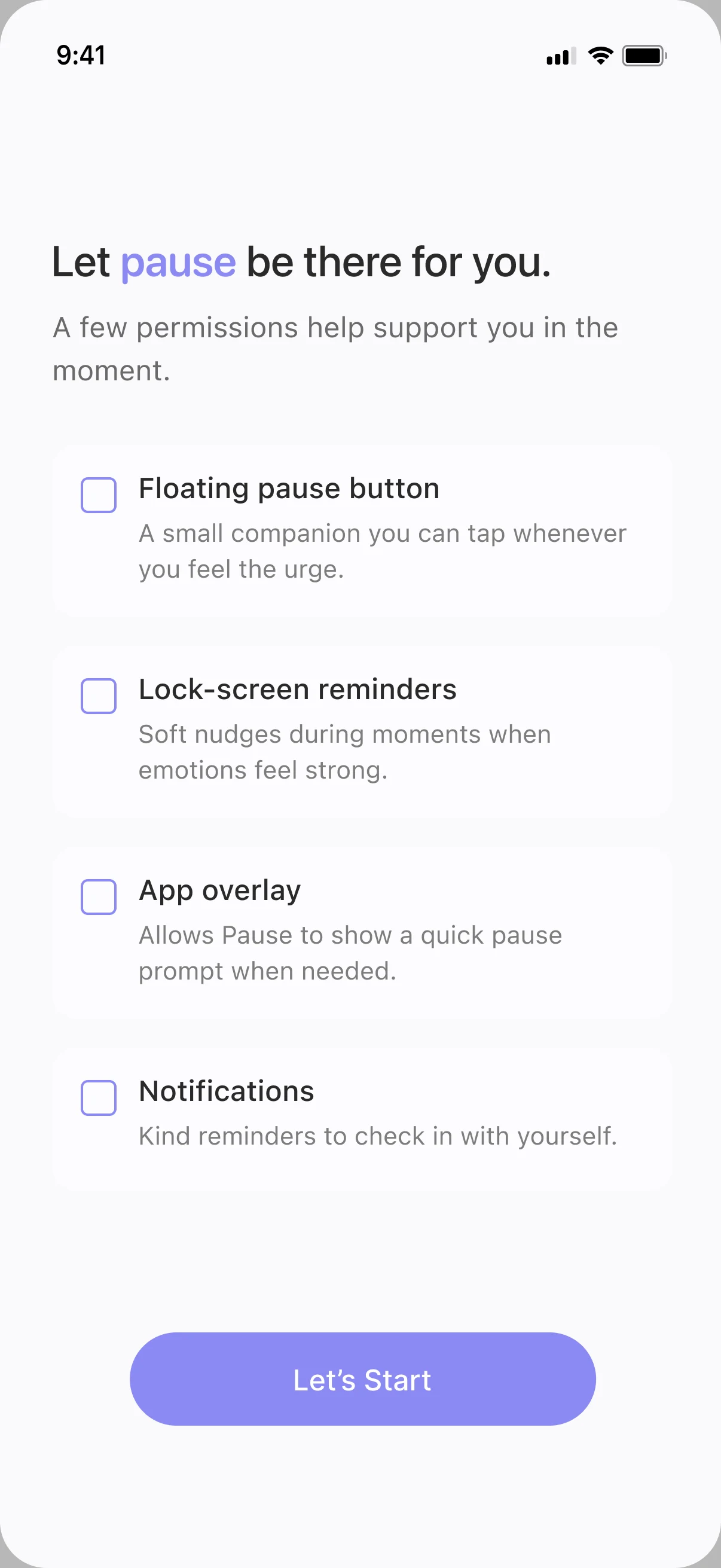
Four permissions, one line each, all unticked.
The screen says what each one does in the person's terms: a small companion you can tap whenever you feel the urge, soft nudges when emotions feel strong.
WHYThe harsh decision: the app has to reach people mid craving, so every permission must earn its place.
A check-in before the usual hour.
Once patterns exist, a lock-screen note arrives around the time the urge usually shows up. The floating orb stays on the home screen, one tap away.
WHYProactive, not reactive (rule 01). An urge often follows a pattern (S2).
Sunday, March 10
9:41
pause15m ago
You tend to feel like eating around this time. Just a gentle check-in.
02 · During the urge
It does not block.It asks, and waits.
The part of the curve with no room to think. Every screen here is one decision at most.
The moment is met where it happens.
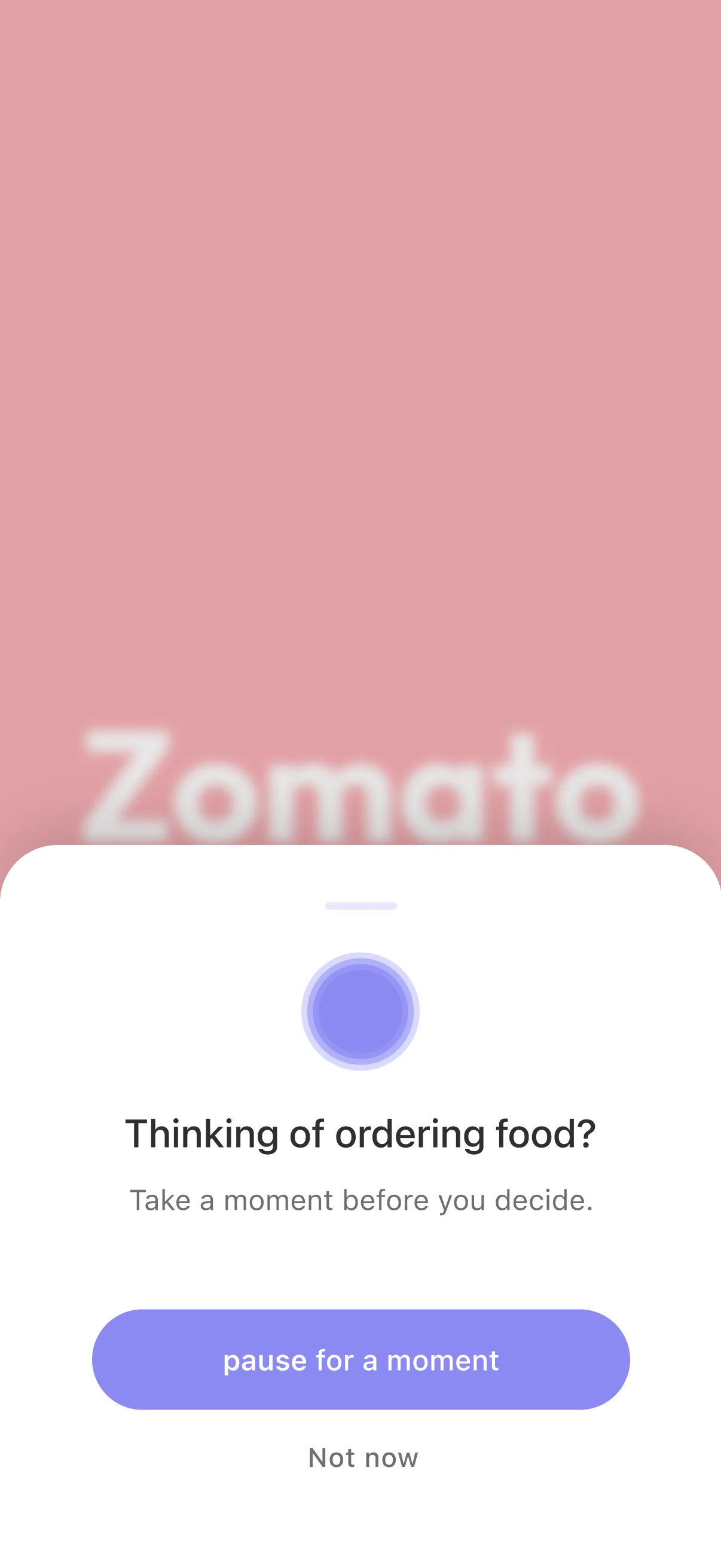
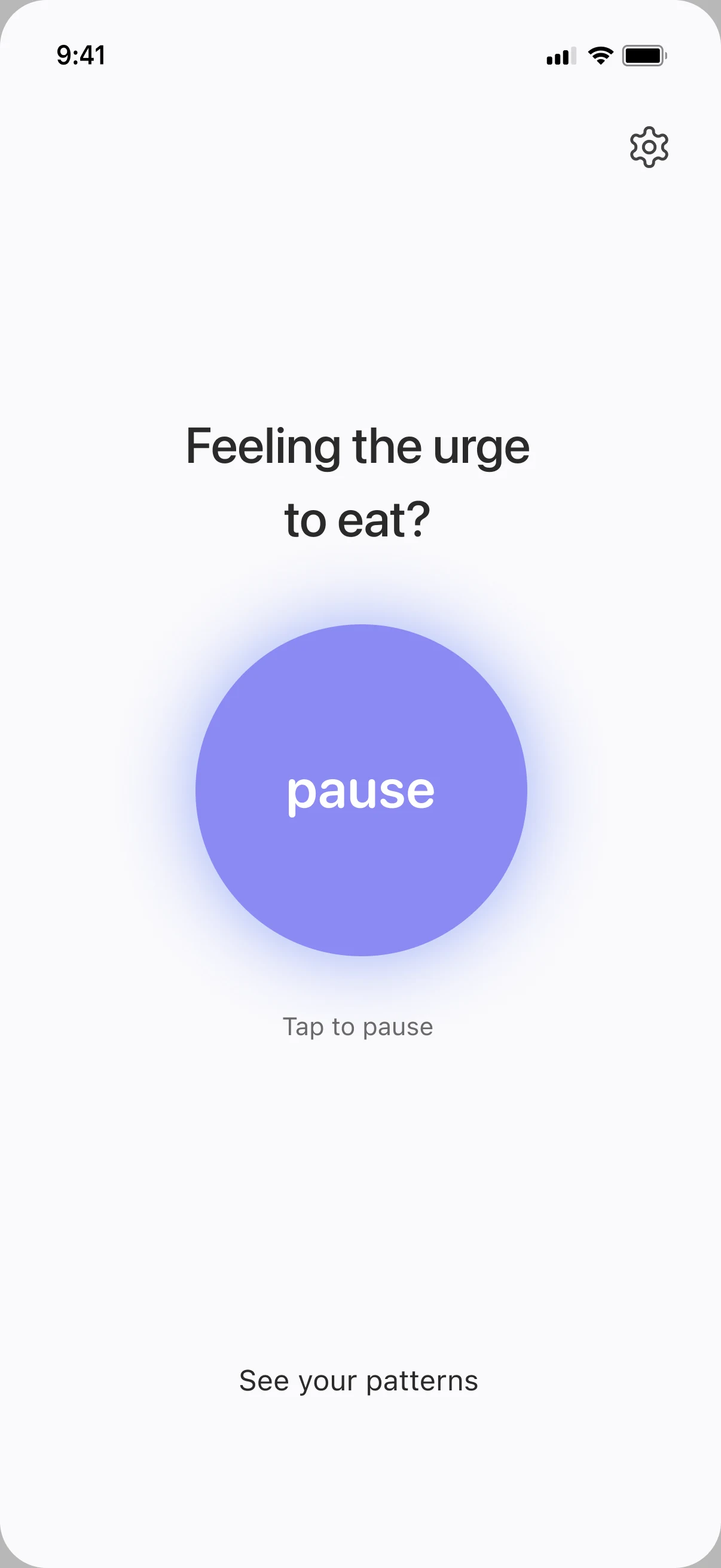
Opening a delivery app brings up a sheet over it: Thinking of ordering food? Take a moment before you decide. Not now is always there. Tapping the floating orb anywhere starts the same moment.
WHYWhen people act on the pull, it is on a delivery app (insight 05). Support, not restrict (rule 04).
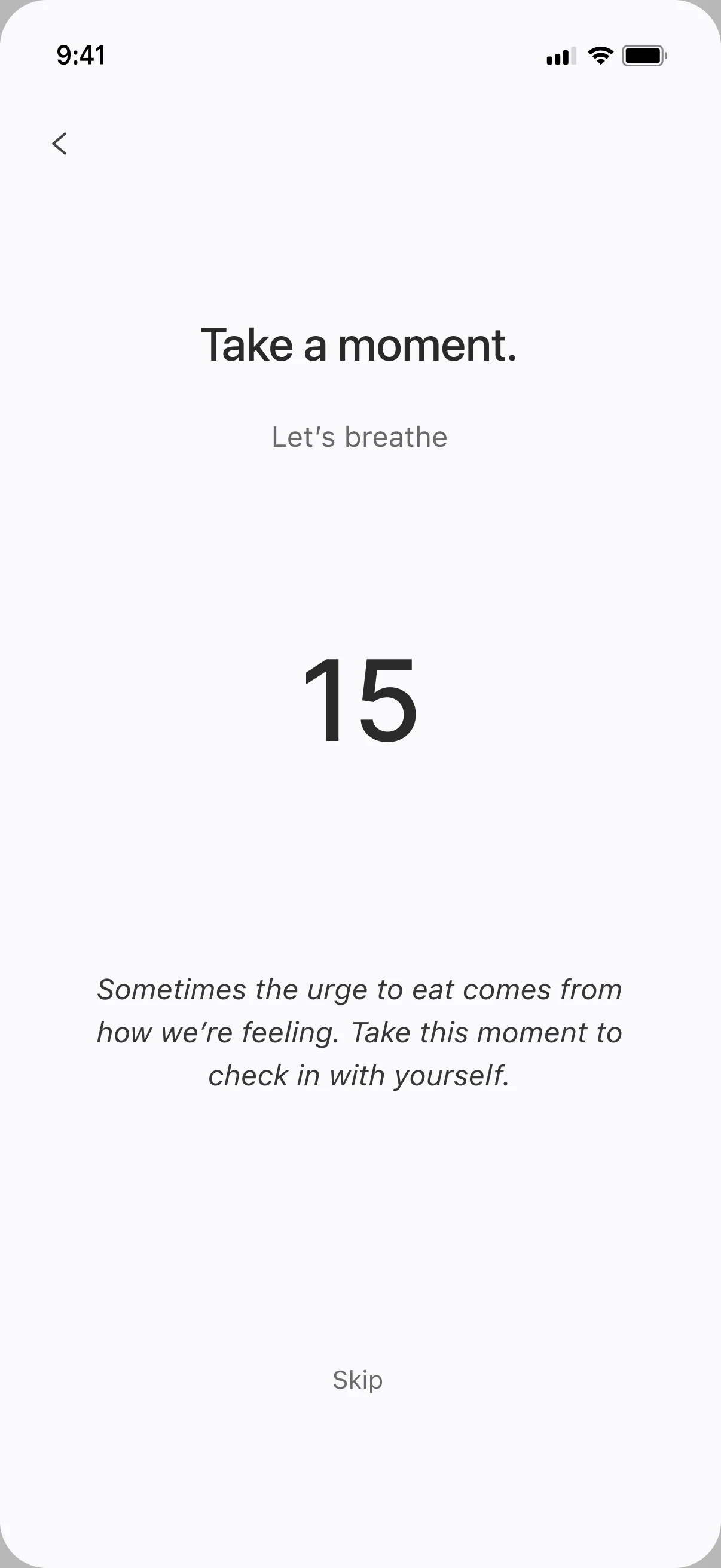
Fifteen seconds, then a choice.
A countdown and one line: sometimes the urge to eat comes from how we are feeling. Skip stays visible the whole time.
WHYAn urge rises and passes (S3). Seconds, not minutes (rule 05).
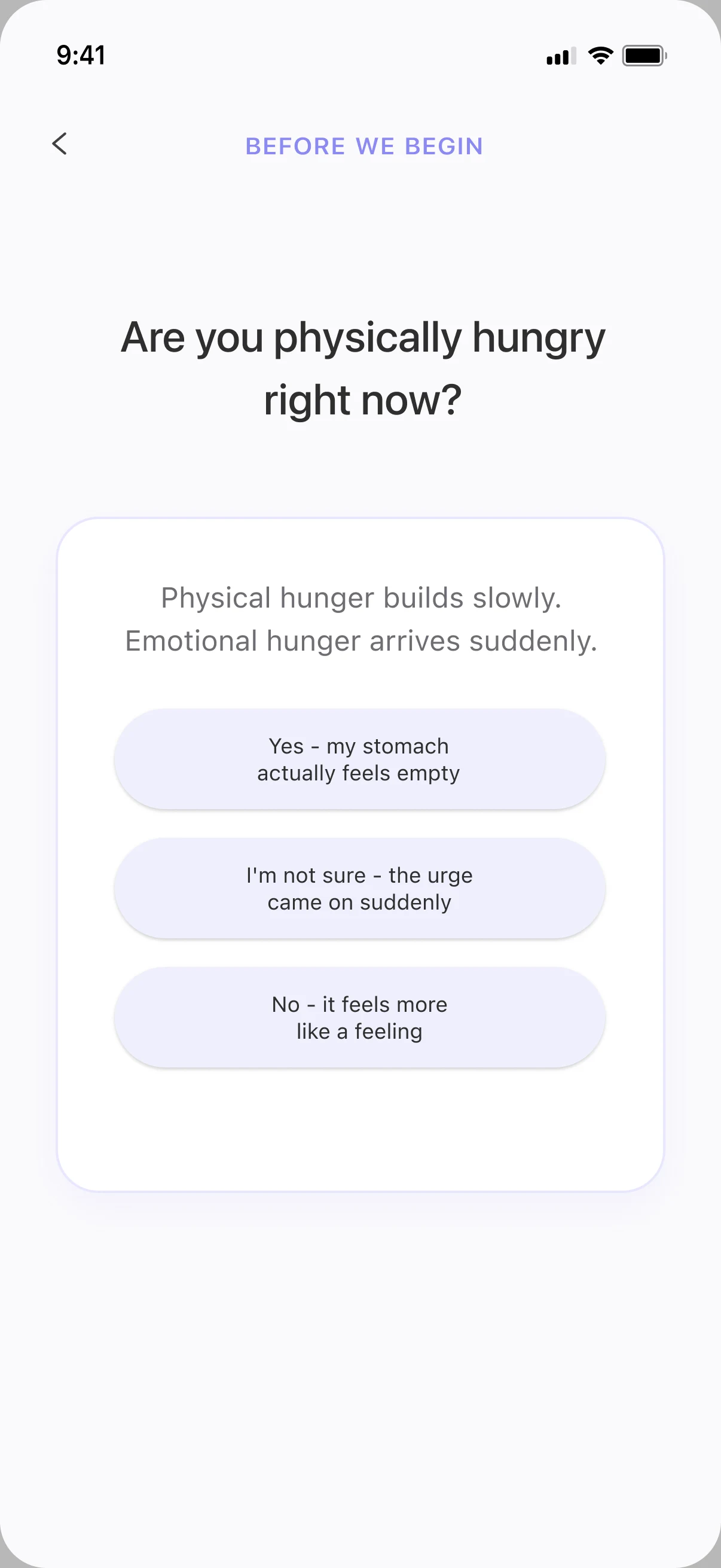
First: is it hunger?
Physical hunger builds slowly. Emotional hunger arrives suddenly. Three answers in the person's own words, not a scale from one to ten.
WHYNot every urge is emotional. Checking first keeps the app honest and avoids assuming.
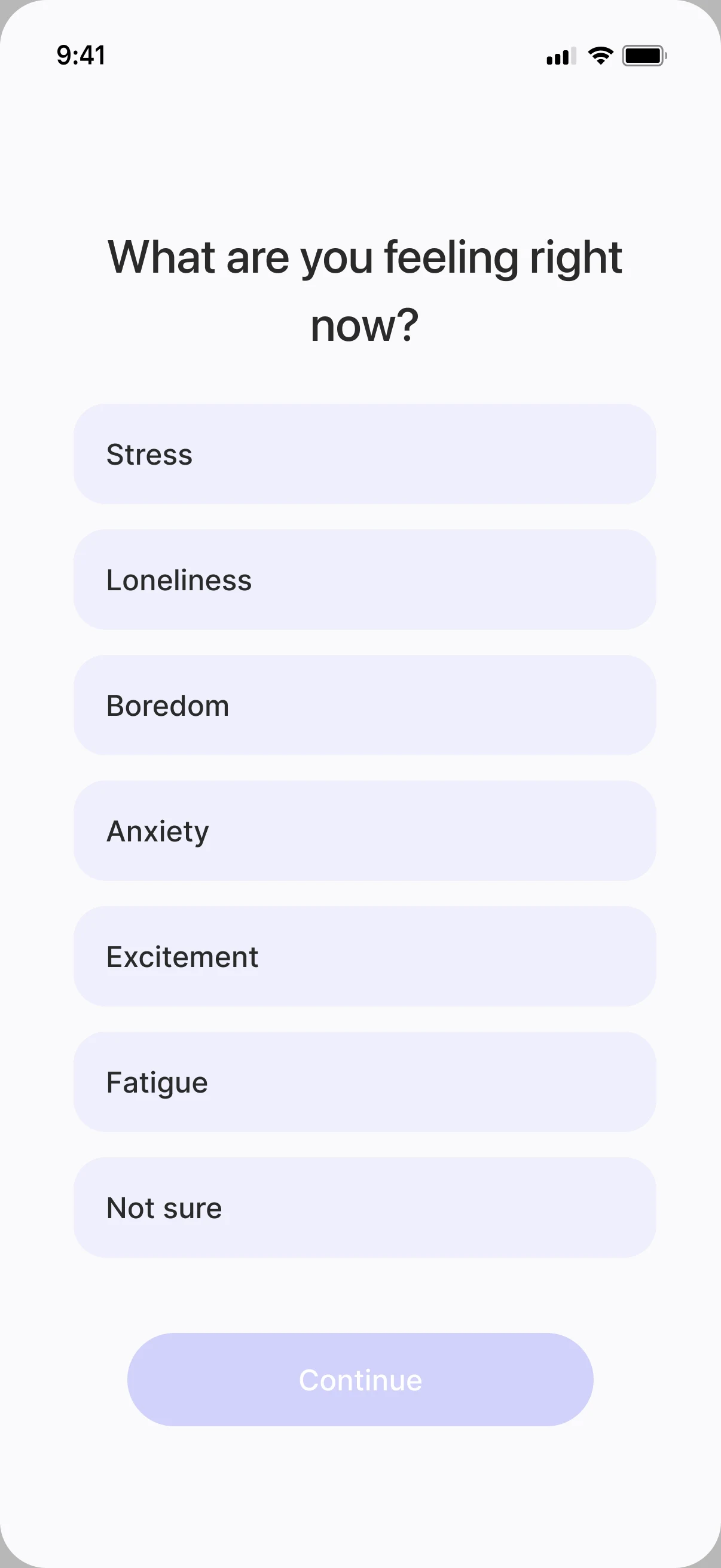
Then one tap, from seven feelings.
Stress, loneliness, boredom, anxiety, excitement, fatigue, not sure. Recognising is easier than describing.
WHYStress takes the thinking brain offline (S5). Ask what the person feels, not what they ate (S6).
Same urge, different need.
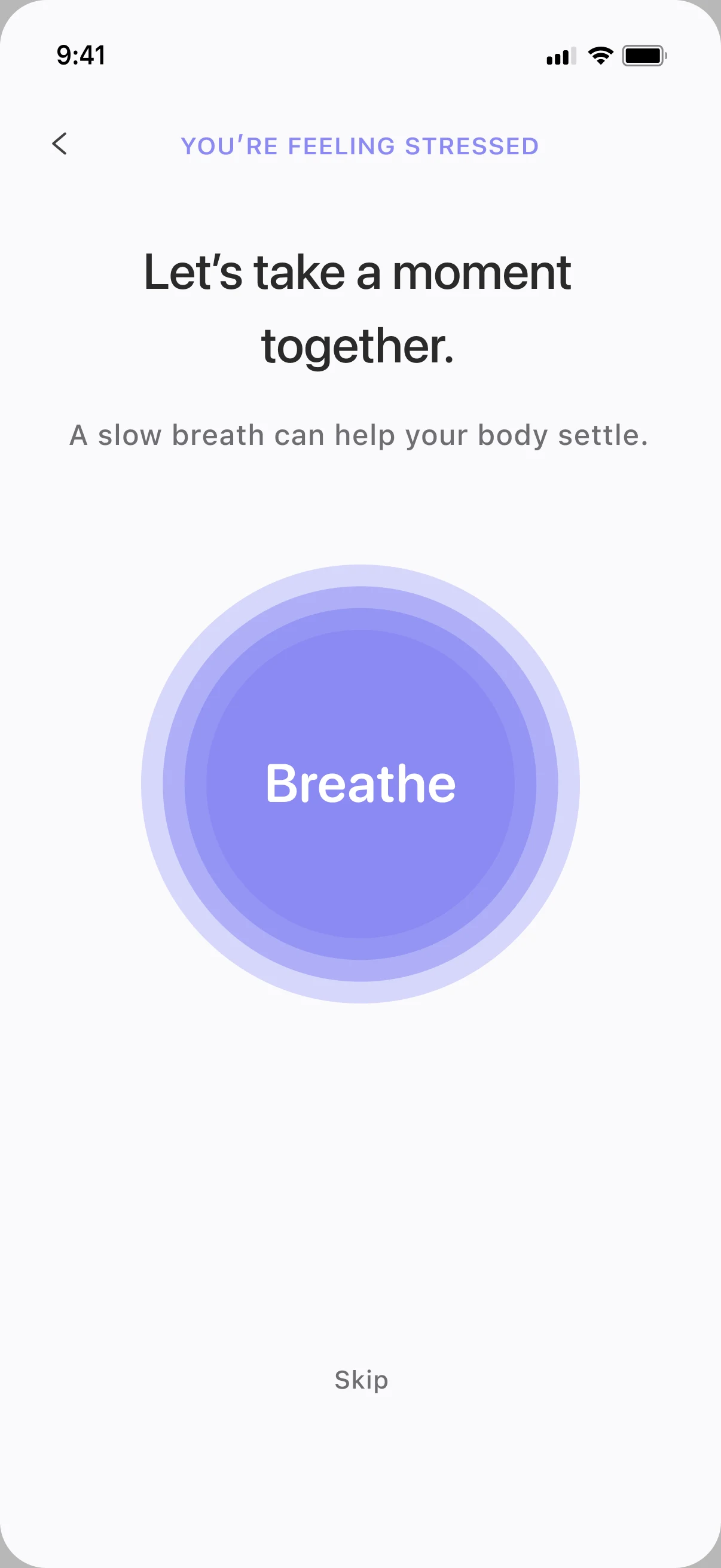
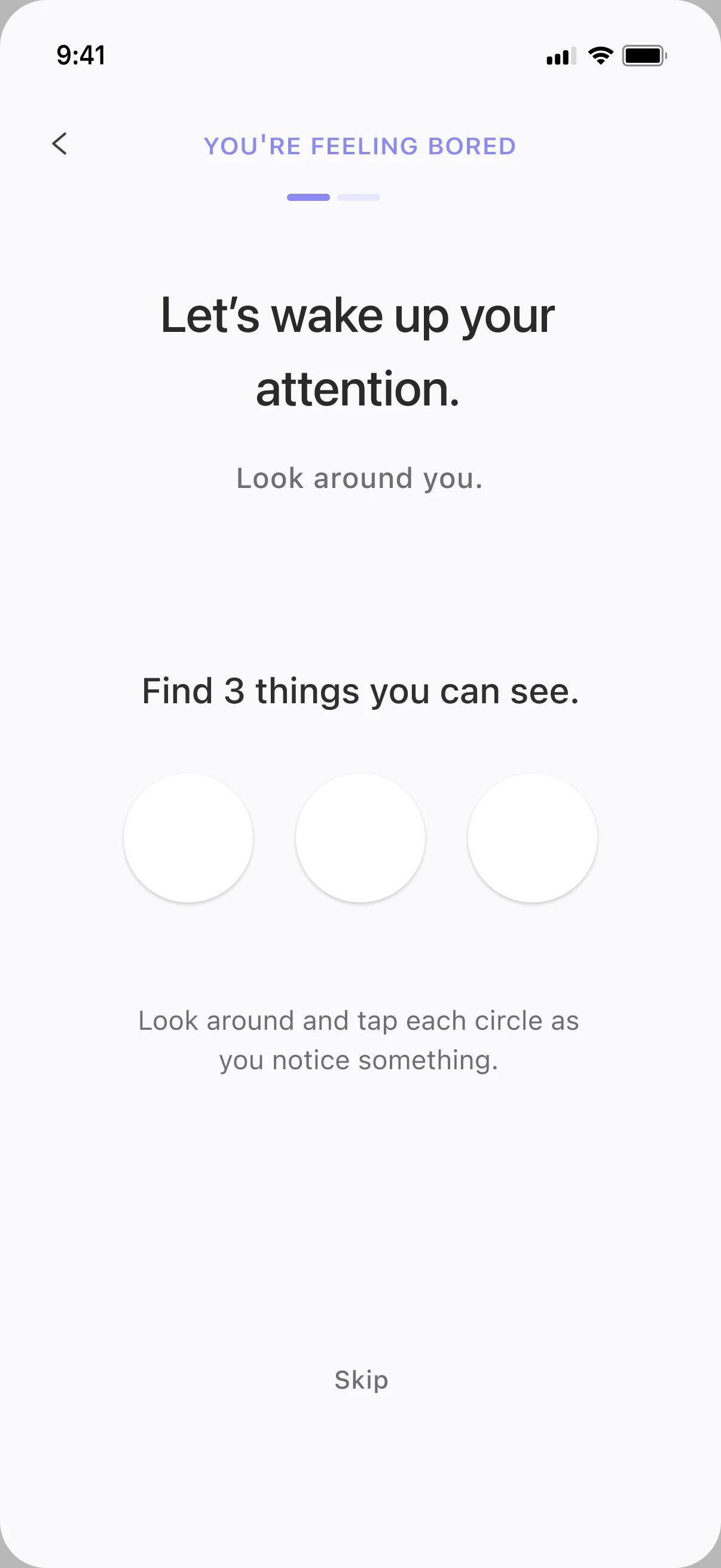
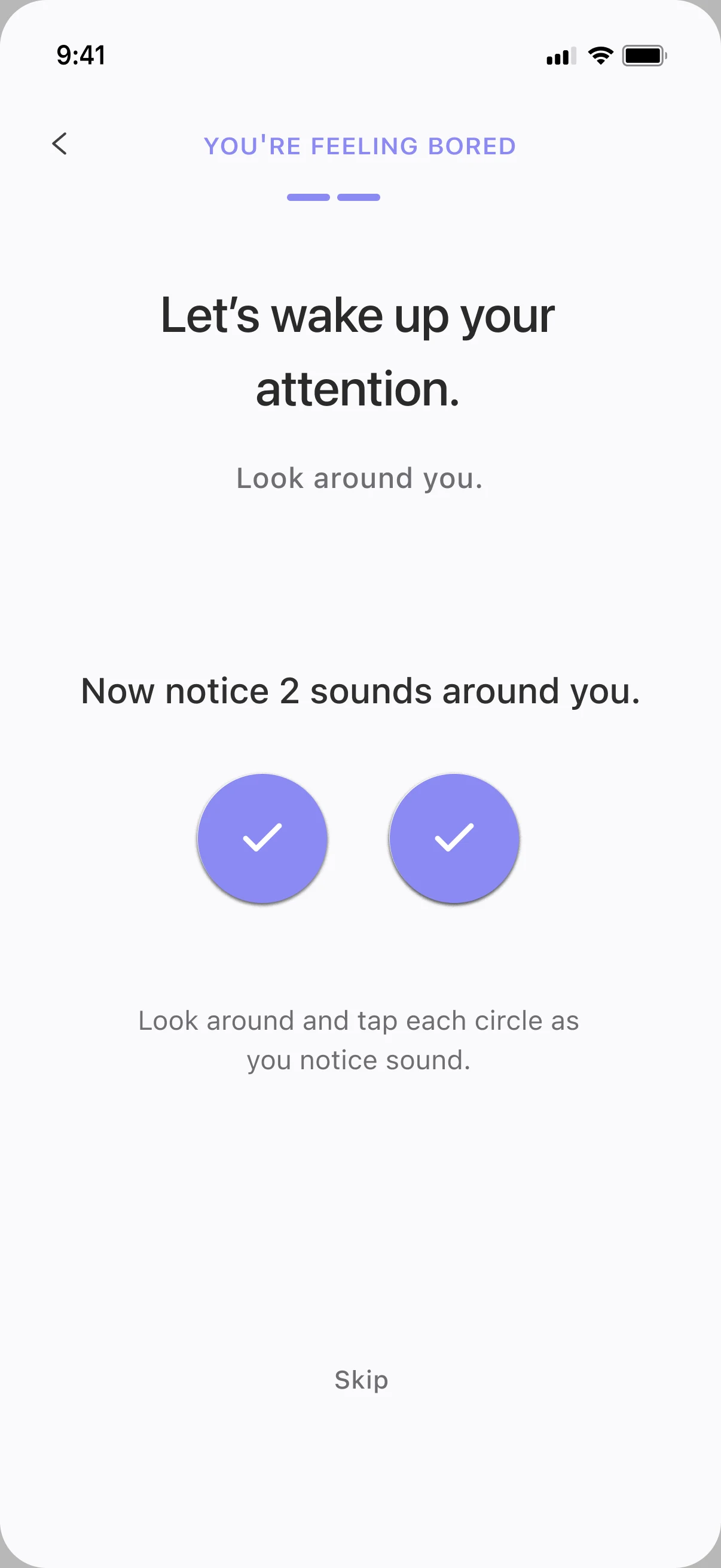
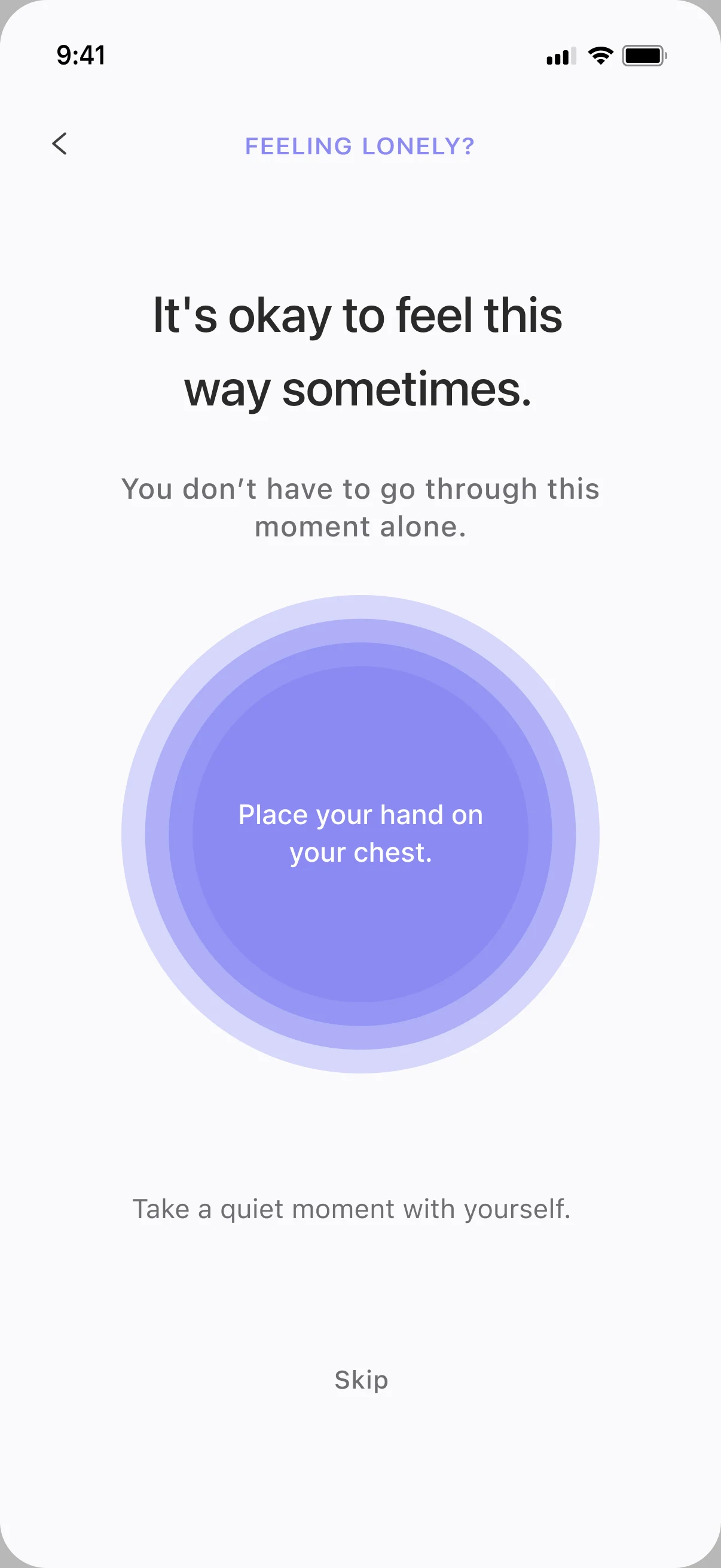
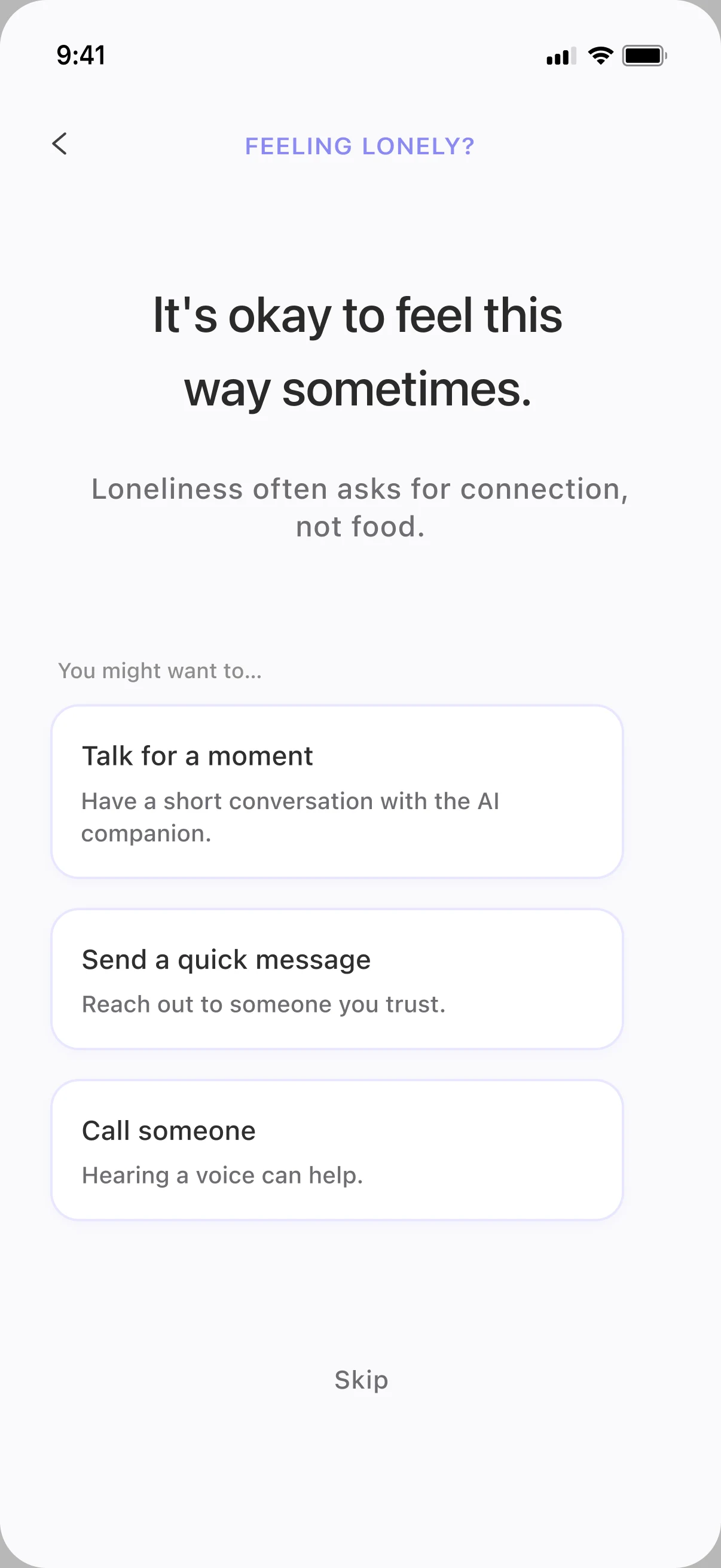
Stress gets a slow breath with the orb. Boredom gets a grounding game: tap a circle for each of three things you can see, then two sounds you can hear. Loneliness gets a hand on the chest, then a way to reach someone.
Short and sensory, never a lecture.
Each response is a few seconds of doing something with the body or the senses. Loneliness ends with three doors out: talk for a moment, send a message, call someone.
WHYEmotions change eating in different ways (S6). Stress needs to settle, boredom needs stimulation, loneliness asks for connection, not food.
03 · After the urge
Understanding,not judging.
The curve comes down on its own. This part makes sure the person notices that it did.
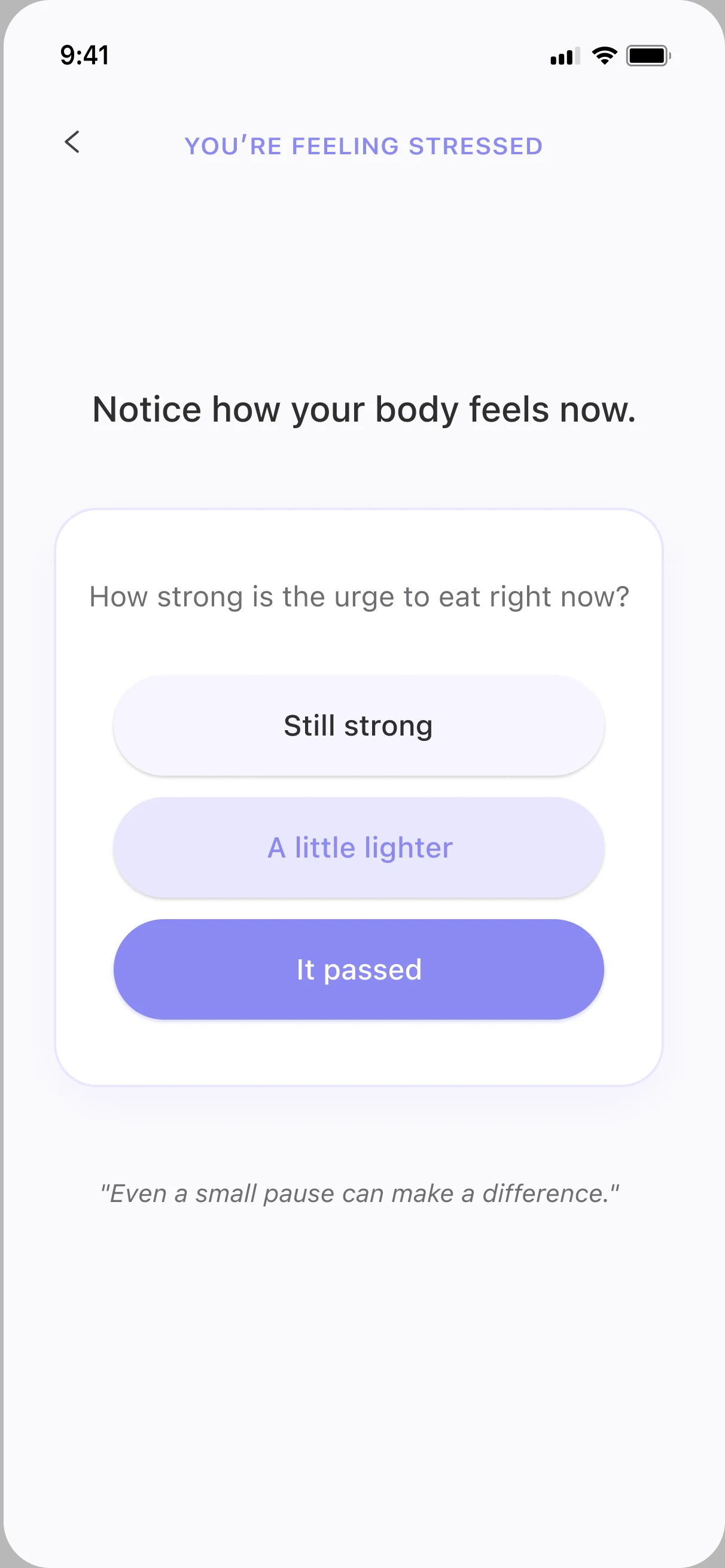
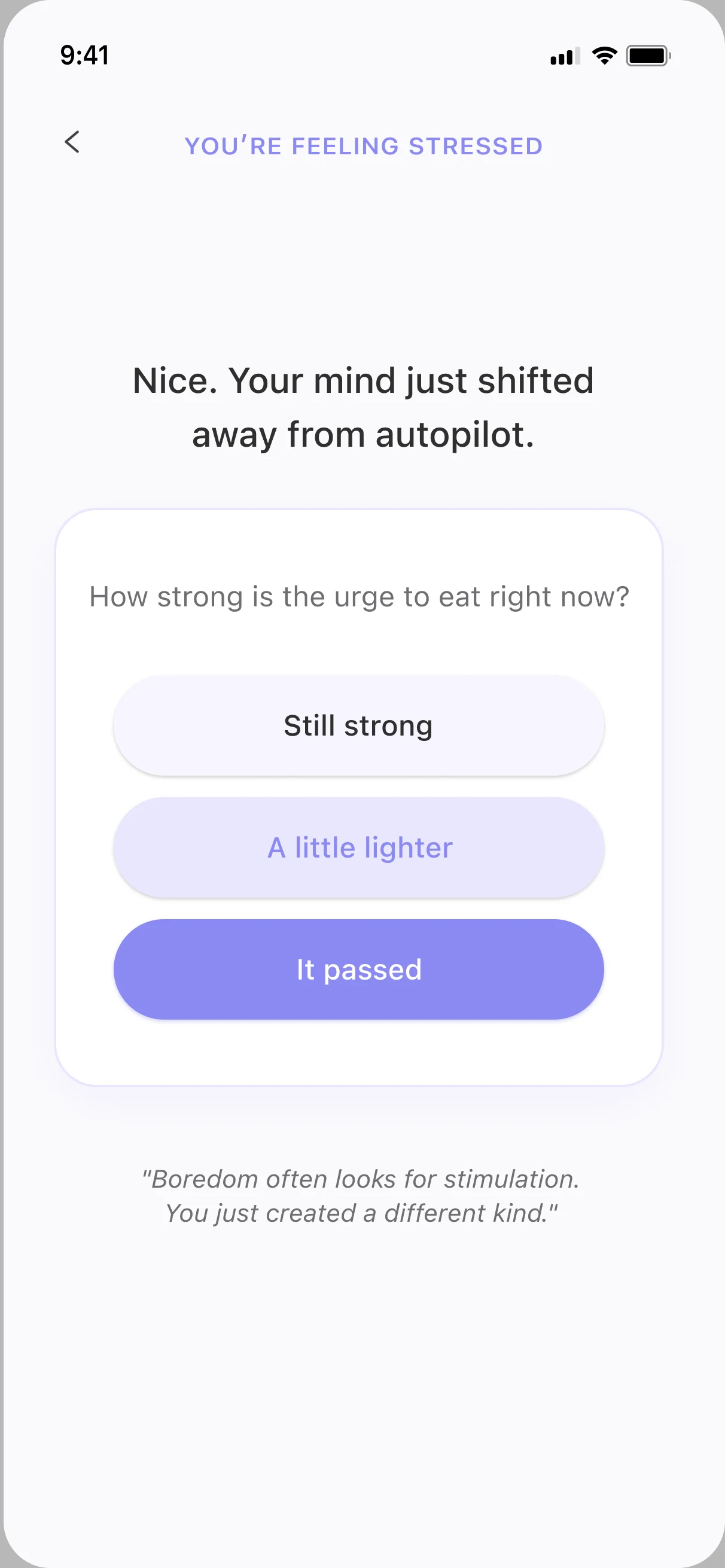
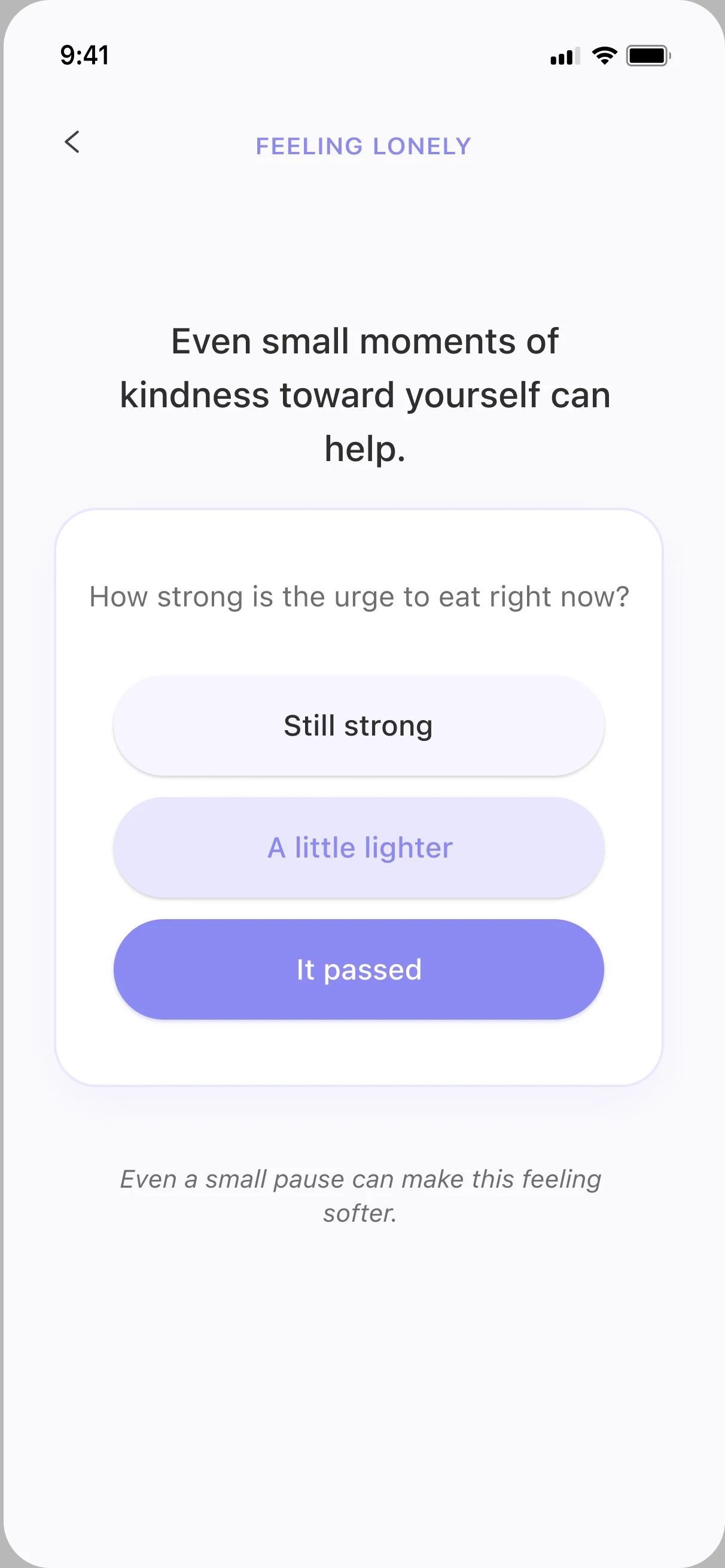
How strong is the urge now?
Still strong, a little lighter, it passed. Each feeling closes with its own line. Boredom often looks for stimulation. You just created a different kind.
WHYAn urge passes (S3). Asking makes the person see it pass, which is the point.
And if they ate anyway.
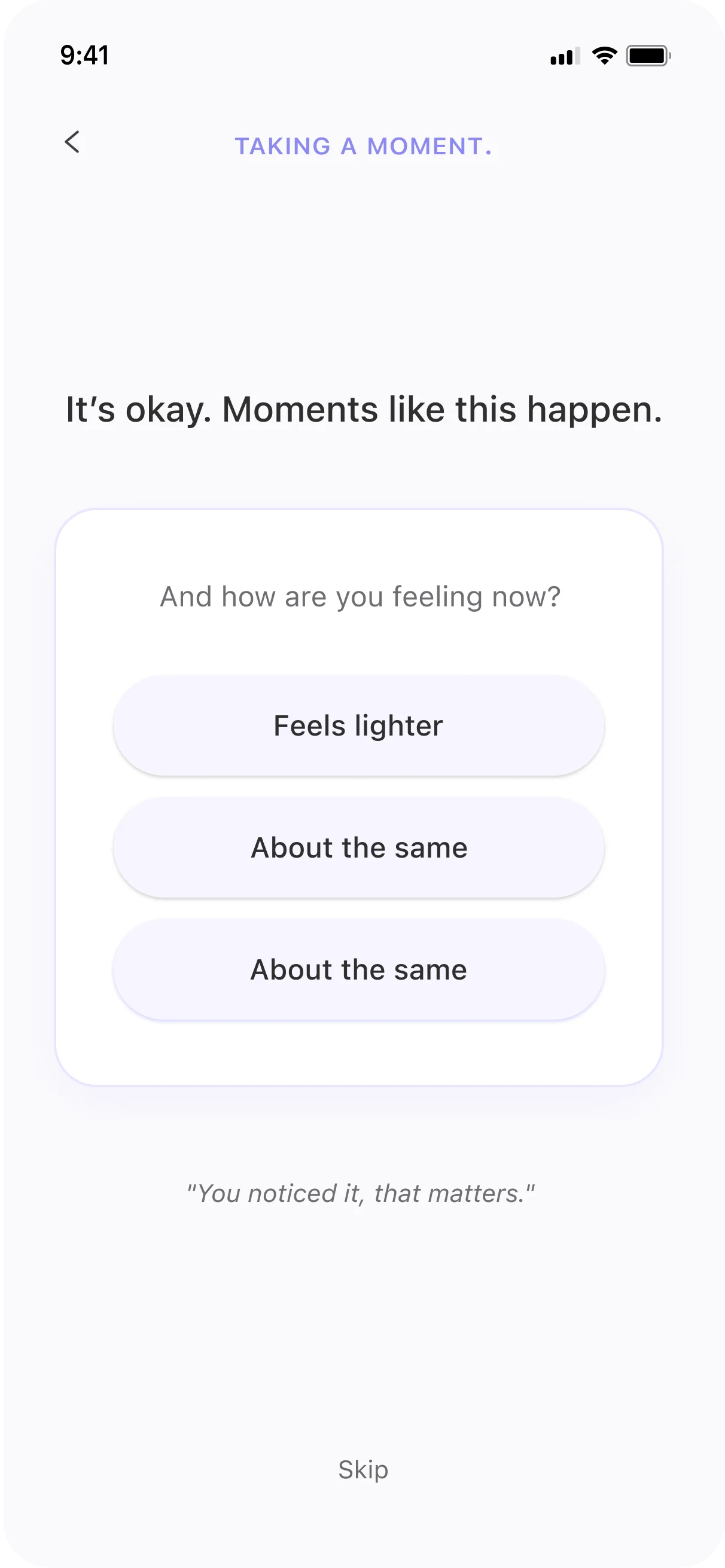
It's okay. Moments like this happen. Then one question about how they feel now, and nothing about the food.
WHYThe first question asked for comfort without guilt. Guilt is part of the loop, so the app never adds to it.
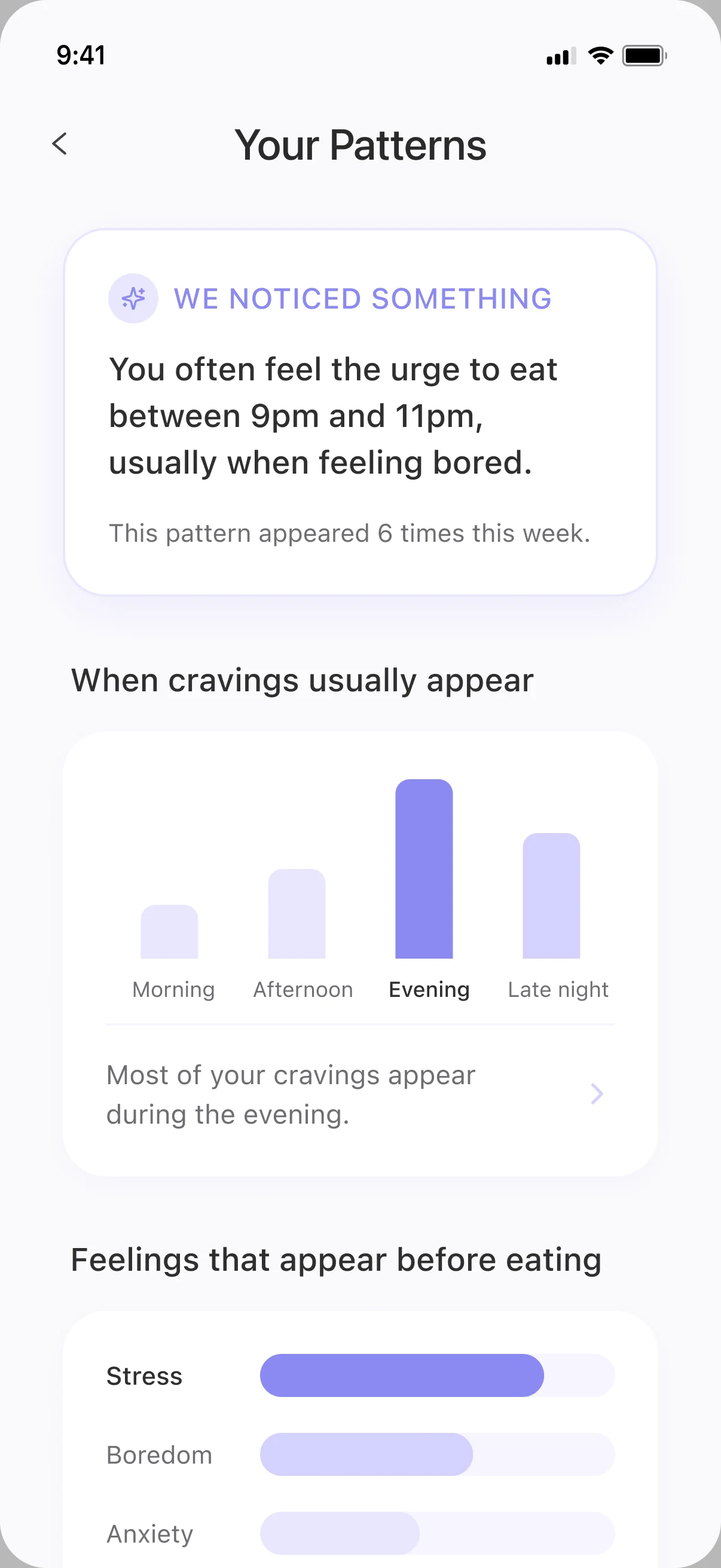
Patterns, without a food log.
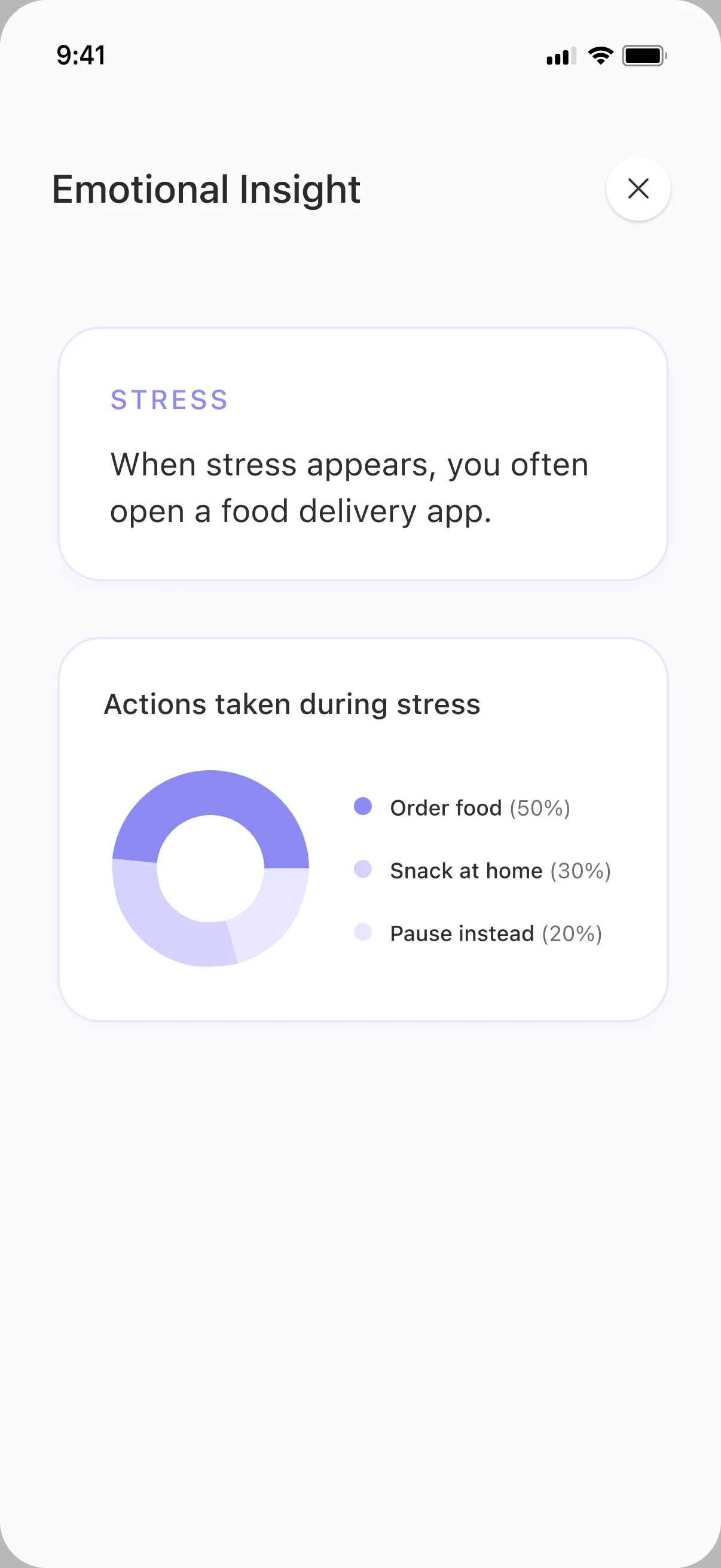
You often feel the urge to eat between 9pm and 11pm, usually when feeling bored. Built only from the moments themselves. One insight per feeling: when stress appears, you often open a food delivery app.
WHYProactive, not reactive (rule 01): these patterns are what let the next check-in come early. Nothing to log (rule 02).
Numbers on these two screens are prototype data, not results.
What comes next
Six things are still open.Leaving them visible is more useful than a neat ending.
Test it with people.
Nobody has used the prototype yet. The first round should ask whether fifteen seconds feels like help or like a hurdle.
Find an iPhone route.
The floating orb and the overlay on a delivery app assume Android style permissions. iOS does not allow drawing over other apps.
Design the other four feelings.
Anxiety, excitement, fatigue and not sure have no response of their own yet.
Design for those who stop eating.
24 of 107 barely eat when stressed. This design does nothing for them.
Design the hungry path.
Yes, my stomach actually feels empty is an answer that leads nowhere in the prototype yet.
Take a stance on privacy.
Moods and eating times are sensitive. Where they live, and who sees them, comes before any launch.
Reflection
Designing for moments like these shifted the focus from controlling behaviour to supporting it. Instead of trying to change what people do, the aim became to create space where they can notice, pause, and respond.
What changed the direction
The analysis. The group expected surroundings to decide eating; the coding and the tests kept pointing at emotion.
What did not survive
Two chi-square results that looked perfect. Re-run properly, they were artefacts, and the claim got smaller and truer.
What is missing
People using it. Every decision on this page is argued from research, and none of it is tested yet.
Sources
Says who.Every figure on this page, and where it came from.
The research
- Group report, “How environment shapes everyday eating behaviours”, Data Analytics and Transformation, MIT Institute of Design, January 2026.
- Survey, Google Forms: 113 responses, ages 17 to 50. Raw file has 111 rows; analysis tables use 107 cleaned rows. Content validity index 0.90.
- “Seeing food makes me want to eat even when not hungry”: 61 of 111 yes in the raw file. The report rounds this differently; the raw count is used here.
- Interviews: 19 participants. Thematic coding: 208 coded quotes from 10 transcripts, 91 themes.
- Experiment and focus groups: 10 participants, two groups of five.
The tests
- Sweet food across five moods, within the same people: Cochran’s Q = 23.48, df 4, p = 0.0001.
- Stress against relaxed, sweet food: McNemar p = 0.60. Sad against relaxed: p = 0.073.
- Stress and sadness against sweet food, as first reported: χ² = 107.0, V = 1.00. Dropped: each crossed an answer with a column derived from it, and 88 % of expected cell counts were below 5.
- Health consciousness and junk food under stress: χ² = 8.34, p = 0.0799.
The studies
- S1 Schwabe and Wolf, 2009. Stress prompts habit behavior in humans. Journal of Neuroscience, 29(22), 7191–7198. Later replications are mixed; used directionally.
- S2 Adam and Epel, 2007. Stress, eating and the reward system. Physiology and Behavior, 91(4), 449–458.
- S3 Bowen and Marlatt, 2009. Surfing the urge: brief mindfulness-based intervention for college student smokers. Psychology of Addictive Behaviors, 23(4), 666–671.
- S4 Gollwitzer and Sheeran, 2006. Implementation intentions and goal achievement: a meta-analysis. Advances in Experimental Social Psychology, 38, 69–119.
- S5 Arnsten, 2009. Stress signalling pathways that impair prefrontal cortex structure and function. Nature Reviews Neuroscience, 10, 410–422.
- S6 Macht, 2008. How emotions affect eating: a five-way model. Appetite, 50(1), 1–11.
Images: process photographs are the team's own. The desk scene and the two bowls are generated and labelled as such. App screens are from the Figma prototype.
Feeling the urge?Sometimes, a small pause is all it takes.