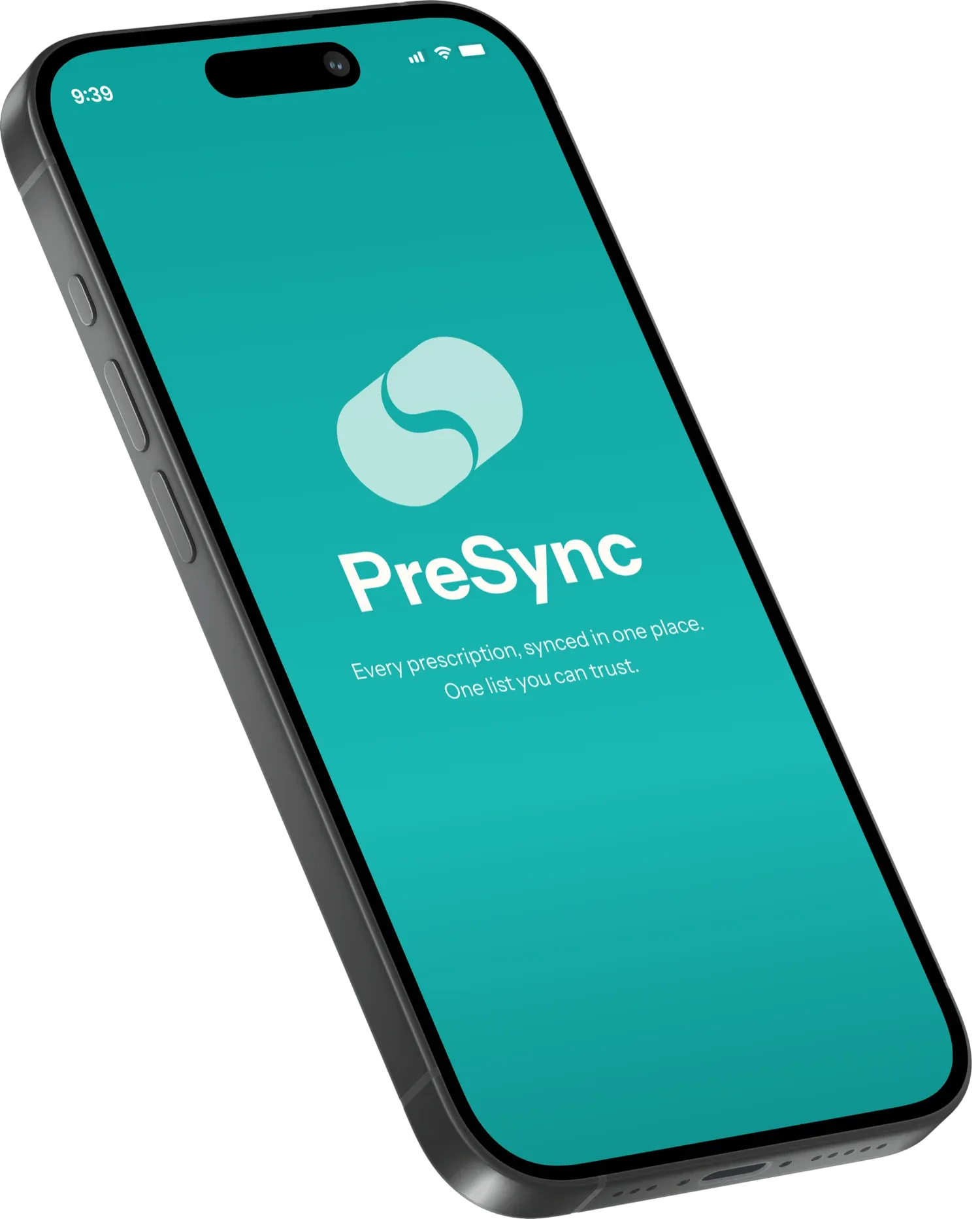
OVERVIEW
PreSync pulls together prescriptions, reports and pharmacy records into one current list of the medicines.
THE PROBLEM
No one holds the full, current list of an older person's medicines. It is scattered across doctors, pharmacies, hospitals and memory.
WHAT I DESIGNED
An app that builds that list from ABHA records, pharmacy bills (simulated) and photos. Nothing is added until a person confirms it.
HOW I TESTED IT
Eleven people, three tasks, one clickable prototype, then the System Usability Scale.
WHY THIS EXISTS
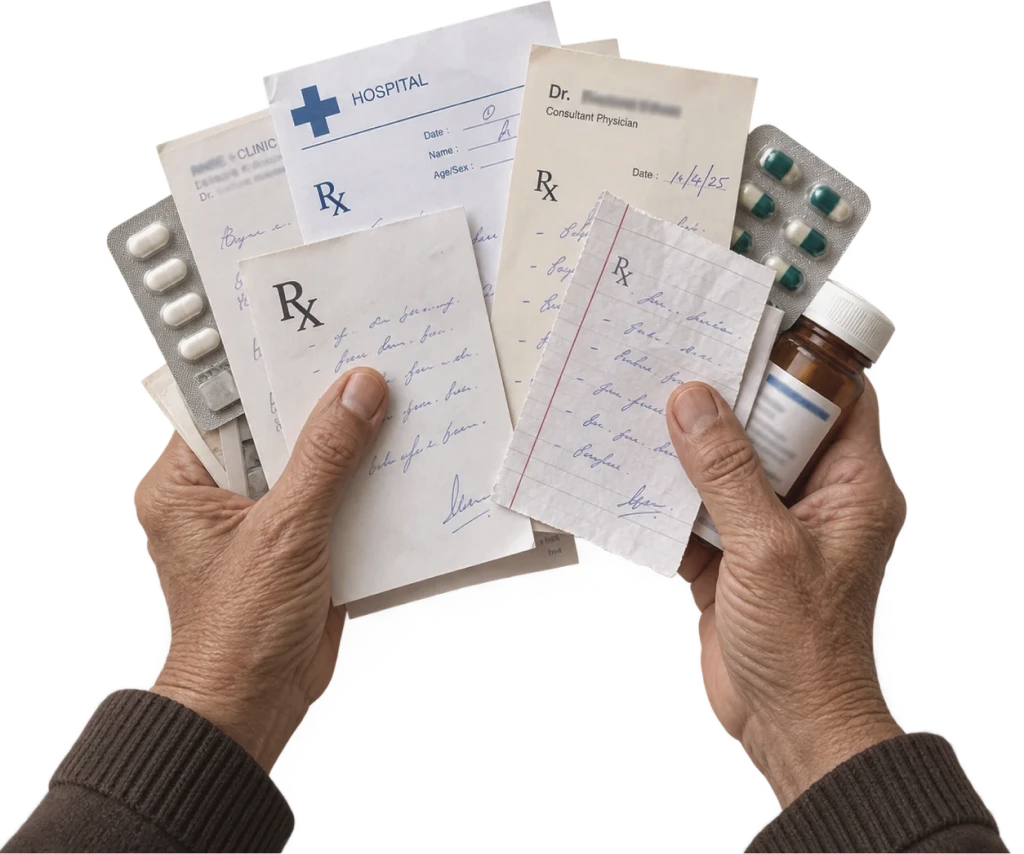
What is he actually supposed to be taking?
Right now. Nobody in the room could say.
My grandfather, 84. Admitted in a city he was only visiting, with every record he had on paper, in another town.




Never prescribed
Strips bought over the counter
No date on it
Still being taken, or not?
Paper only
Exists nowhere else
Multiple prescriptions
Not one sheet is the whole list
WHY THIS EXISTS
What is he actually supposed to be taking?
Right now. Nobody in the room could say.
My grandfather, 84. Admitted in a city he was only visiting, with every record he had on paper, in another town.
Multiple prescriptions
Not one sheet is the whole list
Never prescribed
Strips bought over the counter
Paper only
Exists nowhere else
No date on it
Still being taken, or not?
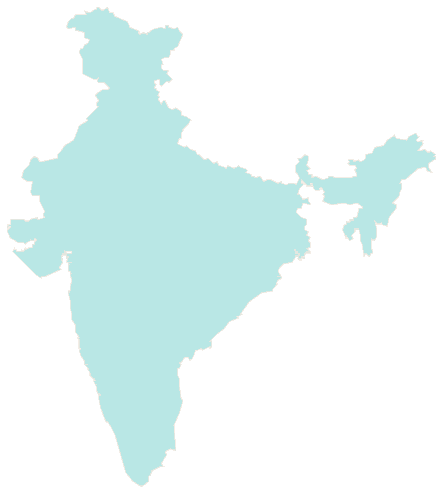


Aged 60+ in India
149
million people, 2022
49 %
take five or more medicines at the same time
67 %
of 261 pharmacies in one Bangalore study sold antibiotics with no prescription

Indians who are
aged 60 or over
1 in 10






GOING IN

GOING HOME


dose changed
dropped
Up to
23 %
1.37
unintended mismatches in medicine list at discharge, in one Indian hospital


28.4 %
of 310 older patients in one Mangalore hospital study had a potential drug interaction rated severe.
BEYOND ONE FAMILY
Medicines come from many places.
The list breaks at each one.
Older adults take the most medicines, so they feel it first. These studies show where the list breaks.
of older adults’ hospital admissions came from a reaction to a medicine


BEYOND ONE FAMILY
Medicines come from many places.
The list breaks at each one.
Older adults take the most medicines, so they feel it first. These studies show where the list breaks.
Indians who are
aged 60 or over
1 in 10
Aged 60+ in India
149
million people, 2022
49 %
take five or more medicines at the same time
67 %
of 261 pharmacies in one Bangalore study sold antibiotics with no prescription
Up to
23 %
of older adults’ hospital admissions came from a reaction to a medicine
GOING IN
GOING HOME
dose changed
dropped
1.37
unintended mismatches in medicine list at discharge, in one Indian hospital
28.4 %
of 310 older patients in one Mangalore hospital study had a potential drug interaction rated severe.
WHAT ALREADY EXISTS
REMINDER APPS
A current list, built from one source
NOBODY HERE
A current list, drawn from every place a medicine comes from
E-PHARMACIES
What you bought from them
RECORD LOCKERS
Documents, sorted by date and doctor
Medisafe

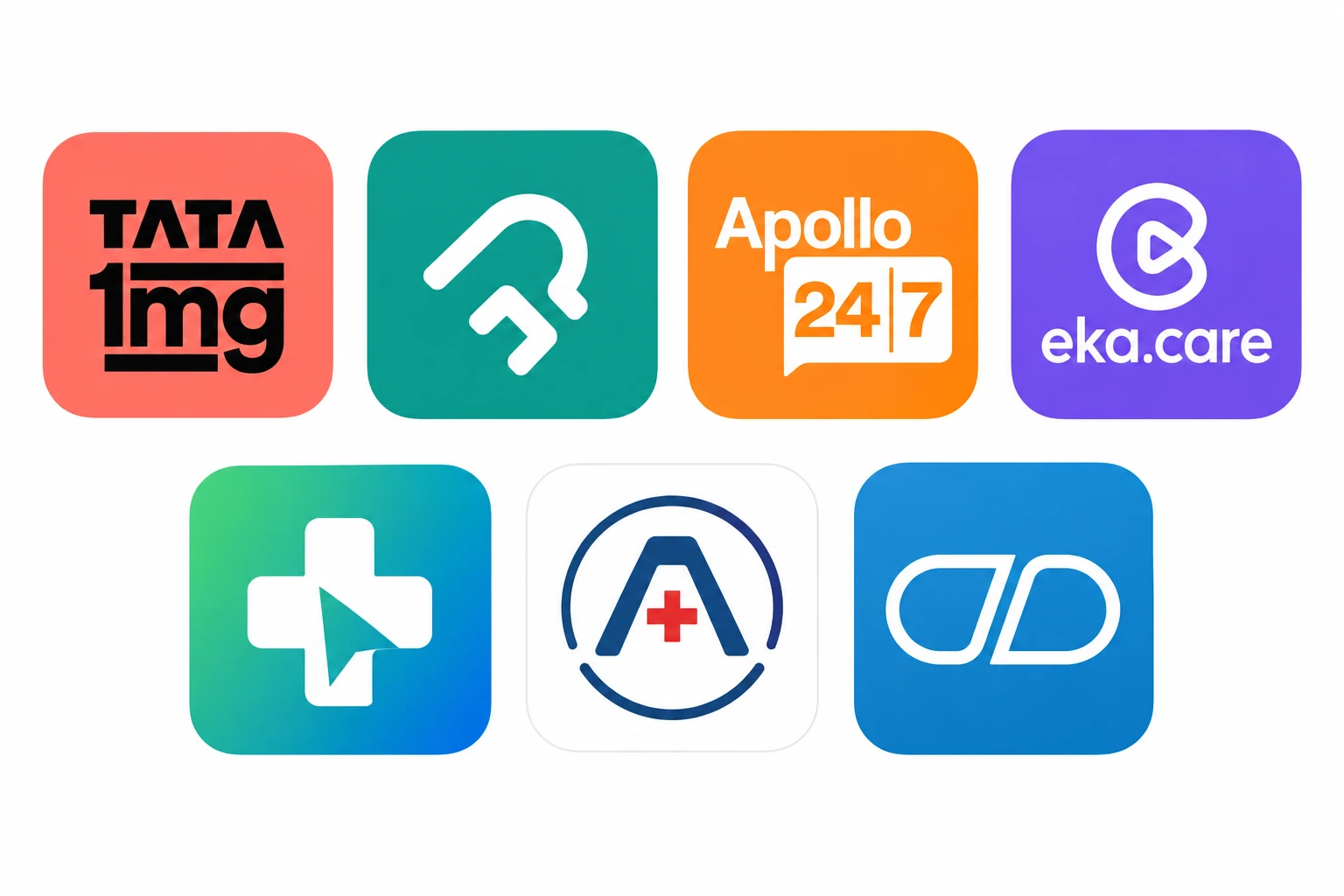
Tata 1mg
PharmEasy
Apollo 24|7
Eka Care
DRiefcase
ABHA app
ONE PLACE
MANY PLACES
A FOLDER OF DOCUMENTS
ONE CURRENT LIST
Ayu








Apps keep the papers, or keep a list.
None joins them into one current list.
The apps were not the whole story.
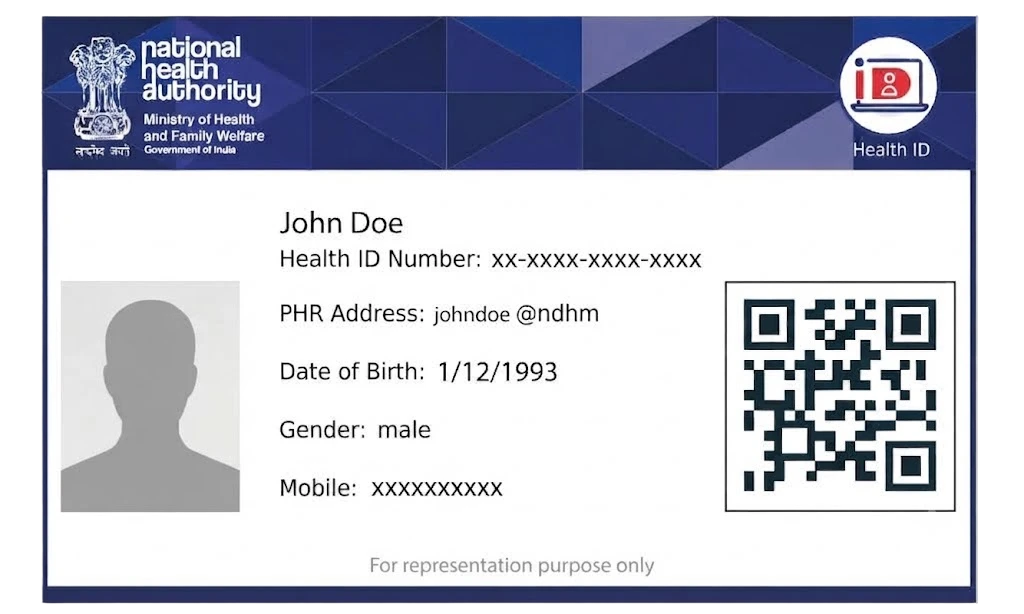
India already has a national health ID.
ABHA, the Ayushman Bharat Health Account, is a 14-digit health ID that allows individuals to securely store, access, and share their health records digitally across different healthcare providers.



Facilities link records to it
You share by consent
You create the number
ABHA NUMBERS CREATED
93.95 crore
Numbers, not people: one person can hold more than one.
HEALTH RECORDS LINKED
105 crore
About one document per number.
FACILITIES THAT CAN SEND ONE
2.72 lakh
Of 5.33 lakh registered.

WHAT I FOUND AND WAS STILL MISSING
ABHA fixes a real problem. A record that used to stay in one hospital can now travel with the person. But only about half the registered facilities can link a visit, and there is about one record per ABHA number so far. What travels is a document, not a list.
The data could only take me this far.
So what is actually happening inside homes?
I sorted the apps by two questions: where do medicines come from, and
is the result one current list or a folder?
None I found reached the fourth corner.


A doctor adds a medicine
Does anyone check it against the others?
A strip is bought at a counter
Where is it written down or doctor hear of it?
An old prescription is kept
Is it still being taken?
WHAT ALREADY EXISTS
Apps keep the papers, or keep a list.
None joins them into one current list.
I sorted the apps by two questions: where do medicines come from, and
is the result one current list or a folder?
None I found reached the fourth corner.
REMINDER APPS
A current list, built from one source
NOBODY HERE
A current list, drawn from every place a medicine comes from
E-PHARMACIES
What you bought from them
RECORD LOCKERS
Documents, sorted by date and doctor
Medisafe
Tata 1mg
PharmEasy
Apollo 24|7
Eka Care
DRiefcase
ABHA app
ONE PLACE
MANY PLACES
A FOLDER OF DOCUMENTS
ONE CURRENT LIST
Ayu
Swipe sideways to see the whole map.
The apps were not the whole story.
India already has a national health ID.
ABHA, the Ayushman Bharat Health Account, is a 14-digit health ID that allows individuals to securely store, access, and share their health records digitally across different healthcare providers.
Facilities link records to it
You share by consent
You create the number
ABHA NUMBERS CREATED
93.95 crore
Numbers, not people: one person can hold more than one.
HEALTH RECORDS LINKED
105 crore
About one document per number.
FACILITIES THAT CAN SEND ONE
2.72 lakh
Of 5.33 lakh registered.
WHAT I FOUND AND WAS STILL MISSING
ABHA fixes a real problem. A record that used to stay in one hospital can now travel with the person. But only about half the registered facilities can link a visit, and there is about one record per ABHA number so far. What travels is a document, not a list.
A doctor adds a medicine
Does anyone check it against the others?
A strip is bought at a counter
Where is it written down or doctor hear of it?
An old prescription is kept
Is it still being taken?
The data could only take me this far.
So what is actually happening inside homes?
WHAT I HEARD
I asked families how they keep track.
Here is what came up.
I spoke with 2 people who manage their own medicines and 5 who manage them for someone older in their family, about their last appointment, hospital stay and counter purchase.

01
Nobody checks one doctor against another.
Each prescription is trusted on its own. No one looks at all of them together.
02
The same medicine came home twice.
Two doctors, two brand names, one molecule. The family could not tell they were the same.
03
The list is recited, not read.
At appointments, medicines were listed from memory, or a bag of strips was handed over.
04
One person holds it all together.
When the medicines belonged to someone older, another family member did the tracking.
05
A counter strip rarely reaches the doctor.
Painkillers and antacids bought without a prescription were left out when medicines were listed.
06
Old prescriptions are kept, stopped or not.
Old sheets were kept. Nothing marked which medicines had stopped.
WHAT I HEARD
I asked families how they keep track.
Here is what came up.
I spoke with 2 people who manage their own medicines and 5 who manage them for someone older in their family, about their last appointment, hospital stay and counter purchase.
01
Nobody checks one doctor against another.
Each prescription is trusted on its own. No one looks at all of them together.
02
The same medicine came home twice.
Two doctors, two brand names, one molecule. The family could not tell they were the same.
03
The list is recited, not read.
At appointments, medicines were listed from memory, or a bag of strips was handed over.
04
One person holds it all together.
When the medicines belonged to someone older, another family member did the tracking.
05
A counter strip rarely reaches the doctor.
Painkillers and antacids bought without a prescription were left out when medicines were listed.
06
Old prescriptions are kept, stopped or not.
Old sheets were kept. Nothing marked which medicines had stopped.
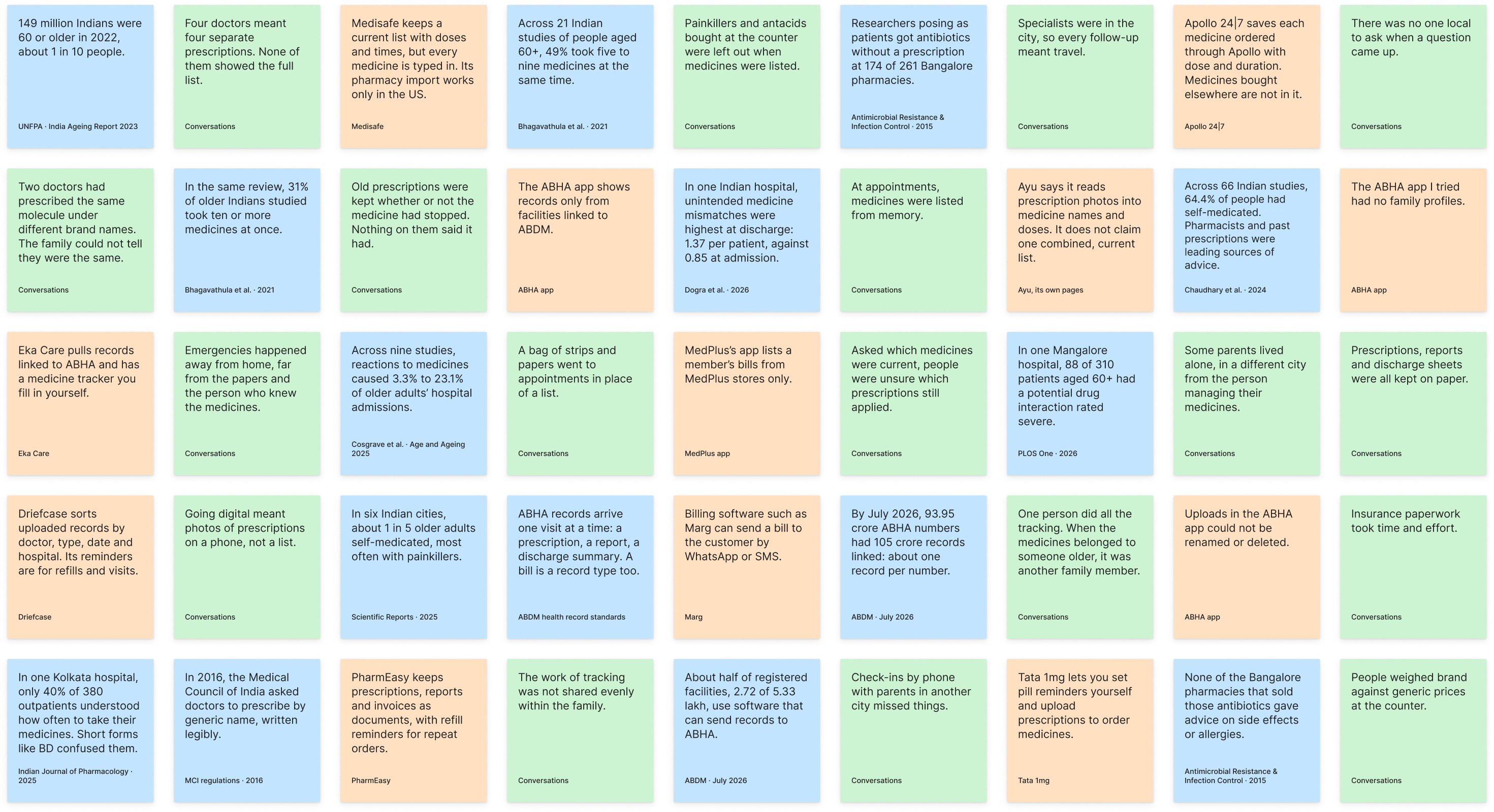
SYNTHESIS
Everything went on one wall,
then I sorted it by where it happens.
Published research, what I heard, and the apps I tried, on one wall. Each note keeps a mark for where it came from, so a finding from one family never passes for a national number.
published research
what i saw and heard
existing tools
AT THE DOCTOR
Many medicines, many doctors. Each prescription shows only part of the list.
People rely on memory, and recite the list at visits sometimes.
The same molecule came home under two brand names.
Medicines taken together can interact, sometimes severely.
AT THE COUNTER
Counter medicines leave no prescription, and get left out.
Each pharmacy keeps only its own sales.
AT HOME
Prescriptions pile up as paper and photos, not a list.
Old prescriptions stay, even after a medicine stops.
One person does all the tracking, often a family caregiver
List apps mostly need everything typed in.
When the person who tracks is away, the list stays behind.
IN HOSPITAL
In one hospital, mismatches came at admission and peaked at discharge.
IN THE RECORDS
ABHA links each visit as a separate record, not as one list.
Record apps file documents, but none I found joins them.
The ABHA app I tried had no family profiles.







CORE PROBLEM
No one holds the current list.
Each place keeps its own part. Nothing I found joins the parts into one list for the person and their doctor.
Only about half of registered facilities can send a record at all.
Counter sales come with no advice on side effects or allergies.
SYNTHESIS
Everything went on one wall,
then I sorted it by where it happens.
Published research, what I heard, and the apps I tried, on one wall. Each note keeps a mark for where it came from, so a finding from one family never passes for a national number.
published research
what i saw and heard
existing tools
AT THE DOCTOR
Many medicines, many doctors. Each prescription shows only part of the list.
People rely on memory, and recite the list at visits sometimes.
The same molecule came home under two brand names.
Medicines taken together can interact, sometimes severely.
AT THE COUNTER
Counter medicines leave no prescription, and get left out.
Each pharmacy keeps only its own sales.
Counter sales come with no advice on side effects or allergies.
AT HOME
Prescriptions pile up as paper and photos, not a list.
Old prescriptions stay, even after a medicine stops.
One person does all the tracking, often a family caregiver
List apps mostly need everything typed in.
When the person who tracks is away, the list stays behind.
IN HOSPITAL
In one hospital, mismatches came at admission and peaked at discharge.
IN THE RECORDS
ABHA links each visit as a separate record, not as one list.
Record apps file documents, but none I found joins them.
The ABHA app I tried had no family profiles.
Only about half of registered facilities can send a record at all.
CORE PROBLEM
No one holds the current list.
Each place keeps its own part. Nothing I found joins the parts into one list for the person and their doctor.
WHO THIS IS FOR
The list belongs to the person taking the medicines.
It is often kept by someone else.
Many older adults take five or more medicines, and a family member often helps keep track of them. Others manage their own medicines, so both have to work.
THE PERSON ON THE LIST
Takes the medicines.
The list is theirs.
THE PERSON KEEPING IT
Keeps track, often for someone older.
PRIMARY USER
THE DOCTOR
Reads the list at visits.
Never logs in.
Sometimes the same person
SO THE LIST HAS TO


01
Belong to the person taking the medicines.
02
Be kept by whoever looks after them.
03
Work the same when that is one person.
WHO THIS IS FOR
The list belongs to the person taking the medicines.
It is often kept by someone else.
Many older adults take five or more medicines, and a family member often helps keep track of them. Others manage their own medicines, so both have to work.
THE PERSON ON THE LIST
Takes the medicines.
The list is theirs.
THE PERSON KEEPING IT
Keeps track, often for someone older.
PRIMARY USER
Sometimes the same person
THE DOCTOR
Reads the list at visits.
Never logs in.
SO THE LIST HAS TO
01
Belong to the person taking the medicines.
02
Be kept by whoever looks after them.
03
Work the same when that is one person.
PROBLEM STATEMENT
The person keeping track of the medicines, often a family caregiver, needs one current list. Each doctor, counter and hospital keeps its own part, and nothing joins them, so a change, a repeat or a clash is easy to miss.
How might we help the person keeping track hold one current list, from the papers, records and purchases that already exist?
PROBLEM STATEMENT
The person keeping track of the medicines, often a family caregiver, needs one current list. Each doctor, counter and hospital keeps its own part, and nothing joins them, so a change, a repeat or a clash is easy to miss.
How might we help the person keeping track hold one current list, from the papers, records and purchases that already exist?
WHAT A SOLUTION HAS TO DO
01
Take in
From the places a medicine comes from paper, records, counter.
02
Ask first
Nothing joins the list until a person confirms it.
03
Check
Look across for repeats and clashes, and leave the decision to a doctor.
04
Hand over
Give the doctor the list, so it is not recited.
05
Belong
To the person taking the medicines, kept by whoever looks after them.
WHAT A SOLUTION HAS TO DO
01
Take in
From the places a medicine comes from paper, records, counter.
02
Ask first
Nothing joins the list until a person confirms it.
03
Check
Look across for repeats and clashes, and leave the decision to a doctor.
04
Hand over
Give the doctor the list, so it is not recited.
05
Belong
To the person taking the medicines, kept by whoever looks after them.
Ideation
Two answers looked obvious.
Neither one survives a real house.
01
Let the person keep the list.
Every app that holds a list asks to be typed in, or photographed. A list nobody is paid to maintain stops being updated in the first tired week, and the tired weeks are the ones that matter.
02
Build it on ABHA alone.
Real, government backed, and only ever as complete as national adoption. 2.72 lakh of 5.33 lakh registered facilities actually run software that can write to it.
Ideation
Two answers looked obvious.
Neither one survives a real house.
01
Let the person keep the list.
Every app that holds a list asks to be typed in, or photographed. A list nobody is paid to maintain stops being updated in the first tired week, and the tired weeks are the ones that matter.
02
Build it on ABHA alone.
Real, government backed, and only ever as complete as national adoption. 2.72 lakh of 5.33 lakh registered facilities actually run software that can write to it.
So the question stopped being where to keep a list, and became where a list could come from.
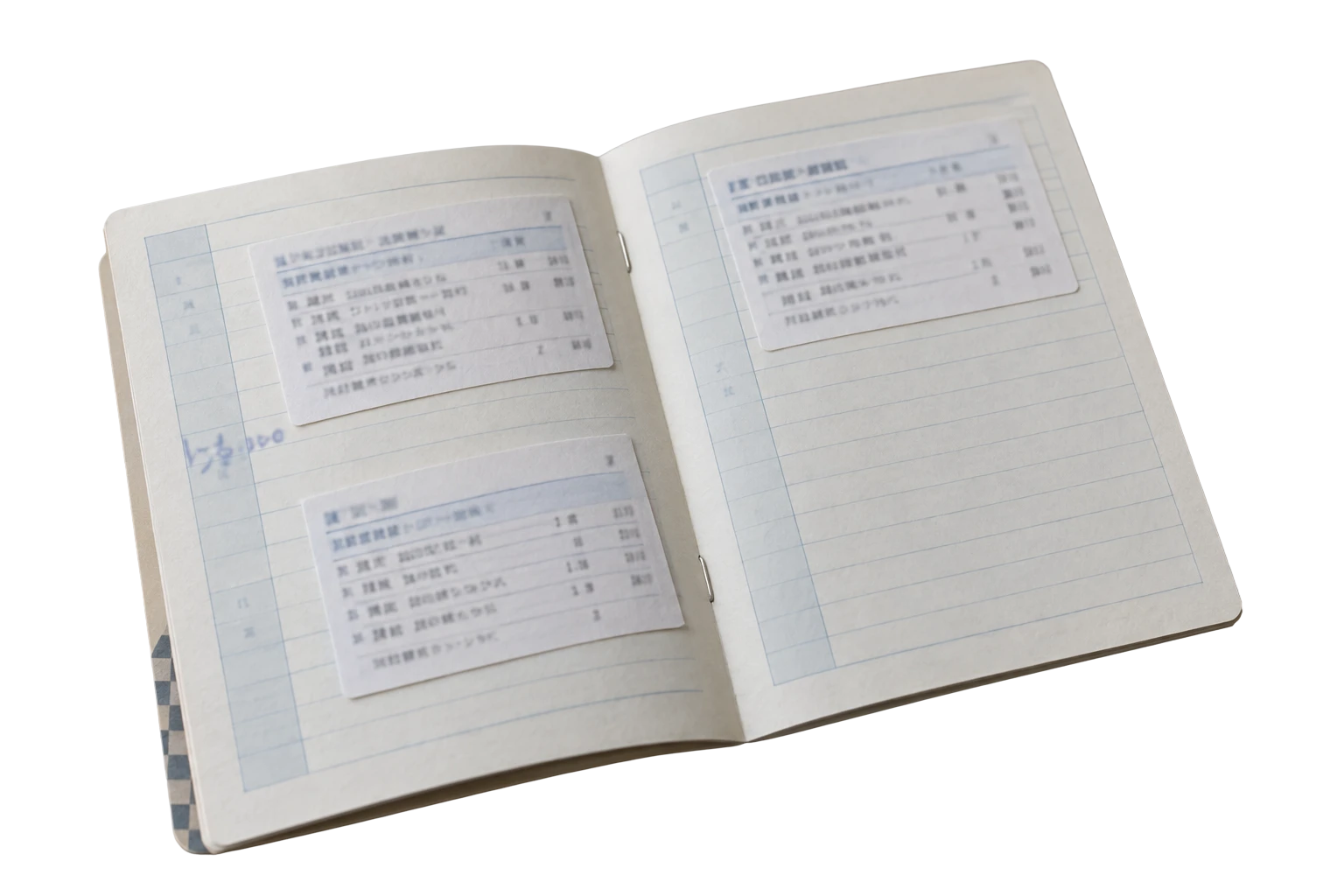
お薬手帳
Okusuri techō · Japan
THE TURN
A paper notebook. At every dispensing, the pharmacist writes in what was handed over. Not the doctor. The person at the counter. It has run nationally for decades.
92.3 %
of doctors said it prevented duplicate prescriptions


Any doctor, however many
A hospital discharge
Bought with no prescription
A repeat, nobody asked again
The pharmacy counter
Japan's version runs on a pharmacist writing.
So what already happens at an Indian counter?

So the question stopped being where to keep a list, and became where a list could come from.
THE TURN
お薬手帳
Okusuri techō · Japan
A paper notebook. At every dispensing, the pharmacist writes in what was handed over. Not the doctor. The person at the counter. It has run nationally for decades.
Any doctor, however many
A hospital discharge
Bought with no prescription
A repeat, nobody asked again
The pharmacy counter
92.3 %
of doctors said it prevented duplicate prescriptions
Japan's version runs on a pharmacist writing.
So what already happens at an Indian counter?
Sign in to manage medicines
Welcome
Continue
Your data is encrypted and never shared without your consent.

MOBILE NUMBER
🇮🇳
+91
97XXXXXX19
FROM THE COUNTER TO THE PHONE
Nothing new has to be captured.
It is already being typed.


01
Someone asks for a strip
With a prescription, or without one
02
Pharmacist searches
In the billing software already running on the counter PC

03
A batch is picked
Because stock is tracked batch by batch, with its expiry
04
Tax & stock are applied
The HSN code sets the GST, and the shelf count drops by sold

05
The bill is raised
And a phone number is asked for, to send the copy
MEDICINE
BATCH
EXPIRY
QTY
RATE
HSN
GST
AMOUNT

Amlodipine 5 mg, 10 tab
AM4213
08 / 27
3
12.40
3004
5 %
37.20

Metformin 500 mg, 15 tab
MF8820
02 / 28
2
28.00
3004
5 %
56.00
Pantoprazole 40 mg, 10 tab
PN1109
11 / 27
1
64.50
3004
5 %
64.50
CUSTOMER MOBILE
97XXXXXX19
TOTAL
157.70
One number is typed at a counter.
The same number signs in on a phone.


The loop already exists.
One segment of it has never been drawn.
WHO DECIDES IT
what goes on the list
WHERE IT HAPPENS
the only two who meet
WHAT RUNS BEHIND IT
never sees a patient
Hometown doctor
writes the first prescription
Specialist
writes another, for one condition
Hospital
changes the list at discharge
The person
carries the paper, takes the strips
The chemist counter
hands it over, types the sale
The distributor
supplies the stock, and the batch
The billing software
records every sale it is told about
The tax system
the reason the record is accurate
ABDM and ABHA
holds what a linked facility uploads
One current list
nobody in this map is holding it, and nobody is being paid to


a record is made

a record that could move, and never does










a prescription each,
never the whole list
a number
money
12.4 lakh
10 lakh+
20,000+
chemists & distributors in India
businesses on Marg, pharma & FMCG together
pharmacists on eVitalRx
Many counters already bill on software.
Three organisations counting three different things, each reporting its own. Enough to show the layer exists, not enough to size it. So this route is simulated in the prototype.
Two things have to be true before anything moves.
PreSync
the app the person chose
The vendor’s server
where the sale is already stored


the key, and a code the person confirmed


the sale, line by line

THE KEY
says which app is asking
THE CODE
says whose purchases it may read
FROM THE COUNTER TO THE PHONE
Nothing new has to be captured.
It is already being typed.
01
Someone asks for a strip
With a prescription, or without one
02
Pharmacist searches
In the billing software already running on the counter PC
03
A batch is picked
Because stock is tracked batch by batch, with its expiry
04
Tax & stock are applied
The HSN code sets the GST, and the shelf count drops by sold
05
The bill is raised
And a phone number is asked for, to send the copy
MEDICINE
BATCH
EXPIRY
QTY
RATE
HSN
GST
AMOUNT
Amlodipine 5 mg, 10 tab
AM4213
08 / 27
3
12.40
3004
5 %
37.20
Metformin 500 mg, 15 tab
MF8820
02 / 28
2
28.00
3004
5 %
56.00
Pantoprazole 40 mg, 10 tab
PN1109
11 / 27
1
64.50
3004
5 %
64.50
CUSTOMER MOBILE
97XXXXXX19
TOTAL
157.70
Swipe sideways to see the whole bill.
One number is typed at a counter.
The same number signs in on a phone.
Sign in to manage medicines
Welcome
Continue
Your data is encrypted and never shared without your consent.
MOBILE NUMBER
🇮🇳
+91
97XXXXXX19
Many counters already bill on software.
12.4 lakh
chemists & distributors in India
10 lakh+
businesses on Marg, pharma & FMCG together
20,000+
pharmacists on eVitalRx
Three organisations counting three different things, each reporting its own. Enough to show the layer exists, not enough to size it. So this route is simulated in the prototype.
Two things have to be true before anything moves.
PreSync
the app the person chose
the key, and a code the person confirmed
the sale, line by line
The vendor’s server
where the sale is already stored
THE KEY
says which app is asking
THE CODE
says whose purchases it may read
The loop already exists.
One segment of it has never been drawn.
2
WHO DECIDES IT
what goes on the list
WHERE IT HAPPENS
the only two who meet
WHAT RUNS BEHIND IT
never sees a patient
Hometown doctor
writes the first prescription
Specialist
writes another, for one condition
Hospital
changes the list at discharge
The person
carries the paper, takes the strips
The chemist counter
hands it over, types the sale
The distributor
supplies the stock, and the batch
The billing software
records every sale it is told about
The tax system
the reason the record is accurate
ABDM and ABHA
holds what a linked facility uploads
One current list
nobody in this map is holding it, and nobody is being paid to
a record is made
a record that could move, and never does
a prescription each,
never the whole list
a number
money
Swipe sideways to see the whole diagram.
THREE WAYS IN
No single route reaches everybody.
So typing stays, but only as the last resort.
The map says medicine arrives from too many directions for any one rail to catch it. So the list fills three ways, stacked. The two automatic routes each depend on a condition somebody else controls. The one at the bottom depends on nothing, so it is always there when the other two cannot reach.
The billing software route
where the counter runs connected software
costs the person a number, once
counters not running connected software
not reached by this route
arrives with the sale, then waits to be sorted
The ABHA route
where the pharmacy is in the facility registry
costs the person a consent, once
pharmacies not registered on the rail
not reached by this route
fetched with the person’s consent
Typing it in
everywhere: cash, over the counter, any shop at all
costs the person one entry, by hand
typed in by hand, as a last resort
Everything above the bottom band removes work.
Band widths show which routes depend on a condition somebody else controls. They are not measured market share, because nobody publishes that.
THREE WAYS IN
No single route reaches everybody.
So typing stays, but only as the last resort.
The map says medicine arrives from too many directions for any one rail to catch it. So the list fills three ways, stacked. The two automatic routes each depend on a condition somebody else controls. The one at the bottom depends on nothing, so it is always there when the other two cannot reach.
The billing software route
where the counter runs connected software
costs the person a number, once
counters not running connected software
not reached by this route
arrives with the sale, then waits to be sorted
The ABHA route
where the pharmacy is in the facility registry
costs the person a consent, once
pharmacies not registered on the rail
not reached by this route
fetched with the person’s consent
Typing it in
everywhere: cash, over the counter, any shop at all
costs the person one entry, by hand
typed in by hand, as a last resort
Everything above the bottom band removes work.
Band widths show which routes depend on a condition somebody else controls. They are not measured market share, because nobody publishes that.
WHAT THIS CHANGES
The list stops being something you keep.
It becomes something that arrives.
This is what the three routes are for. Not a feature list, four specific things that are broken today and are not broken once the list fills itself.
TODAY
ONCE THE LIST ARRIVES
Over the counter medicines
A strip of painkillers never gets logged by hand, so it is simply missing from the list.
Arrives with the sale, and waits for the person to confirm it.
The caregiver
Has to ask what was bought, and is told whatever somebody remembers.
Sees the purchase without having to ask anyone.
Duplicates and interactions
Cannot be caught reliably, because the list was never complete.
Can be caught, because the list is more complete.
Entering things by hand
Every medicine, by hand.
Only the ones that did not arrive.
WHAT THIS CHANGES
The list stops being something you keep.
It becomes something that arrives.
This is what the three routes are for. Not a feature list, four specific things that are broken today and are not broken once the list fills itself.
TODAY
ONCE THE LIST ARRIVES
Over the counter medicines
A strip of painkillers never gets logged by hand, so it is simply missing from the list.
Arrives with the sale, and waits for the person to confirm it.
The caregiver
Has to ask what was bought, and is told whatever somebody remembers.
Sees the purchase without having to ask anyone.
Duplicates and interactions
Cannot be caught reliably, because the list was never complete.
Can be caught, because the list is more complete.
Entering things by hand
Every medicine, by hand.
Only the ones that did not arrive.
INTRODUCING PRESYNC

PreSync
Prescription, synced.
One current list of what a person is taking, assembled from records that already exist. Nothing on it is final until a person confirms it.
IT TAKES IN
From a purchase at a connected counter, from ABHA by consent, or from a photo and a search.
IT ASKS BEFORE IT ADDS
Anything it is unsure of waits for a person to confirm. Nothing is decided for them.
IT HANDS OVER
One summary, grouped by condition, ready for the next doctor.
INTRODUCING PRESYNC
2
PreSync
Prescription, synced.
One current list of what a person is taking, assembled from records that already exist. Nothing on it is final until a person confirms it.
IT TAKES IN
From a purchase at a connected counter, from ABHA by consent, or from a photo and a search.
IT ASKS BEFORE IT ADDS
Anything it is unsure of waits for a person to confirm. Nothing is decided for them.
IT HANDS OVER
One summary, grouped by condition, ready for the next doctor.
USER FLOW
From opening the app,
to a list that stays current.
Every person passes through setup once. The ABHA choice decides how the first list is built, and after that the three tasks keep it current.
Open PreSync
Four onboarding cards
Skip on each one
Sign in with a mobile number
Verify the one-time code
Who is this for?
Name, age, conditions
Relationship
Myself included

Link ABHA?
Add health information
Upload photos, or search a medicine
ABHA number and code
Create an ABHA ID with ABDM
Allow access?
What we found, by source
Putting the list together
Review
Confirm the unsure ones
Home
Kishor’s medicines
What happens next?
Show to doctor
TASK 01
A purchase arrives in Activity
TASK 02
Something is flagged in Activity
TASK 03
The list stays current



Skip for now

Link existing

Create one


Allow

Not now










USER FLOW
From opening the app,
to a list that stays current.
Every person passes through setup once. The ABHA choice decides how the first list is built, and after that the three tasks keep it current.
Open PreSync
Four onboarding cards
Skip on each one
Sign in with a mobile number
Verify the one-time code
Who is this for?
Name, age, conditions
Relationship
Myself included
Link ABHA?
Add health information
Upload photos, or search a medicine
ABHA number and code
Create an ABHA ID with ABDM
Allow access?
What we found, by source
Putting the list together
Review
Confirm the unsure ones
Home
Kishor’s medicines
What happens next?
Show to doctor
TASK 01
A purchase arrives in Activity
TASK 02
Something is flagged in Activity
TASK 03
The list stays current
Skip for now
Link existing
Create one
Allow
Not now
2
Swipe sideways to see the whole diagram.
SETUP
Setup asks about the person on the list,
not the person holding the phone.
Everyone passes through these screens: one number to sign in, one person to set up, and one choice before the first medicine is added: ABHA.
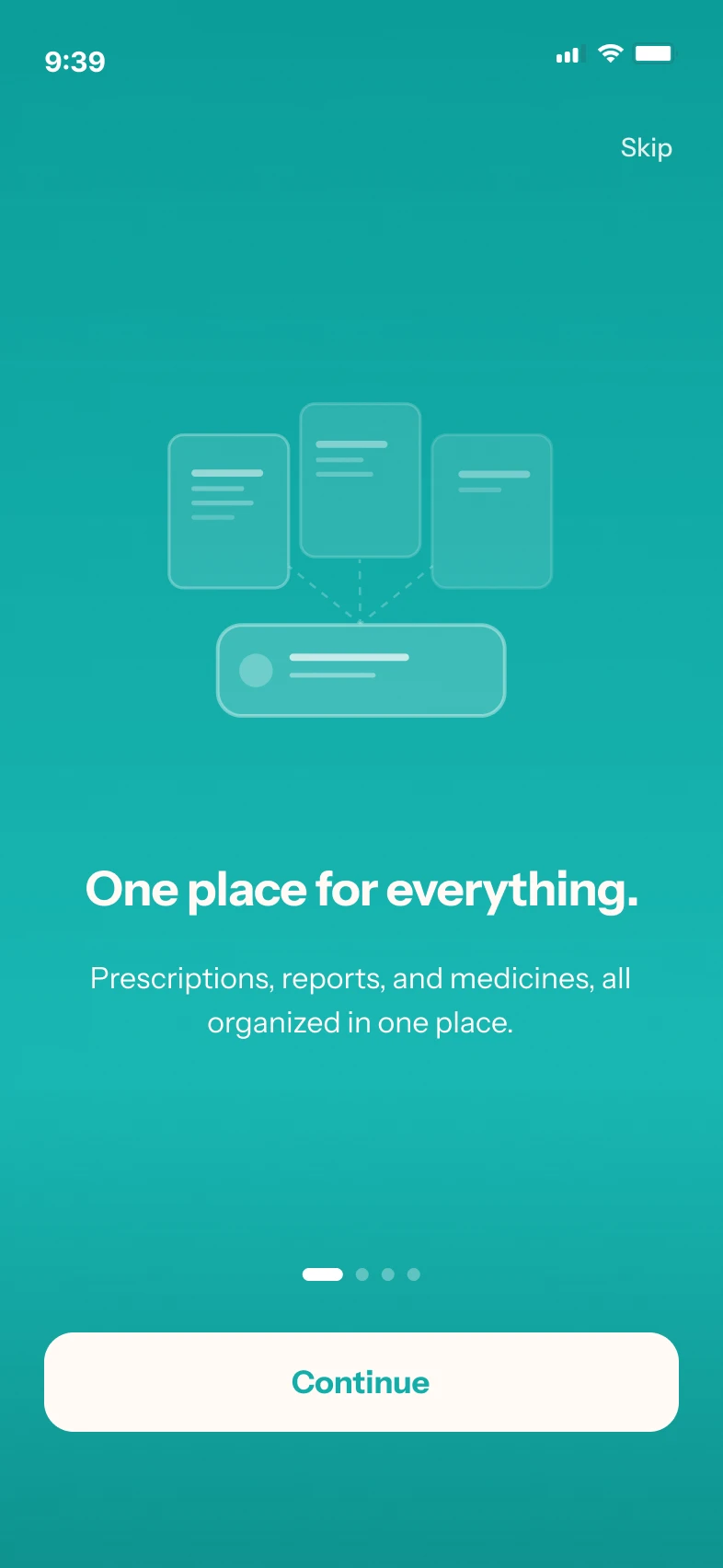
Skip on every card. The four cards say what the app does, and none of them blocks setup.
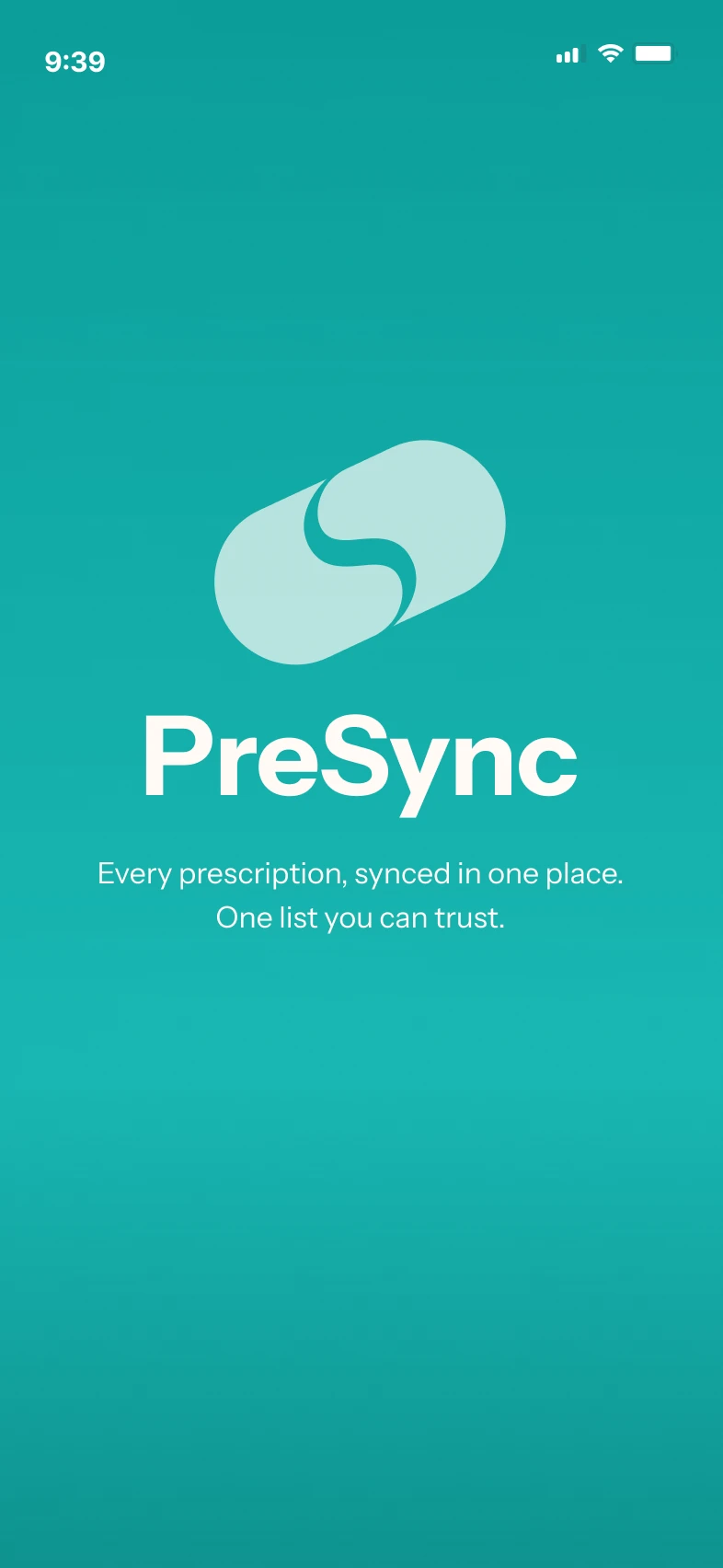
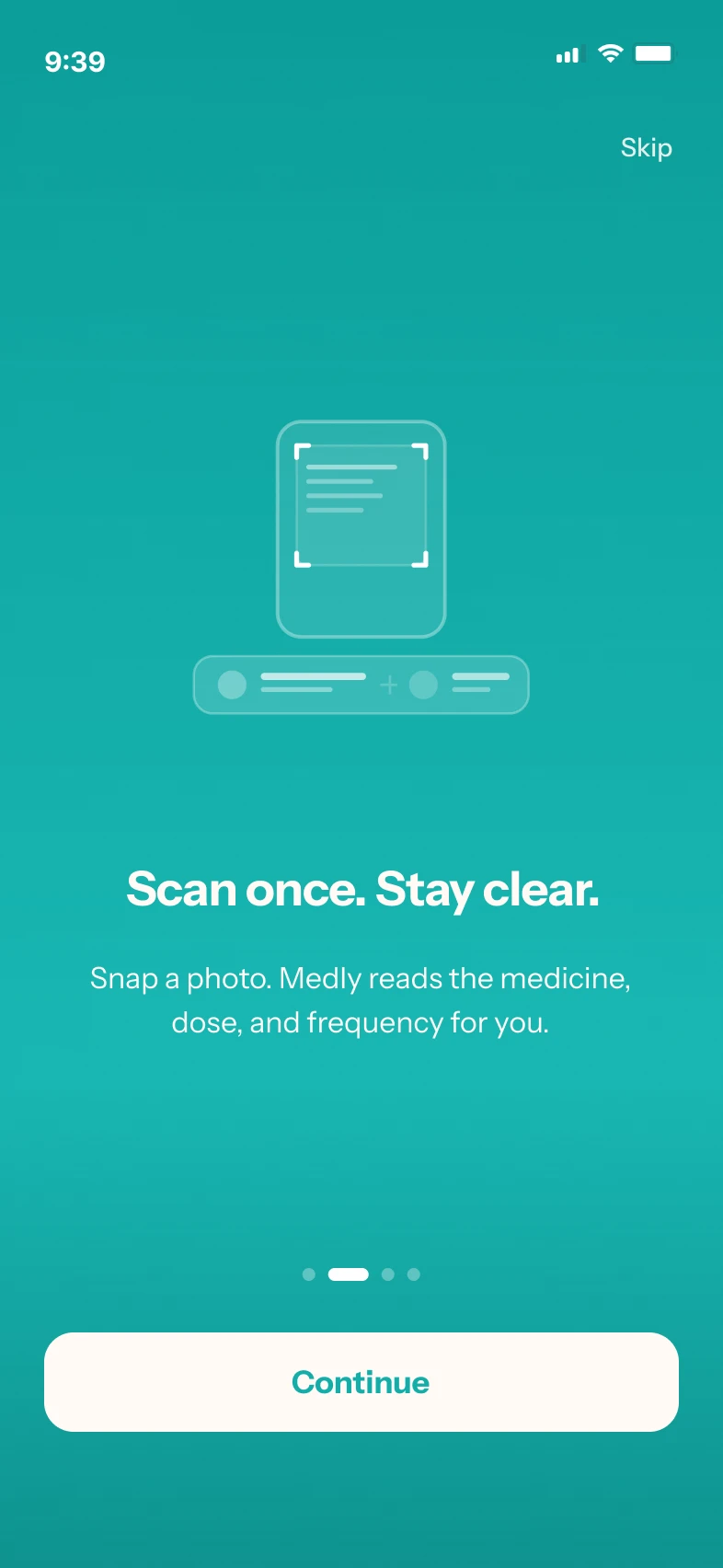
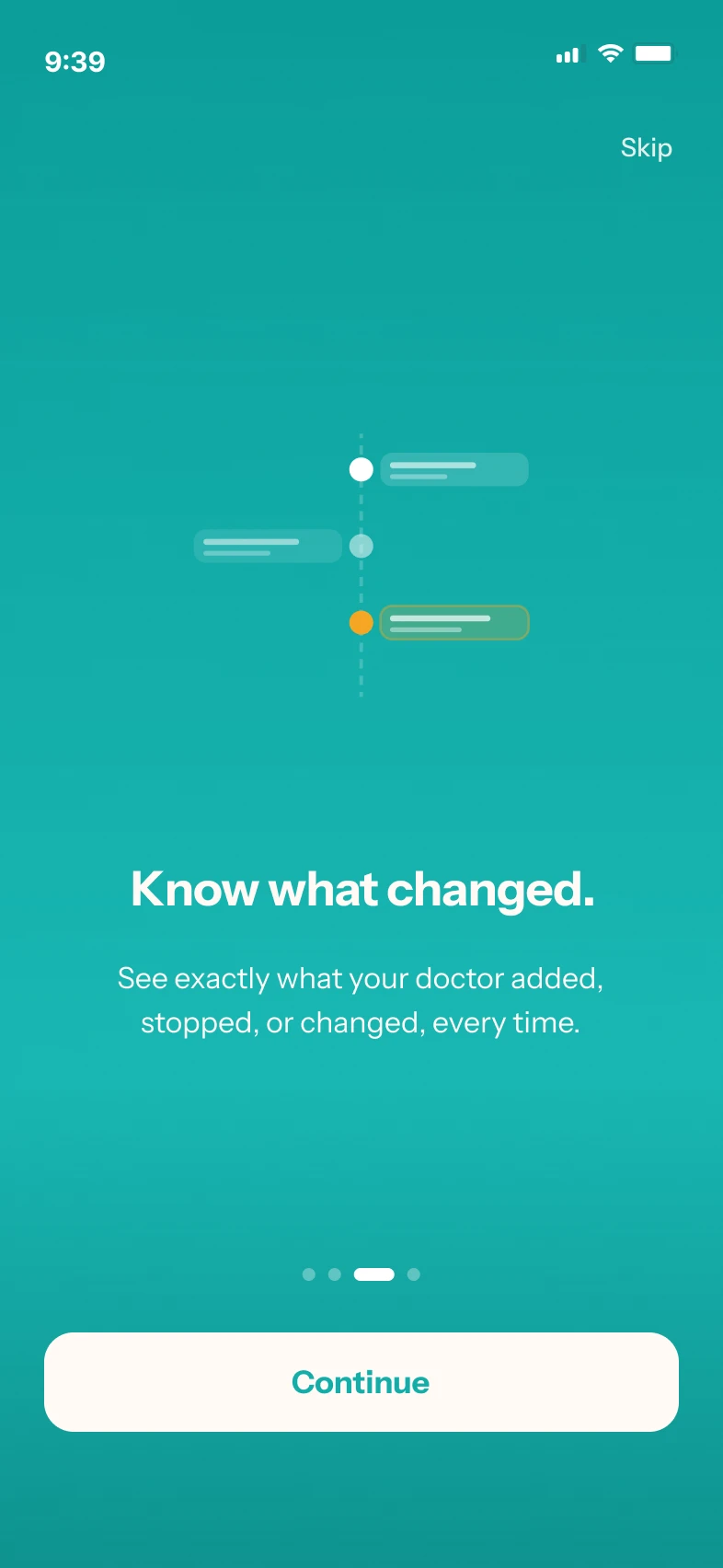
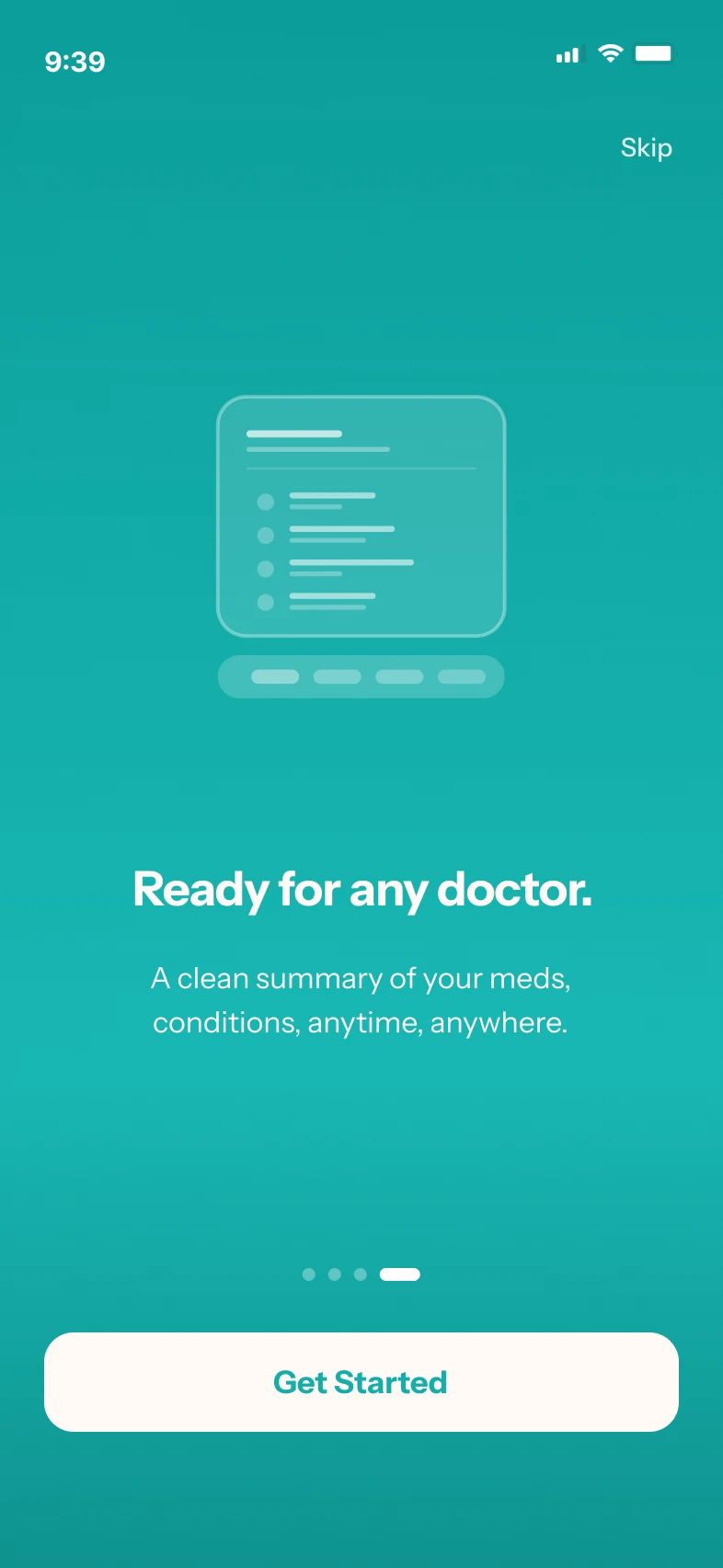
Splash
One place for everything
Scan once. Stay clear.
Know what changed.
Ready for any doctor.
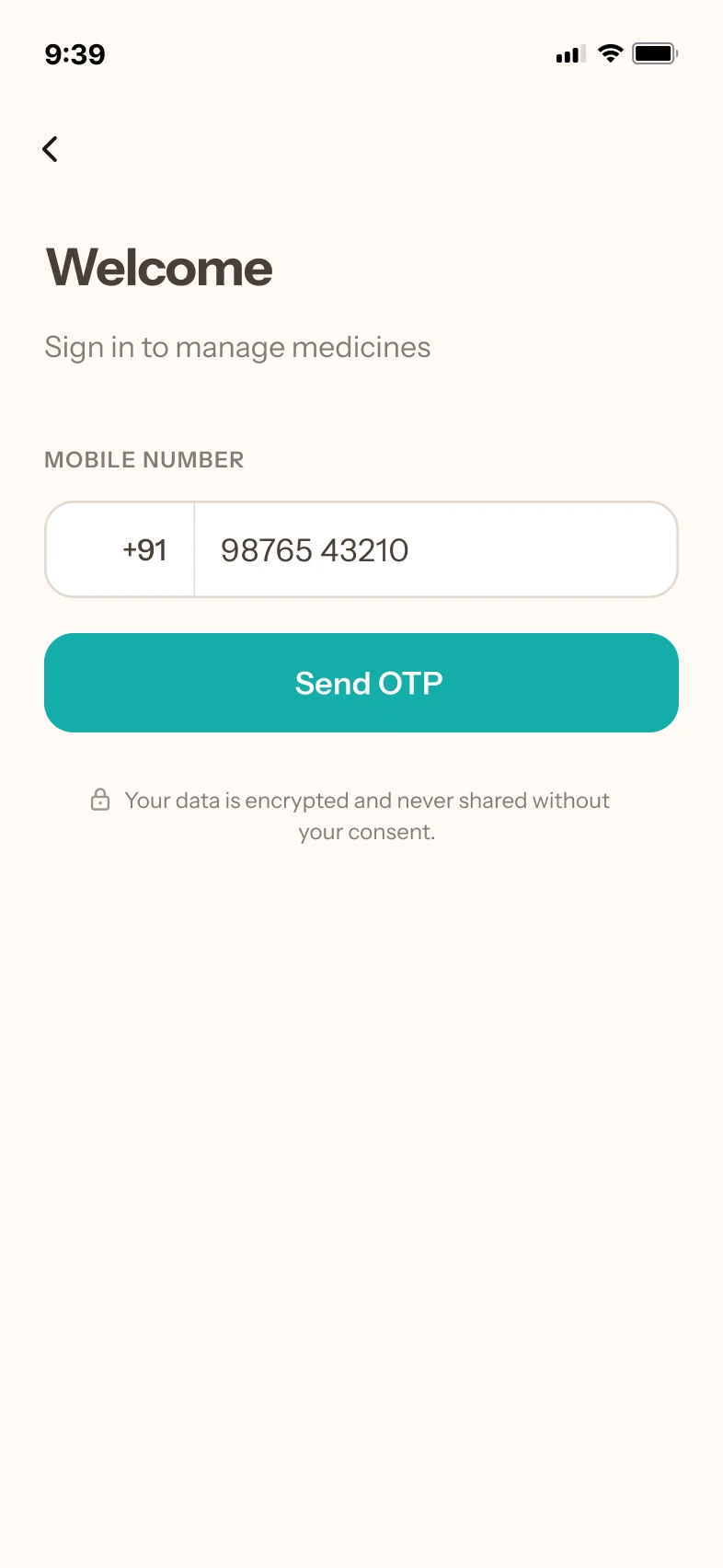
Sign in
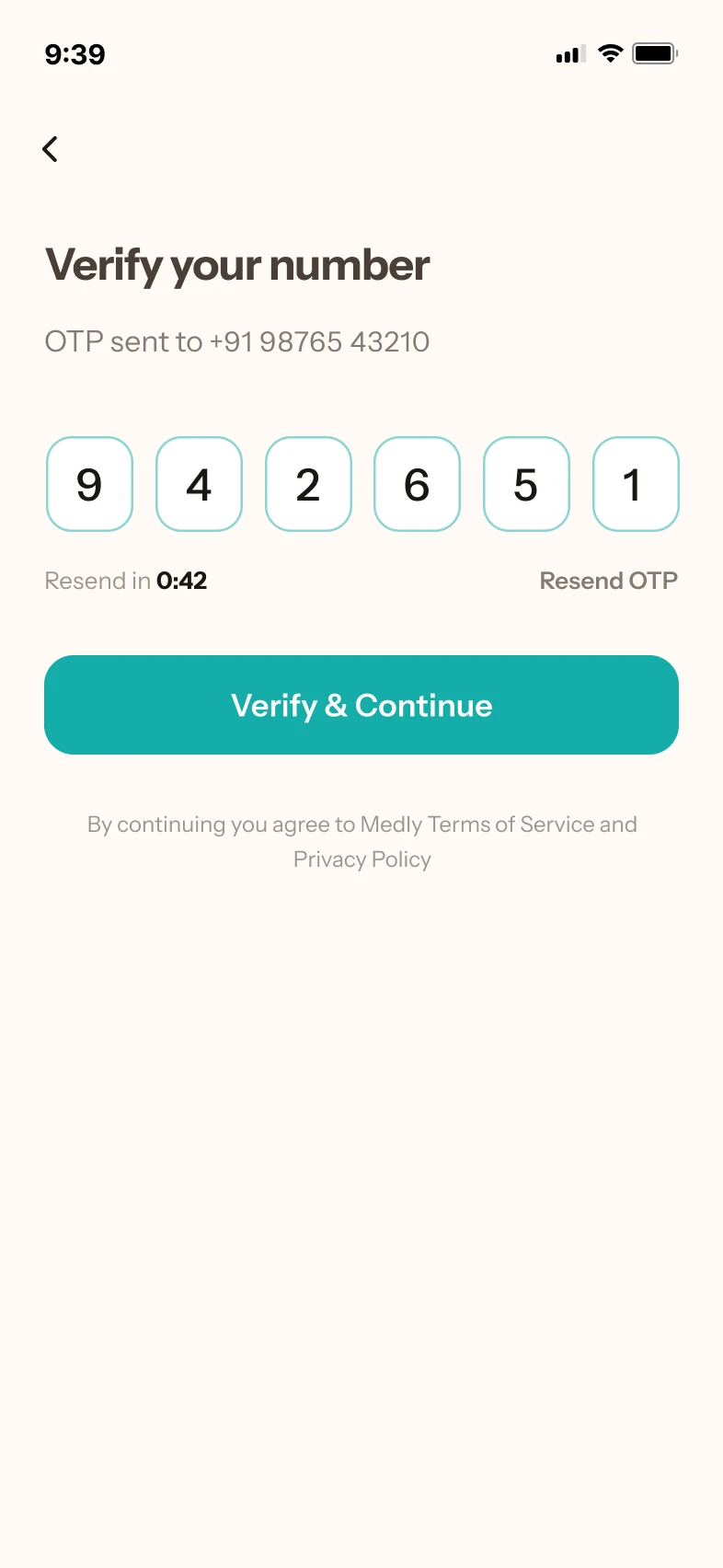
Verify the number
One number, and a code.
The same mobile number a pharmacy counter asks for, which is what later lets a purchase find the right person.
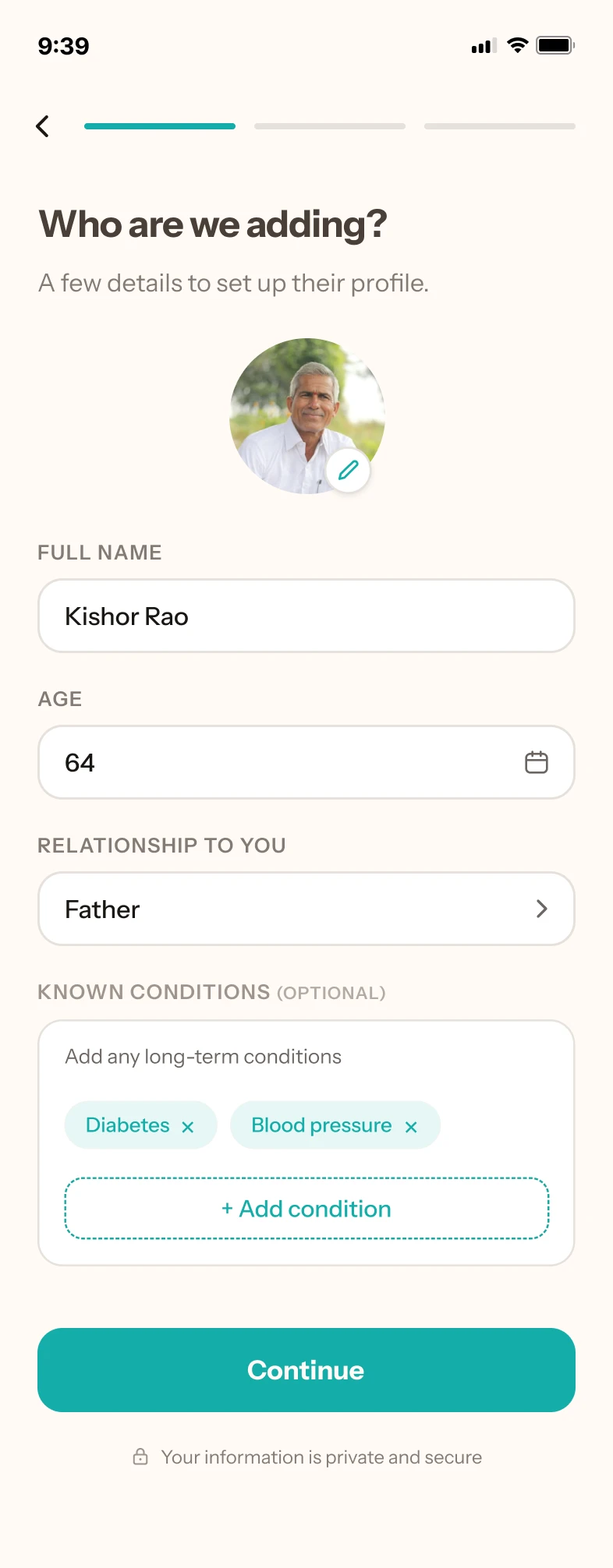
Who are we adding?
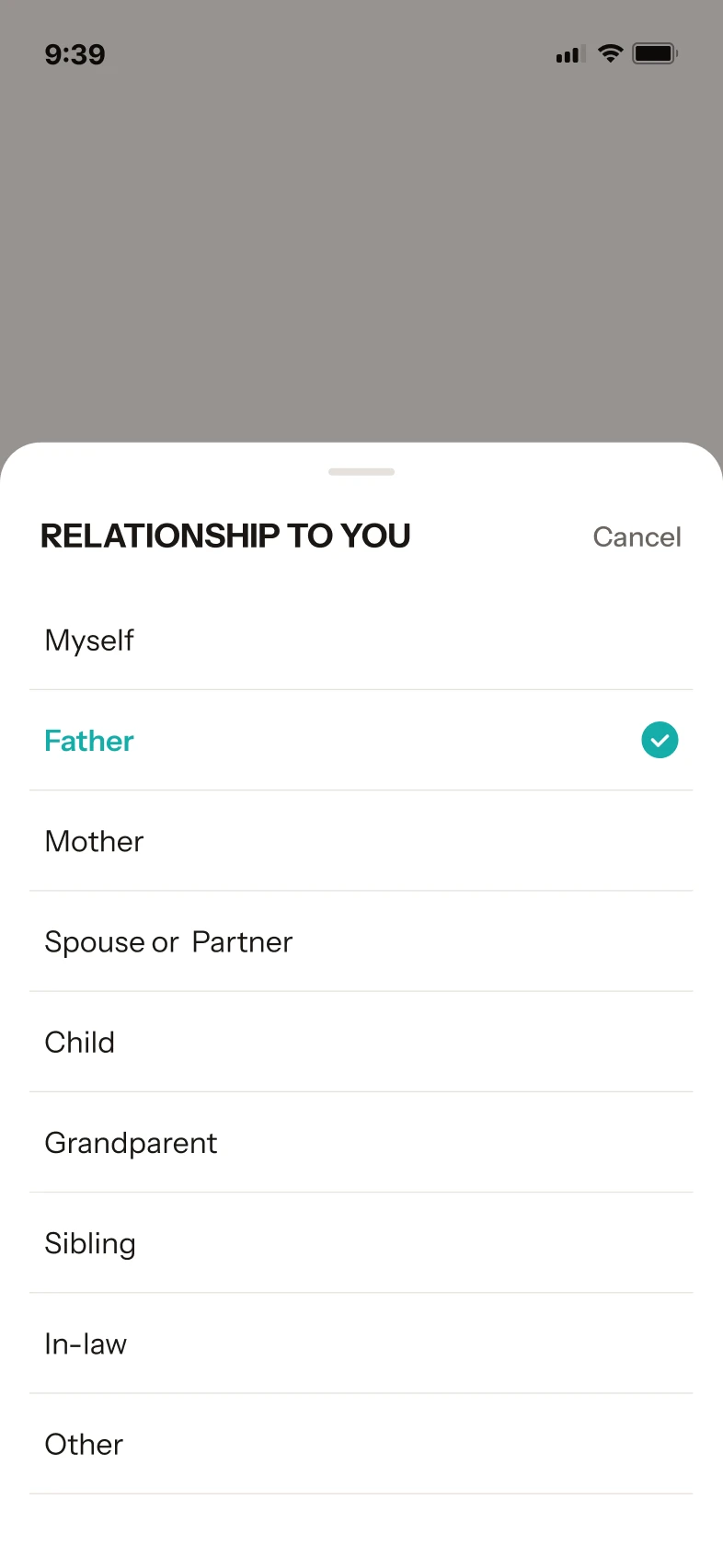
Relationship
Setup asks about the patient.
Name, age, relationship and conditions describe the person whose medicines these are, not whoever is holding the phone. “Myself” is on the list too.
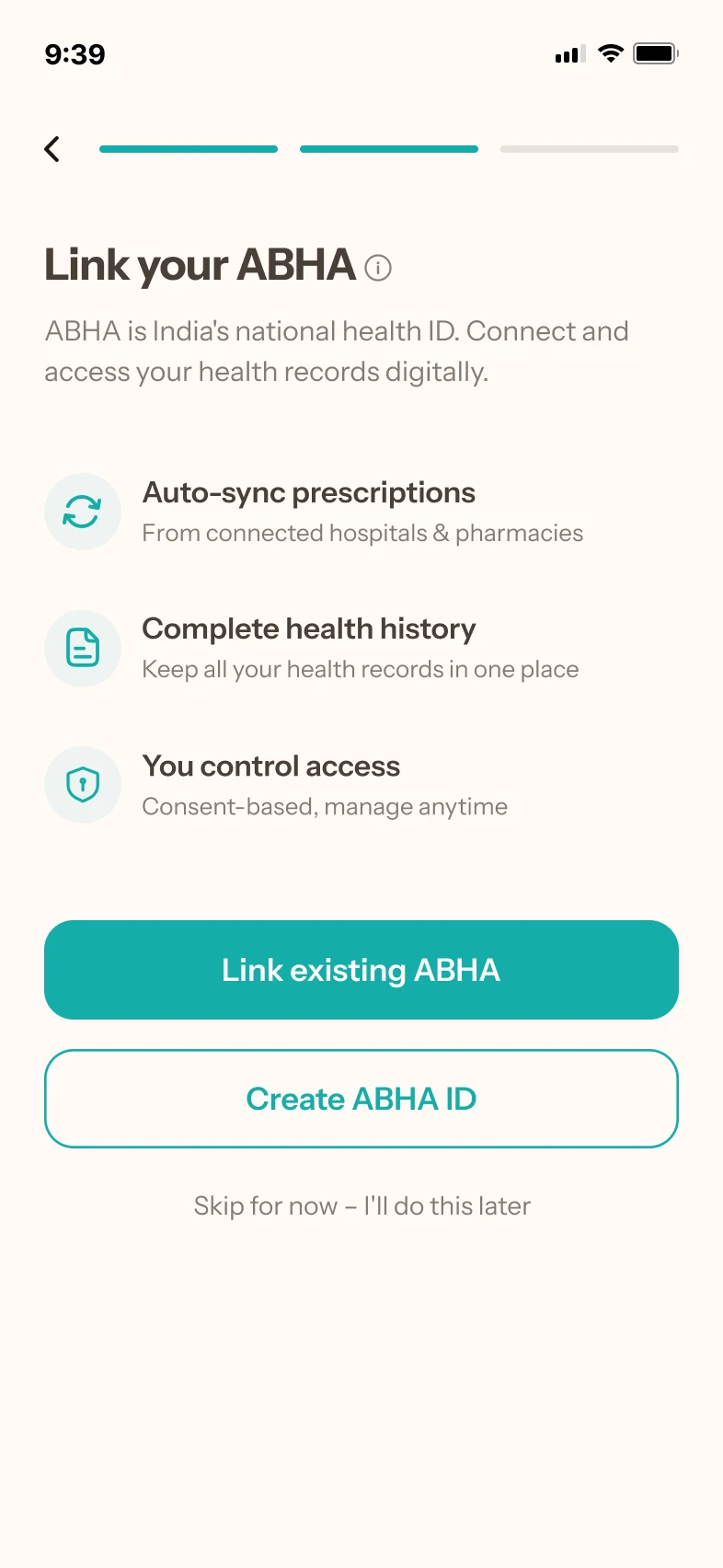
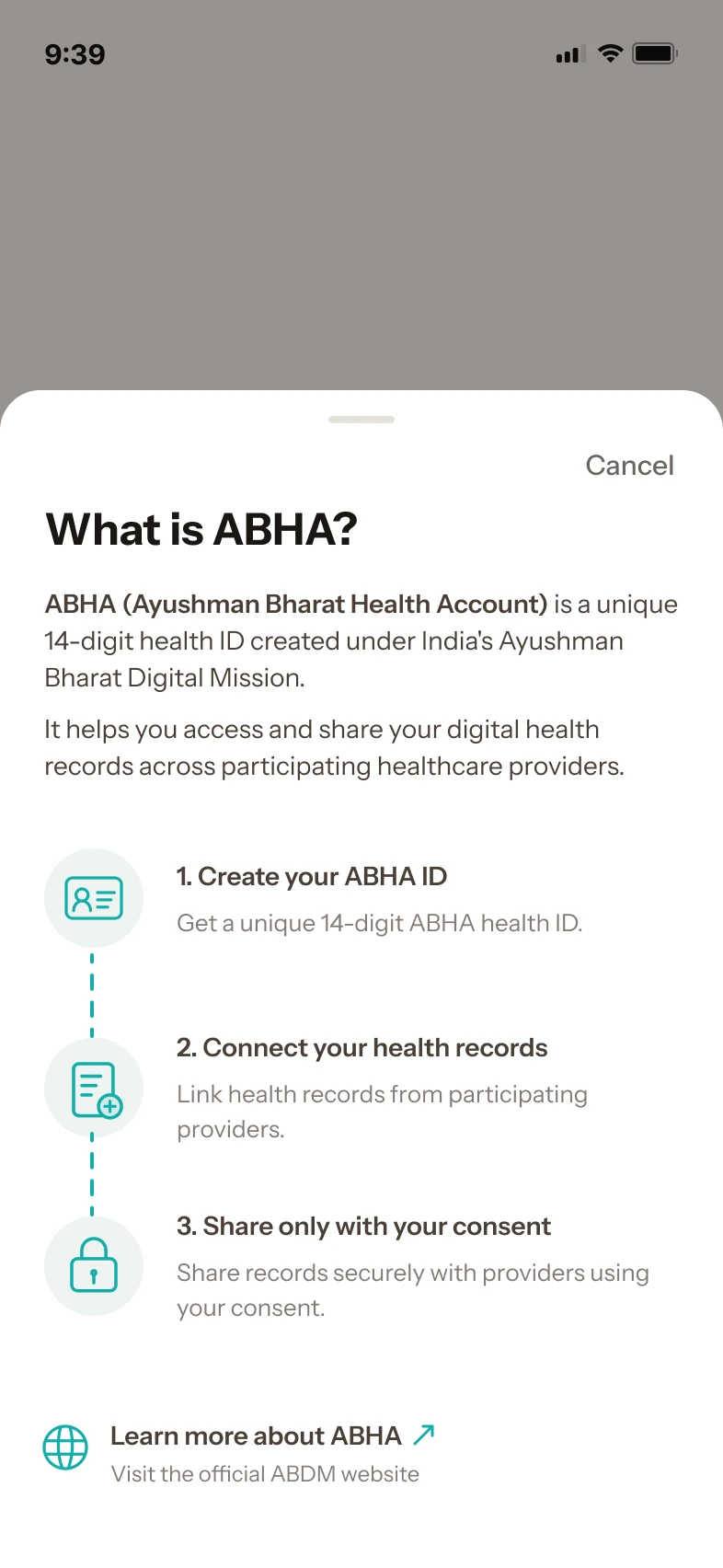
Link your ABHA
What is ABHA?
ABHA is offered before the first medicine is added.
Link an ABHA you already have, create one inside the app, or skip and add by hand. The ⓘ explains ABHA right there.
WHY the counter already asks for this number. It is what later lets a purchase find the right person.
WHY one person holds the list together, and it is usually not the patient (insight 04).
WHY a record can only travel to the list if the ABHA is linked first.
SETUP
Setup asks about the person on the list,
not the person holding the phone.
Everyone passes through these screens: one number to sign in, one person to set up, and one choice before the first medicine is added: ABHA.
Skip on every card. The four cards say what the app does, and none of them blocks setup.
Splash
One place for everything
2
Scan once. Stay clear.
Know what changed.
Ready for any doctor.
One number, and a code.
The same mobile number a pharmacy counter asks for, which is what later lets a purchase find the right person.
WHY the counter already asks for this number. It is what later lets a purchase find the right person.
Sign in
2
Verify the number
Setup asks about the patient.
Name, age, relationship and conditions describe the person whose medicines these are, not whoever is holding the phone. “Myself” is on the list too.
WHY one person holds the list together, and it is usually not the patient (insight 04).
2
Who are we adding?
Relationship
ABHA is offered before the first medicine is added.
Link an ABHA you already have, create one inside the app, or skip and add by hand. The ⓘ explains ABHA right there.
WHY a record can only travel to the list if the ABHA is linked first.
Link your ABHA
2
What is ABHA?
TASK 01
Build the list from paper,
then show it to a doctor.
Starting from an empty list, through the review that asks instead of guessing, to the visit and the change the doctor makes.
Home, the list is empty
Add health information for Kishor
Paper, or a name?
Upload photos or documents
Camera, gallery or files
Up to twenty
The card counts what was added
Search or type a medicine
Found it?
Pick it, add the details
Add it by hand
Putting the list together
Sure about every medicine?
Please confirm card
With the reason and date
Still taking?
Stays on the list
Removed from the list
Kishor’s medicines
Morning, afternoon, night
Show to doctor
Grouped by condition
At the visit, the doctor stops one medicine and starts another
Medicine details, Mark as stopped
Reason picked?
Confirm stays off
Stopped, kept in Activity
Add medicine
Search, then the details
The list matches what the doctor decided

Paper

A name
Yes

No



No

Yes
Yes

No



No

Yes


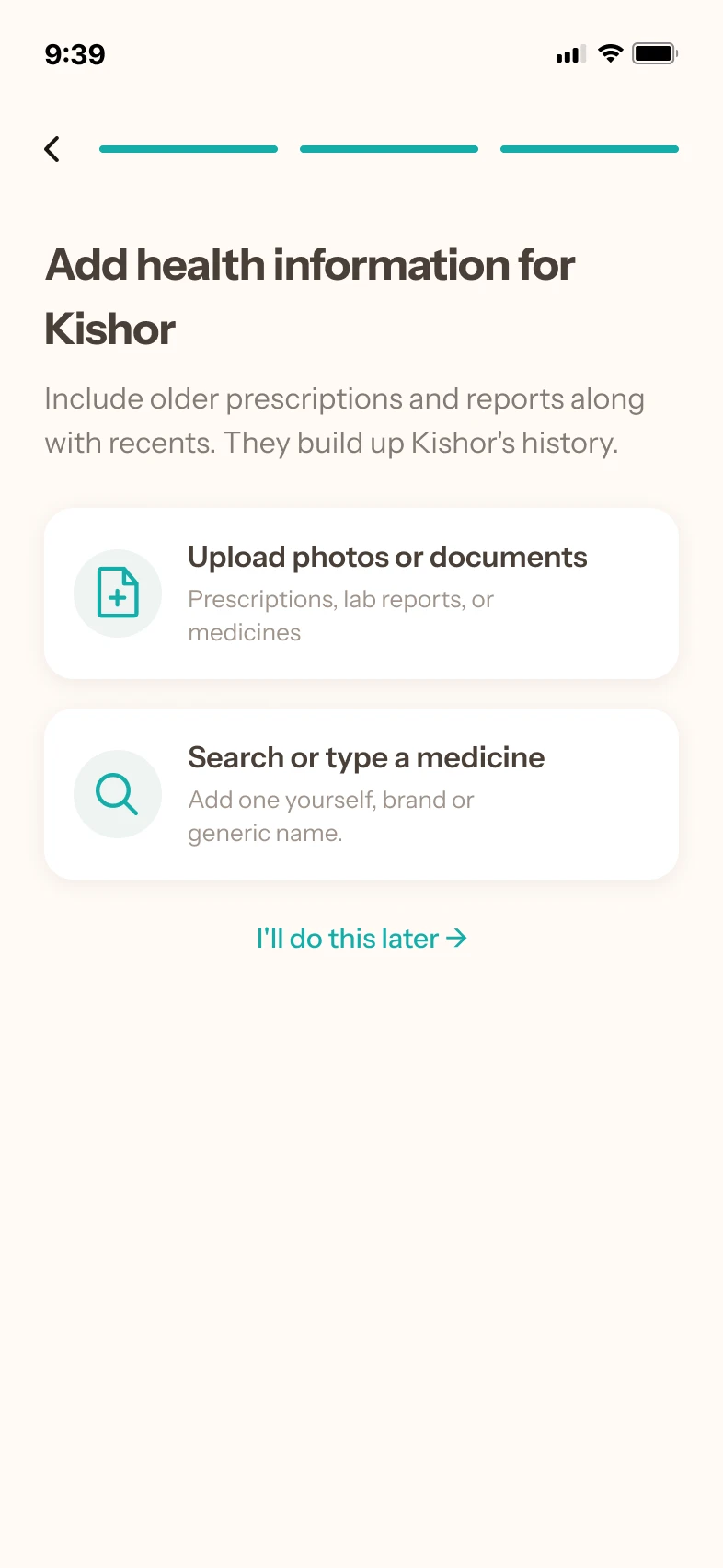
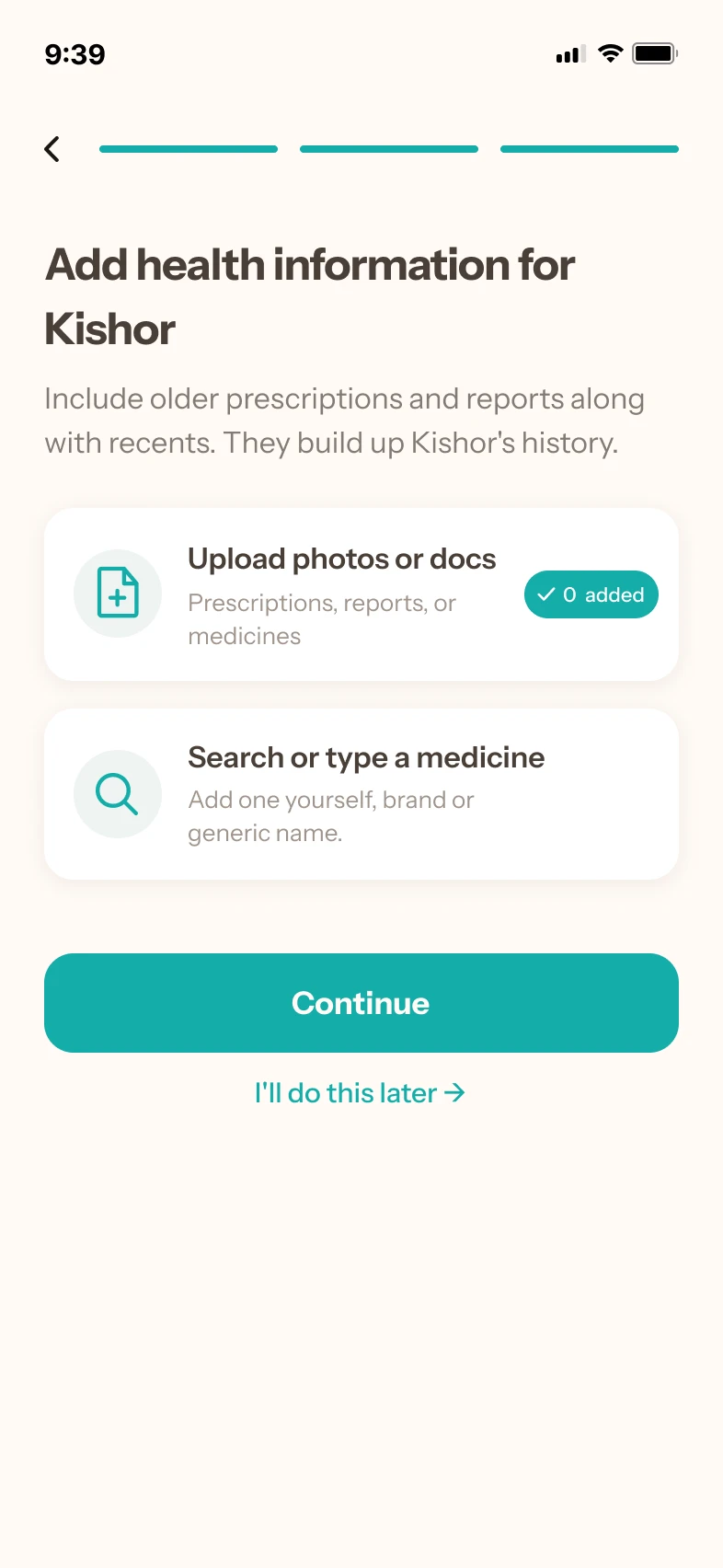
Add health information
Photos added, not yet read
One way in for paper.
Prescriptions, reports and medicine boxes all go through one button, and the card counts what was added before anything is read. Telling them apart is the app’s job.
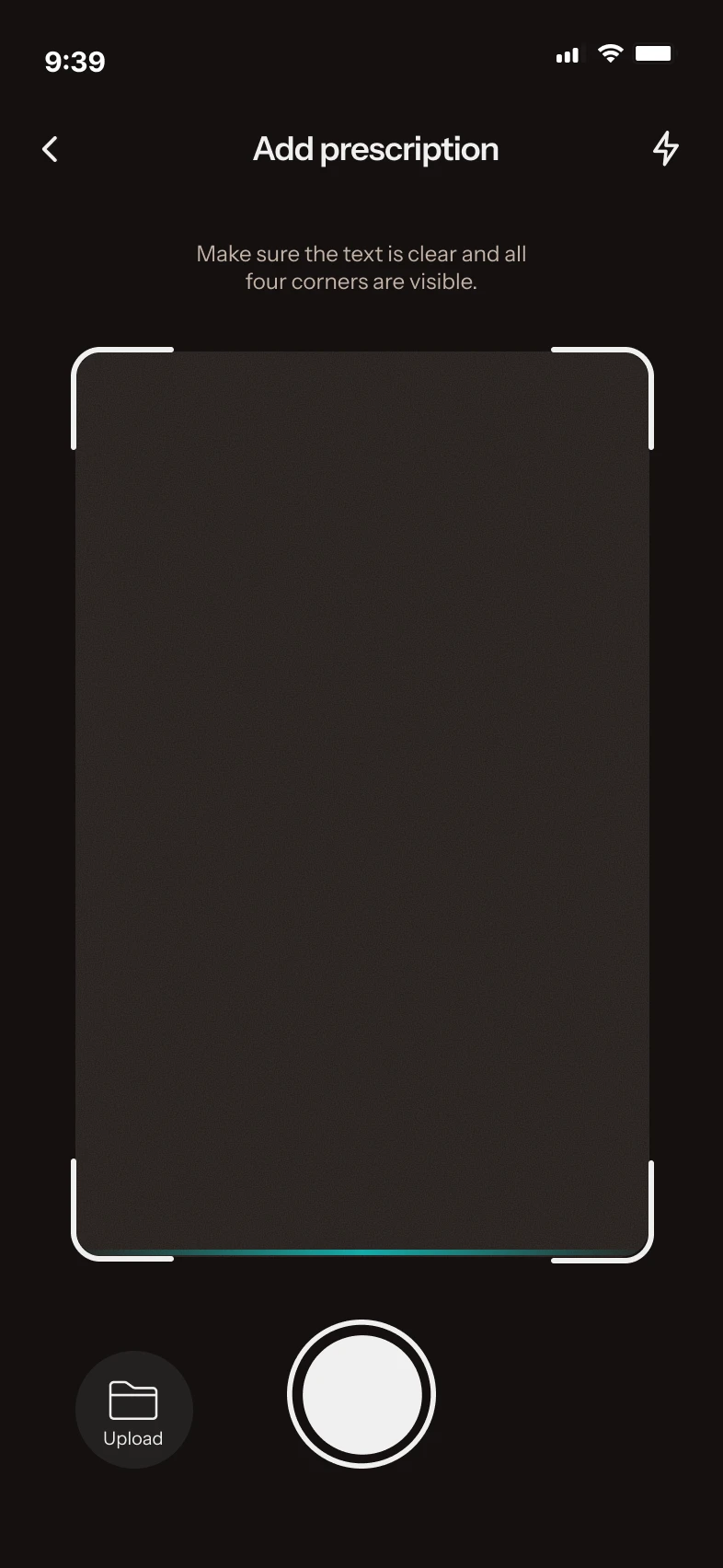
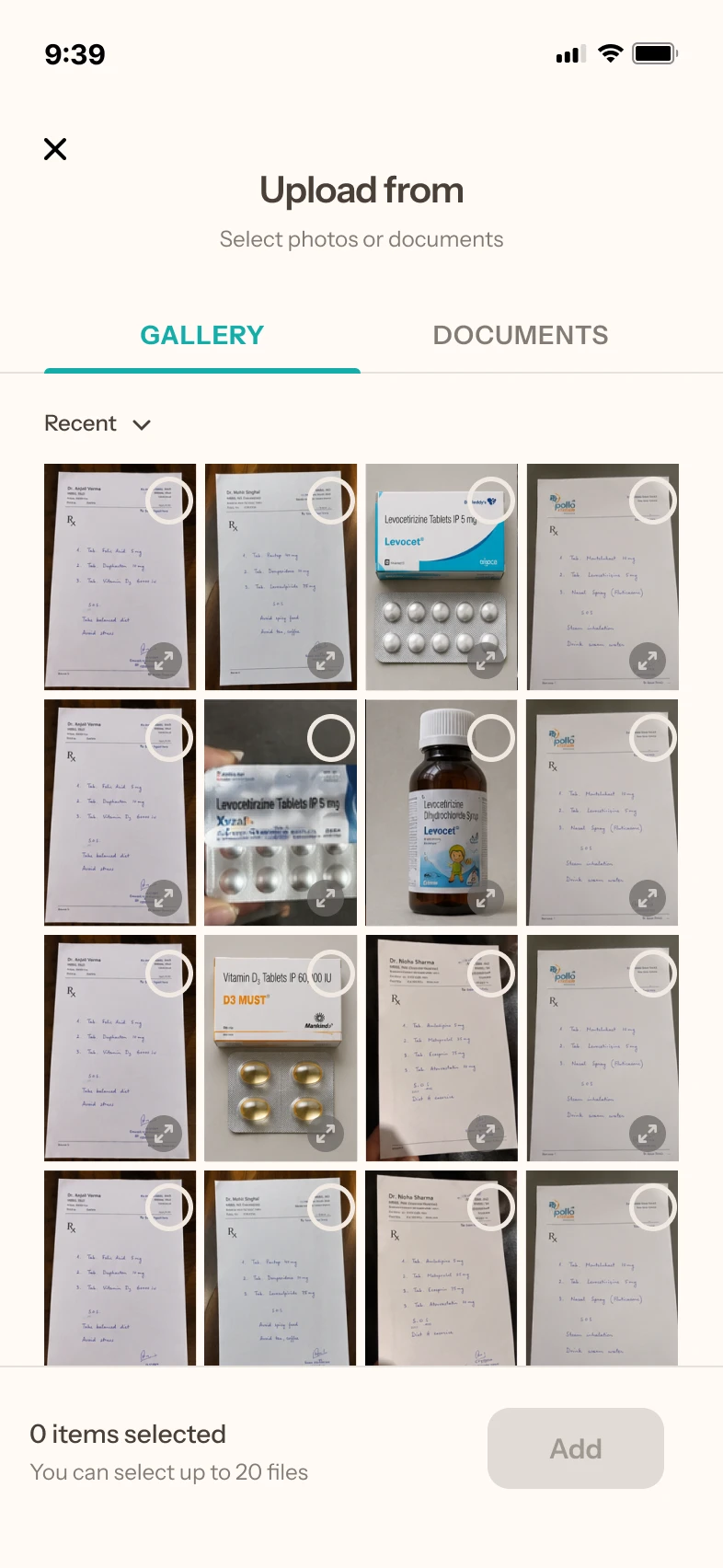
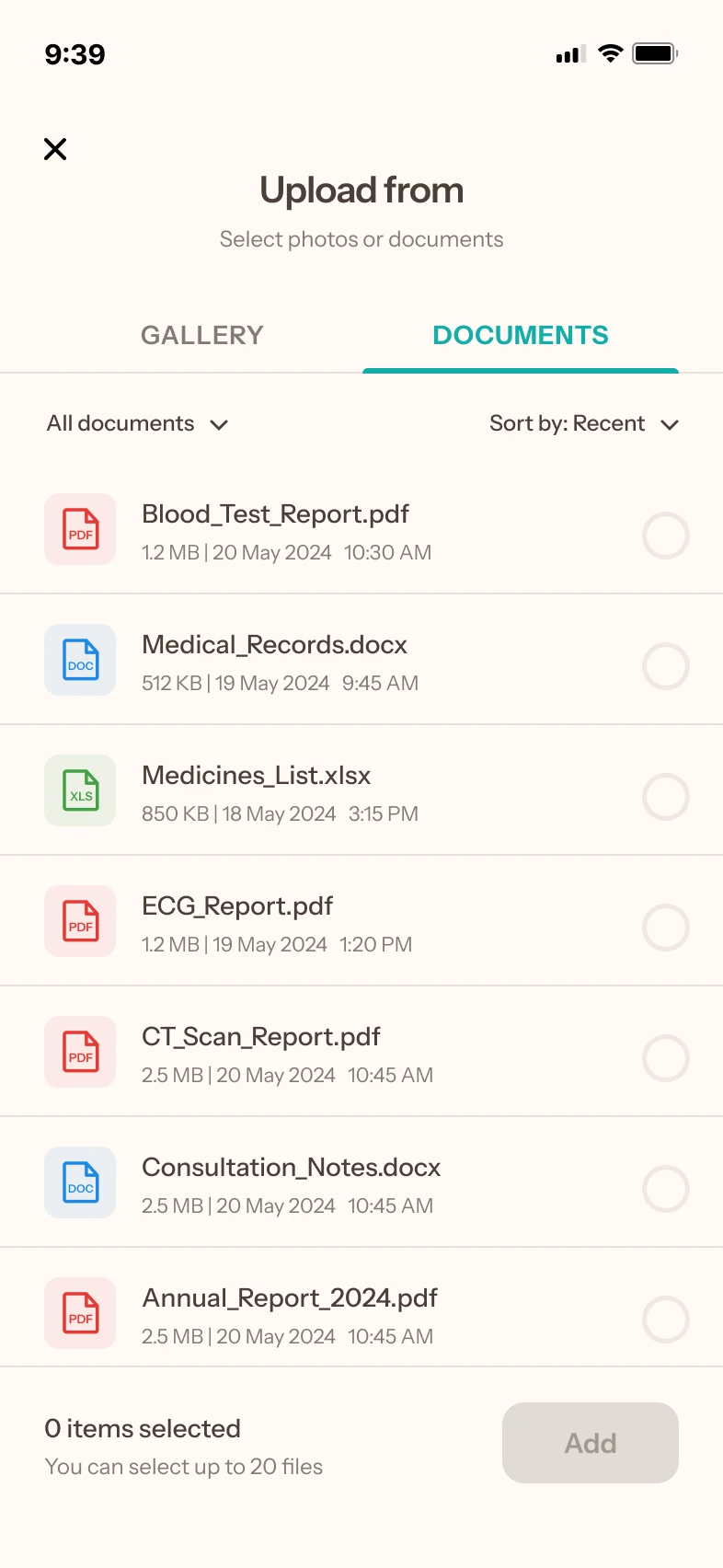
Photograph
Gallery
Documents
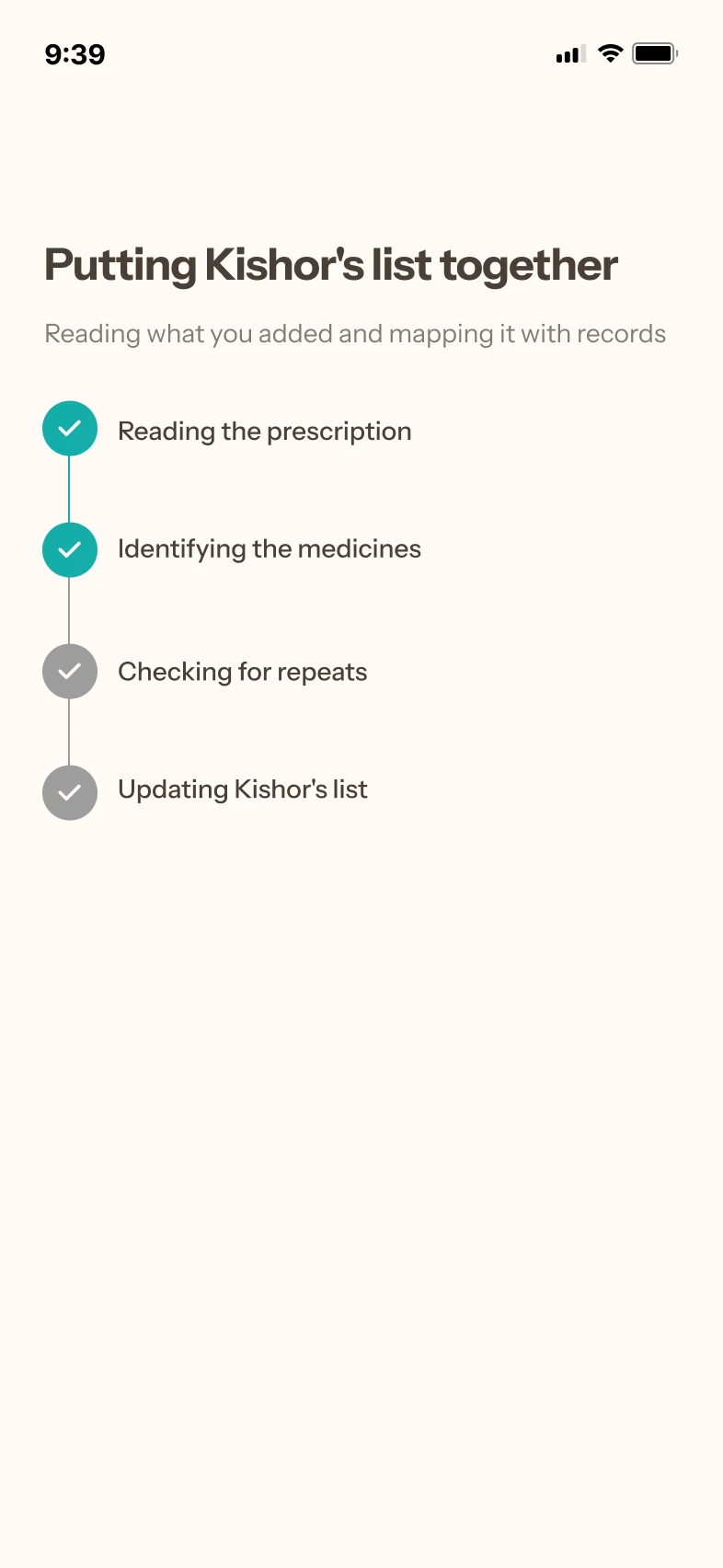
Putting the list together
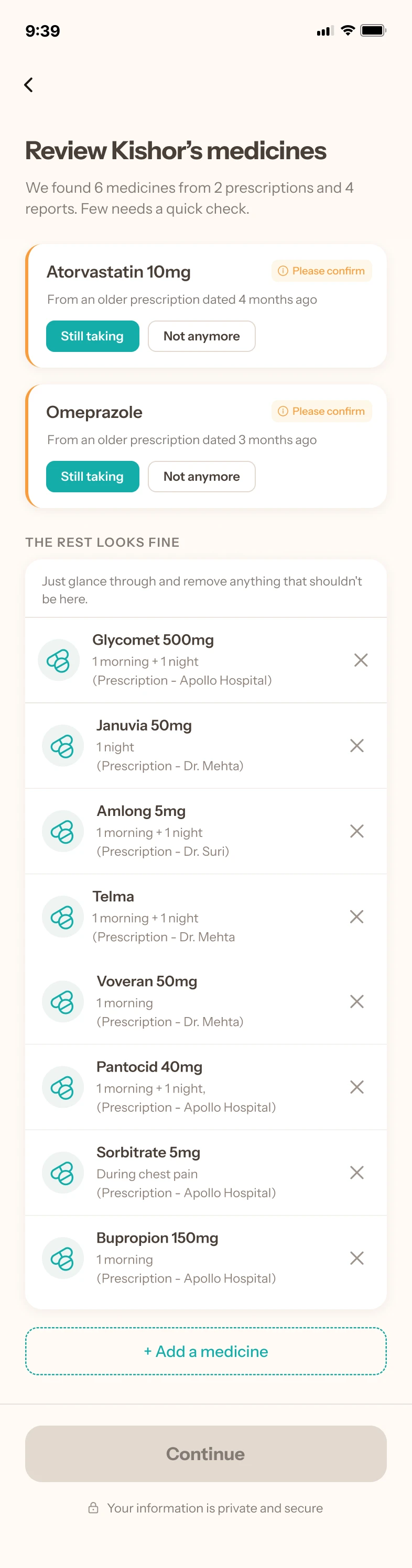
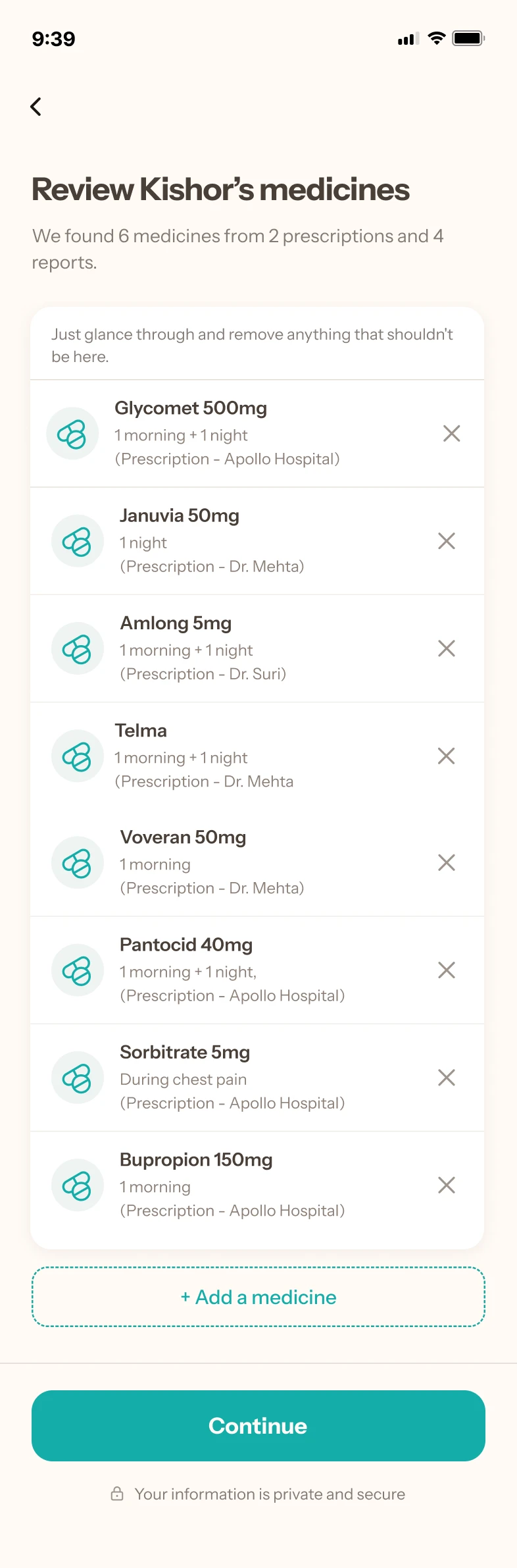
Two to confirm
All answered
When it is not sure, it asks.
A medicine from an older prescription comes with its reason and its date. Continue waits until each one is answered: still taking, or not anymore.
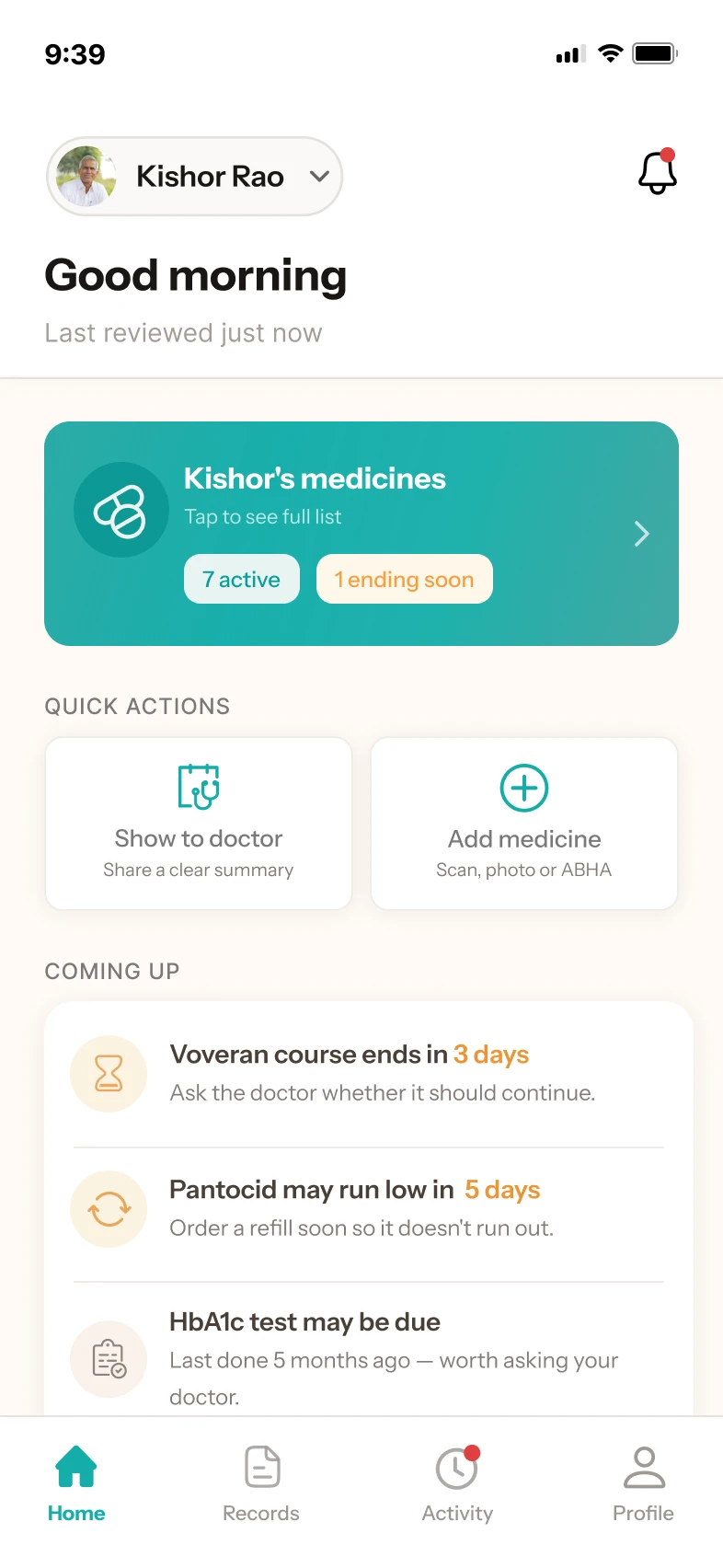
Home
Kishor’s medicines
The list is the hero.
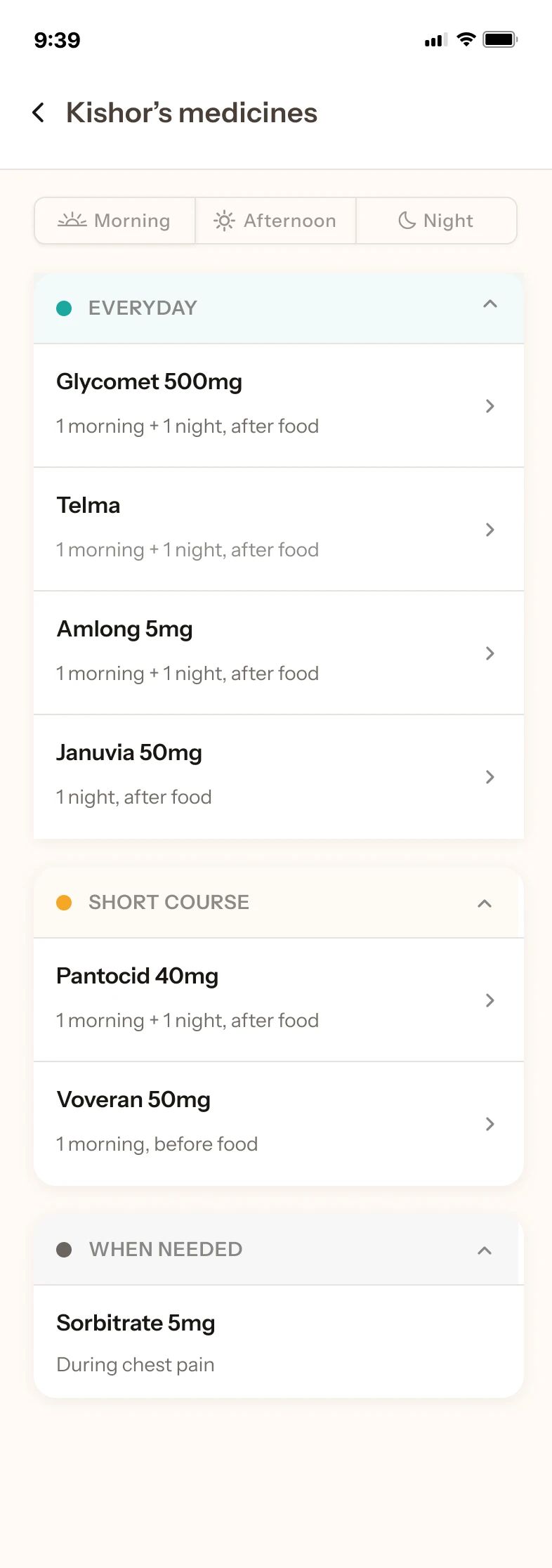
Home gives almost all its weight to the card for Kishor’s medicines, and one tap opens the whole list: everyday, short course, when needed.
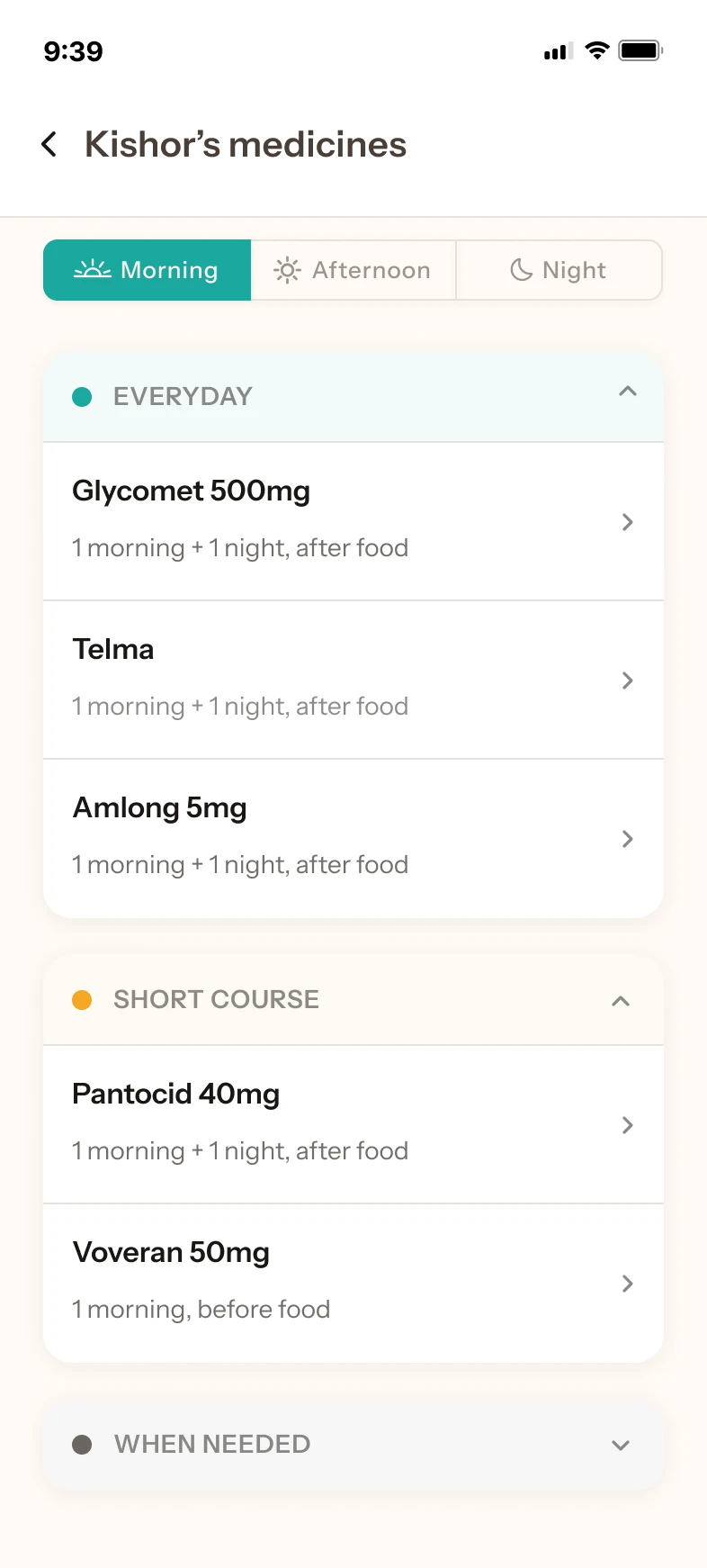
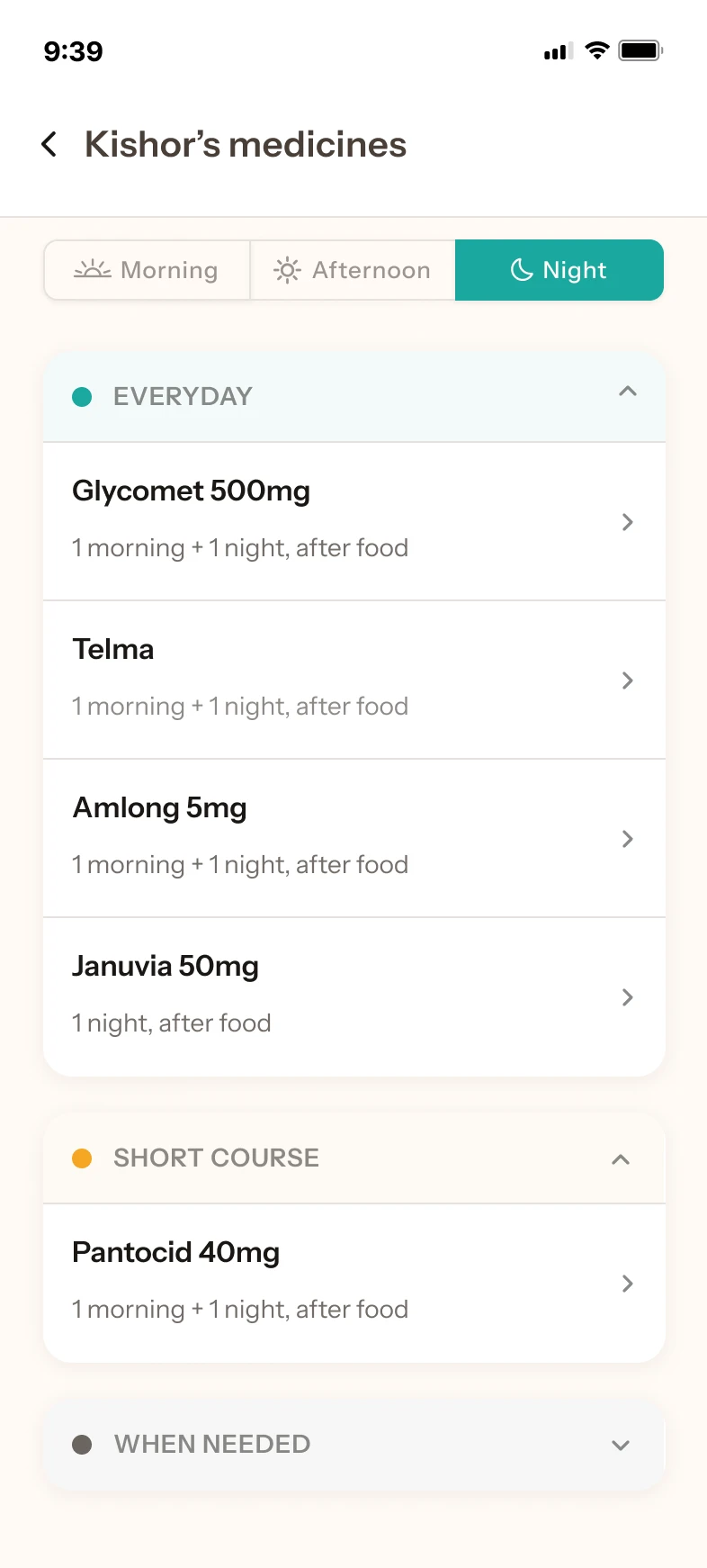
Morning
Night
What to take, right now.
Morning, afternoon or night in one tap. When needed stays at the bottom of every view.
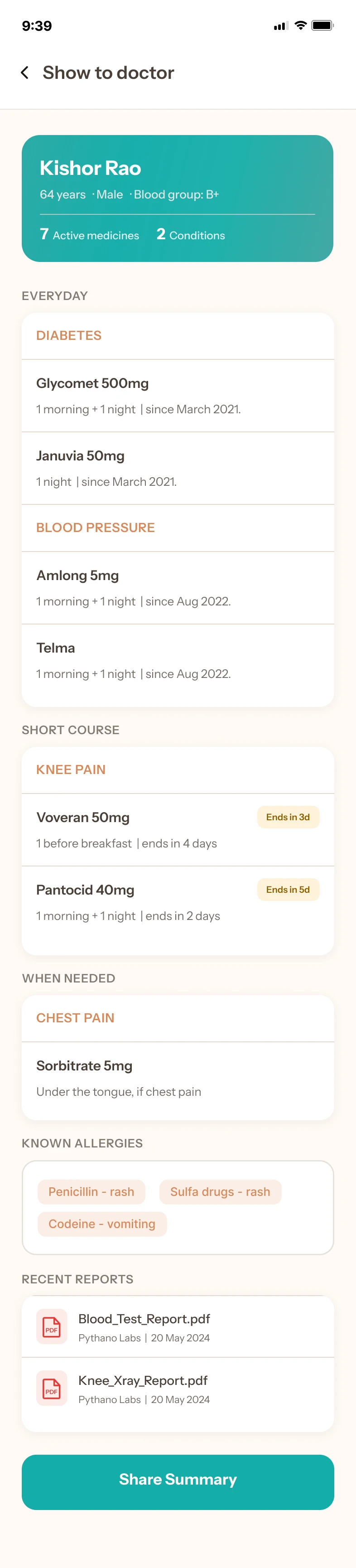
Show to doctor
Scrolled to the end
Grouped by condition, the way a doctor reads.
Diabetes, then blood pressure, then short courses and when needed, with allergies and recent reports at the end. One screen for a doctor with ten minutes and no history.
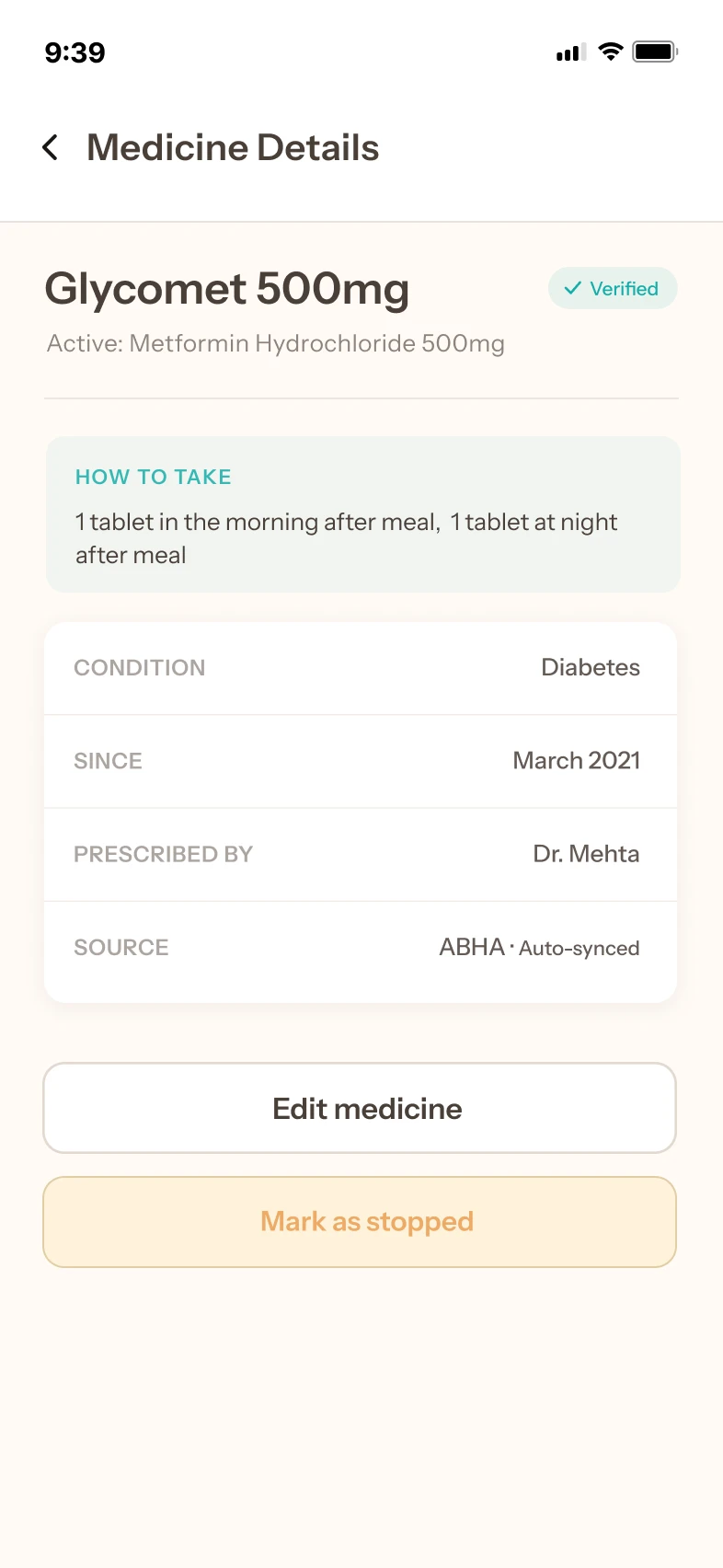
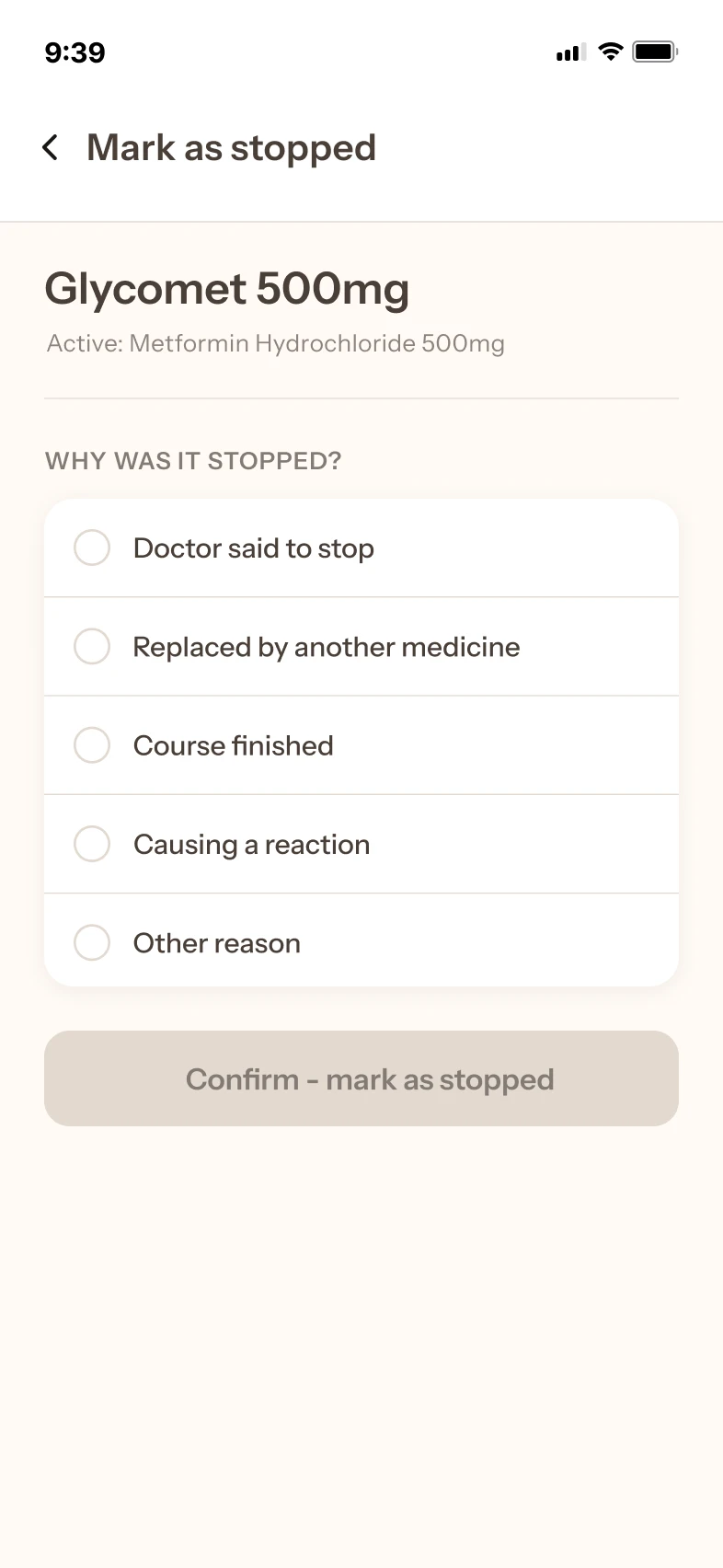
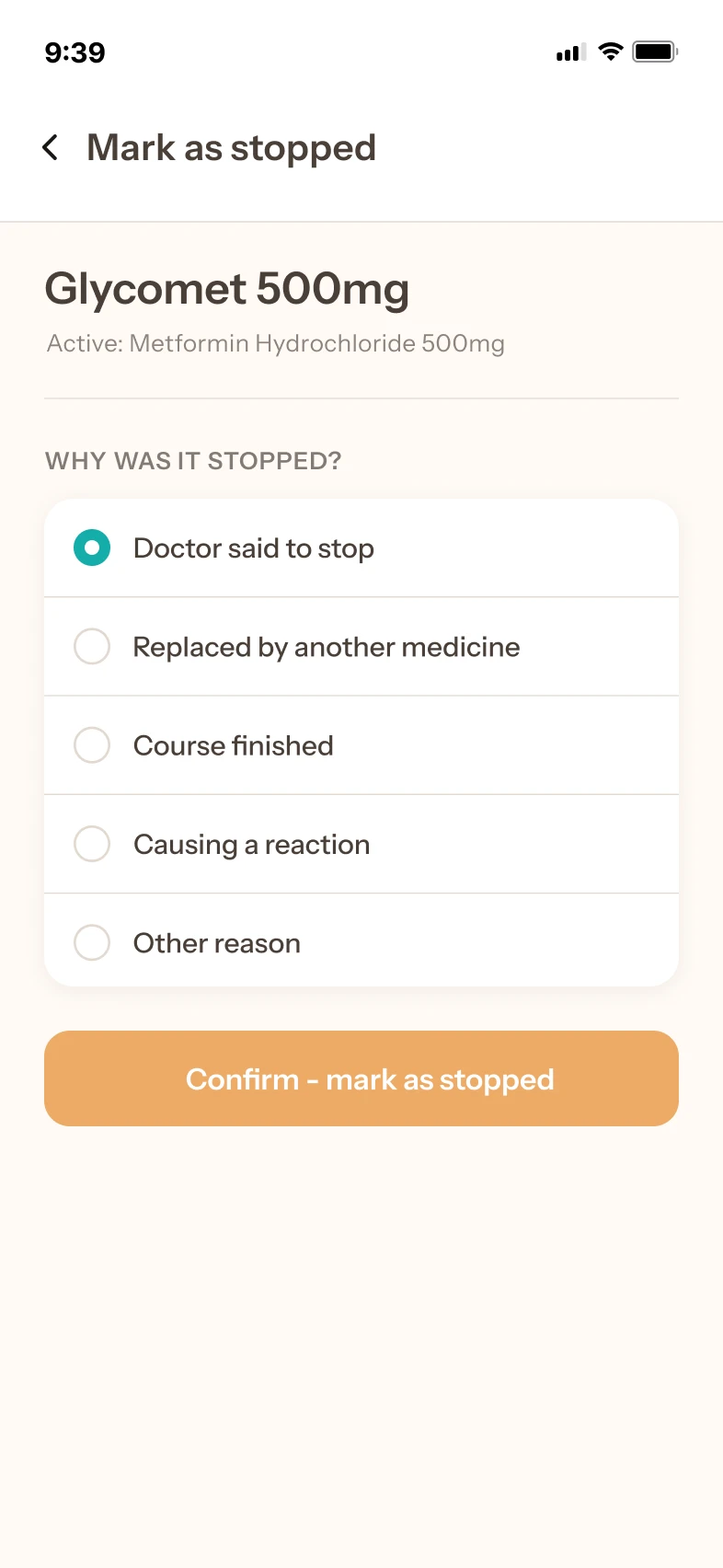
Medicine details
Why was it stopped?
Stopping needs a reason.
Mark as stopped sits on every medicine’s detail. The reasons start with nothing picked, and Confirm stays off until one is chosen.
Reason picked
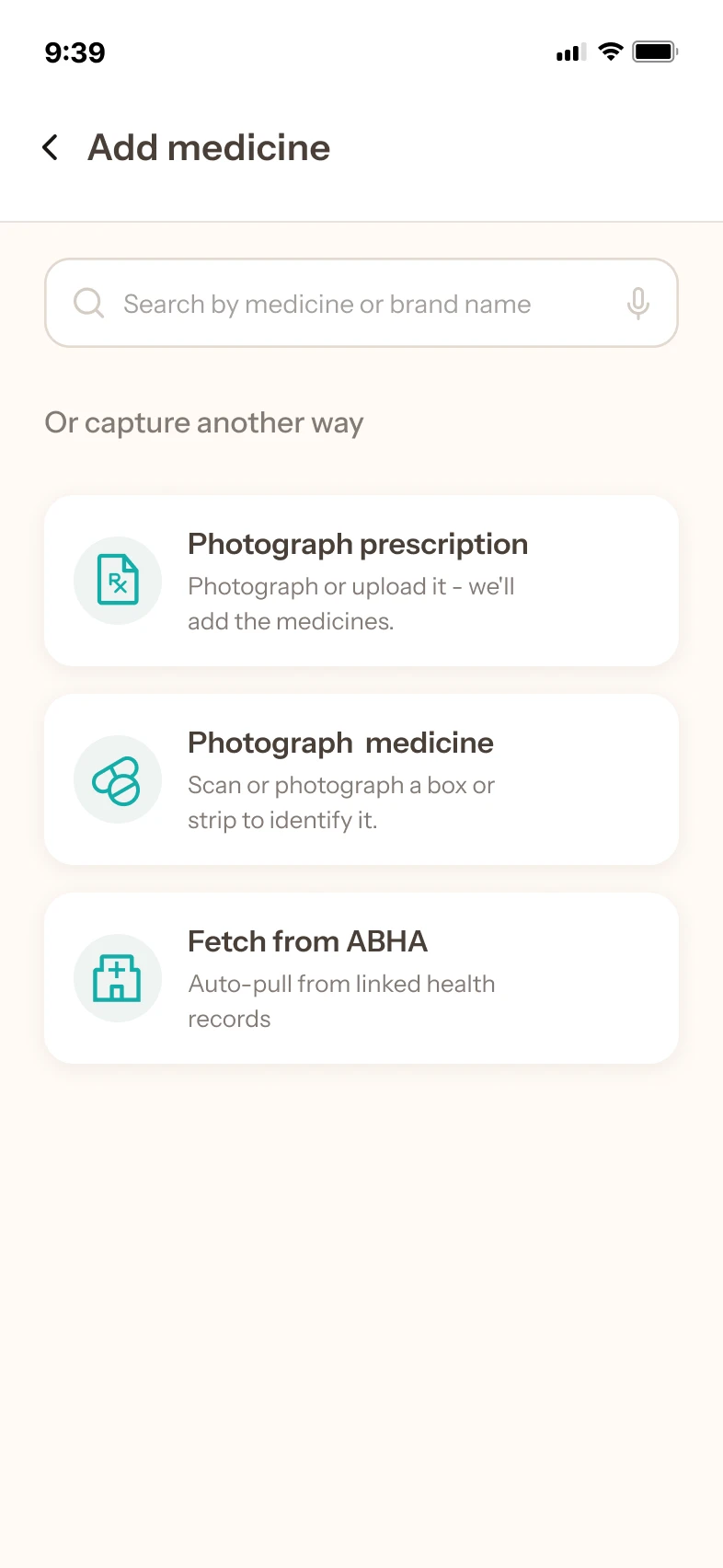
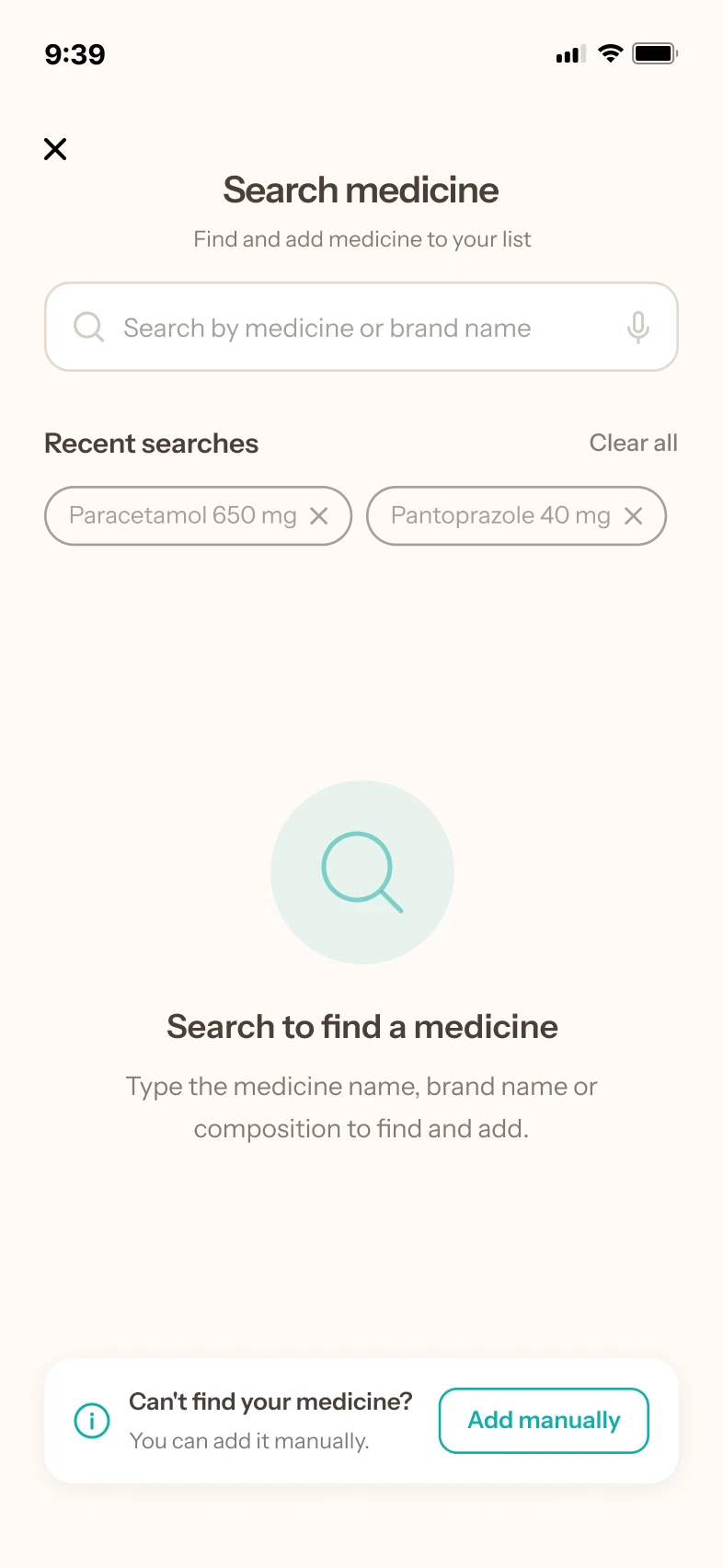
Add medicine
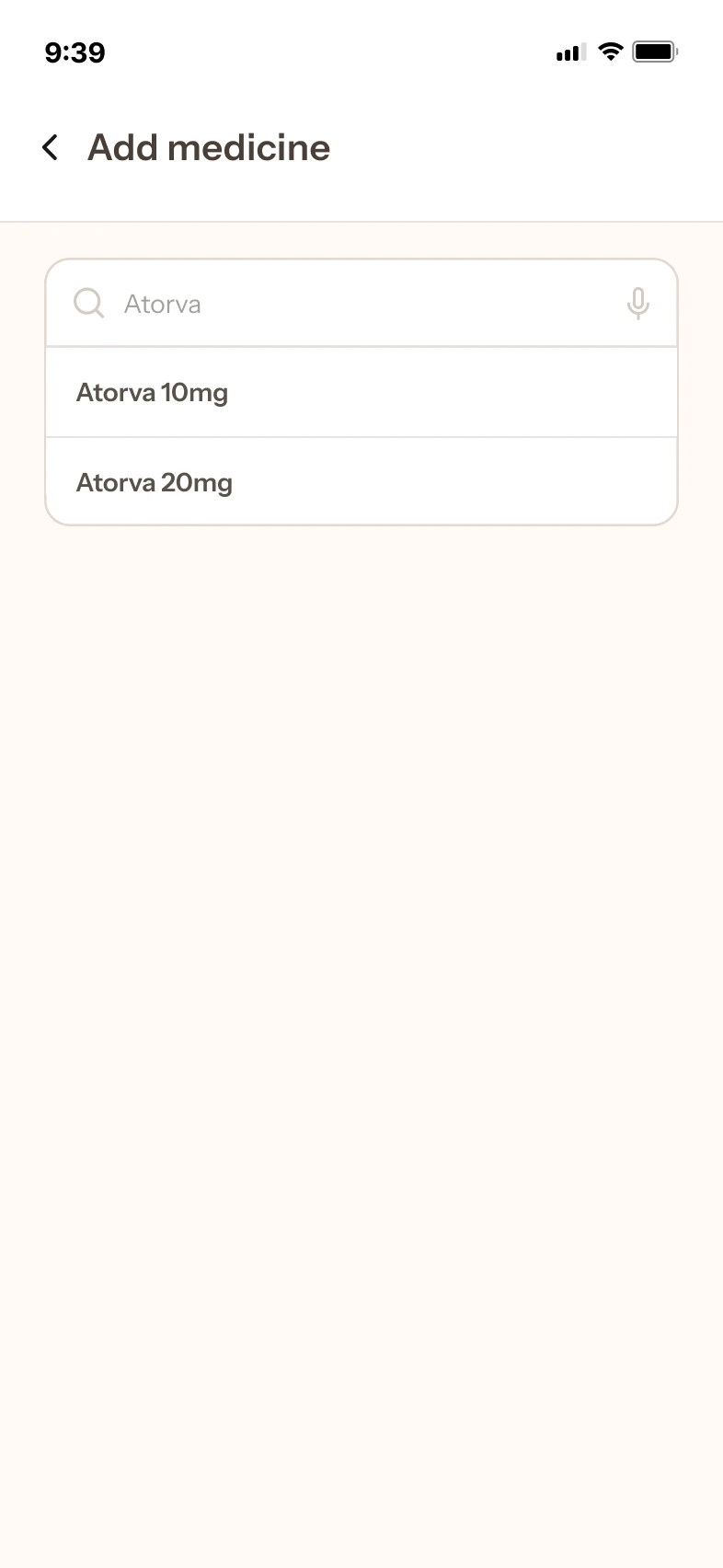
Search
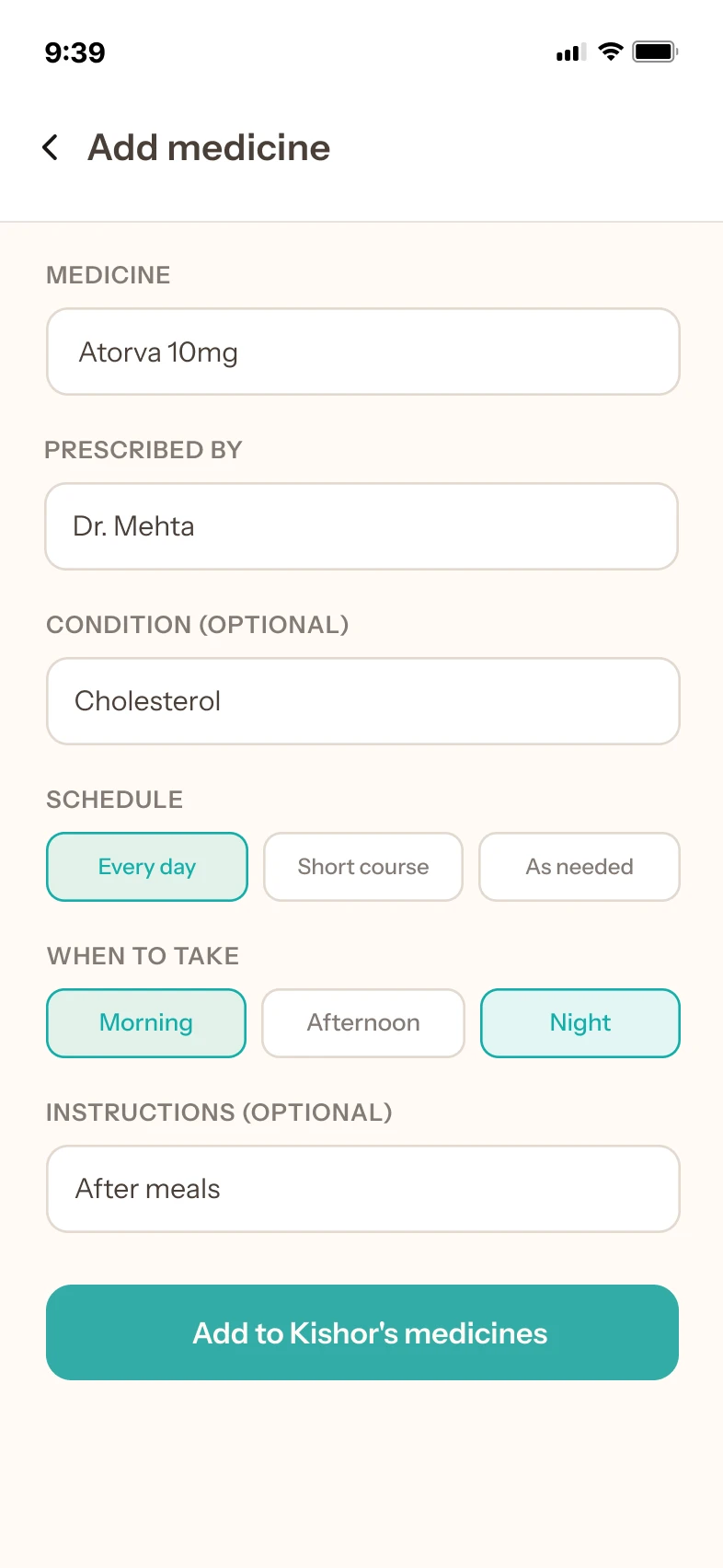
Details
Nothing found
IN TESTING


9 of 11 completed
PLACEHOLDER · replace with the real count
WHERE PEOPLE PAUSED
Choosing between separate cards for a prescription, a report and a medicine before taking the photo. People stopped to decide what kind of paper they were holding.
WHAT CHANGED
One Upload photos or documents button. The app works out what each photo is.
WHY papers came from every doctor, and none of them was the whole list.
WHY a change is written on a new sheet, never against the old one (cause 03).
WHY nobody holds one current list. This screen is that list.
WHY outside feedback: one long list felt overwhelming.
WHY the list was recited at every visit, not read (insight 03).
WHY nothing said when a medicine was stopped, or why.
TASK 01
Build the list from paper,
then show it to a doctor.
Starting from an empty list, through the review that asks instead of guessing, to the visit and the change the doctor makes.
Home, the list is empty
Add health information for Kishor
Paper, or a name?
Upload photos or documents
Camera, gallery or files
Up to twenty
The card counts what was added
Search or type a medicine
Found it?
Pick it, add the details
Add it by hand
Putting the list together
Sure about every medicine?
Please confirm card
With the reason and date
Still taking?
Stays on the list
Removed from the list
Kishor’s medicines
Morning, afternoon, night
Show to doctor
Grouped by condition
At the visit, the doctor stops one medicine and starts another
Medicine details, Mark as stopped
Reason picked?
Confirm stays off
Stopped, kept in Activity
Add medicine
Search, then the details
The list matches what the doctor decided
Paper
A name
Yes
No
No
Yes
Yes
No
No
Yes
2
Swipe sideways to see the whole diagram.
One way in for paper.
Prescriptions, reports and medicine boxes all go through one button, and the card counts what was added before anything is read. Telling them apart is the app’s job.
WHY papers came from every doctor, and none of them was the whole list.
Add health information
2
Photos added, not yet read
Photograph
Gallery
2
Documents
Putting the list together
When it is not sure, it asks.
A medicine from an older prescription comes with its reason and its date. Continue waits until each one is answered: still taking, or not anymore.
WHY a change is written on a new sheet, never against the old one (cause 03).
2
Two to confirm
All answered
The list is the hero.
Home gives almost all its weight to the card for Kishor’s medicines, and one tap opens the whole list: everyday, short course, when needed.
WHY nobody holds one current list. This screen is that list.
Home
2
Kishor’s medicines
What to take, right now.
Morning, afternoon or night in one tap. When needed stays at the bottom of every view.
WHY outside feedback: one long list felt overwhelming.
2
Morning
Night
Grouped by condition, the way a doctor reads.
Diabetes, then blood pressure, then short courses and when needed, with allergies and recent reports at the end. One screen for a doctor with ten minutes and no history.
WHY the list was recited at every visit, not read (insight 03).
Show to doctor
2
Scrolled to the end
Stopping needs a reason.
Mark as stopped sits on every medicine’s detail. The reasons start with nothing picked, and Confirm stays off until one is chosen.
WHY nothing said when a medicine was stopped, or why.
2
Medicine details
Why was it stopped?
Reason picked
Add medicine
2
Search
Details
Nothing found
IN TESTING
9 of 11 completed
PLACEHOLDER · replace with the real count
WHERE PEOPLE PAUSED
Choosing between separate cards for a prescription, a report and a medicine before taking the photo. People stopped to decide what kind of paper they were holding.
WHAT CHANGED
One Upload photos or documents button. The app works out what each photo is.
TASK 02
The list fills itself,
from ABHA and from the counter.
Two routes bring records in without anyone typing them. Both stop and wait for a person before anything reaches a list.
Records arrive without typing
Where from?
Link existing ABHA
Enter the ABHA number
Verify the code
Allow access?
Add by hand instead, Task 01
Looking for linked records
What we found
Grouped by source
Open a source in place
Its medicines, the original
Review
Same screen as Task 01
Bought at a connected pharmacy
Synced to Activity
Needs review
Whose purchase?
Not mine: removed, logged
Sort purchase
What was bought, where
Who is this for?
Add the details
Two fields grow
Name, relationship
Added to Kishor’s medicines
Added to Sunita’s list
Sunita’s home
Finish setup later
On the right person’s list, confirmed by a person

ABHA

The counter

Allow

Not now


Not mine
Sort it

Kishor

Add someone



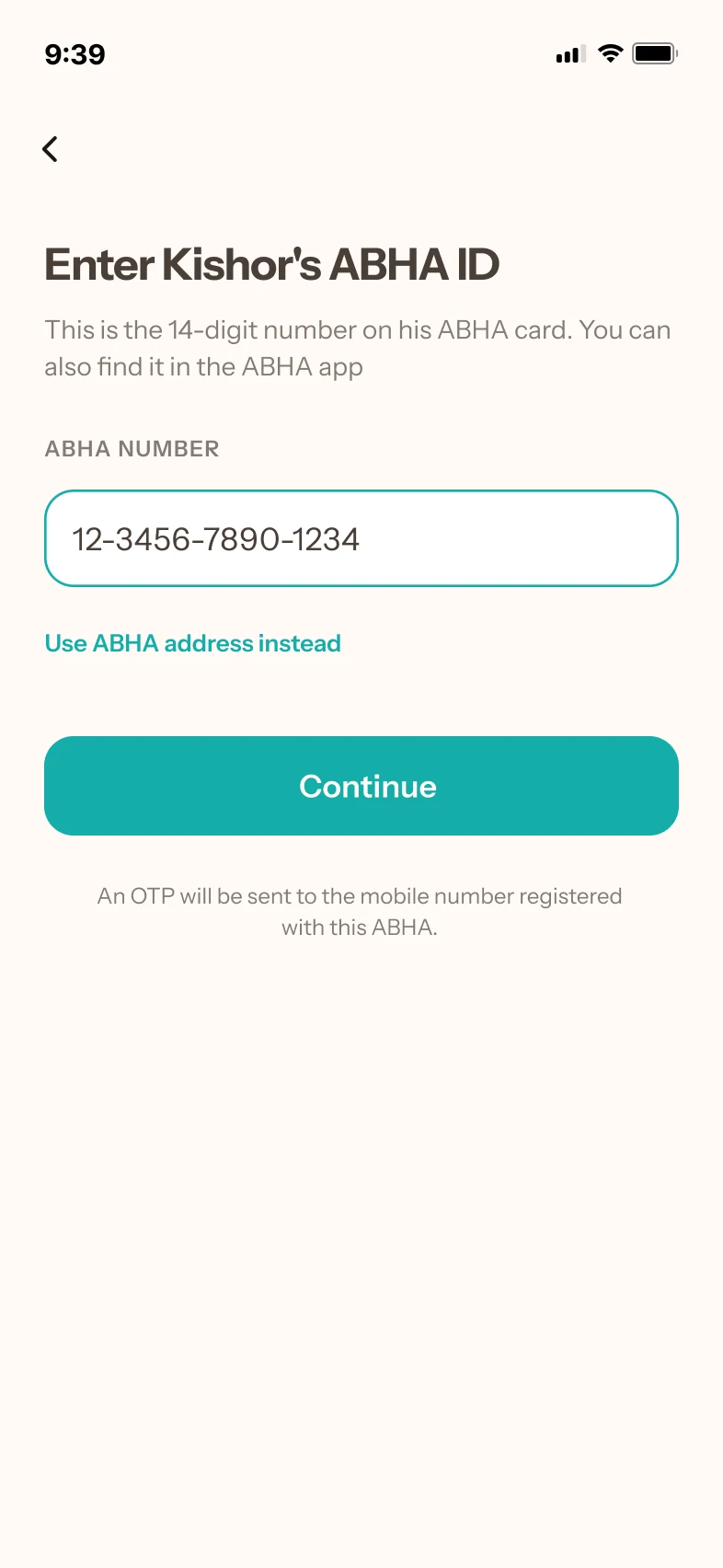
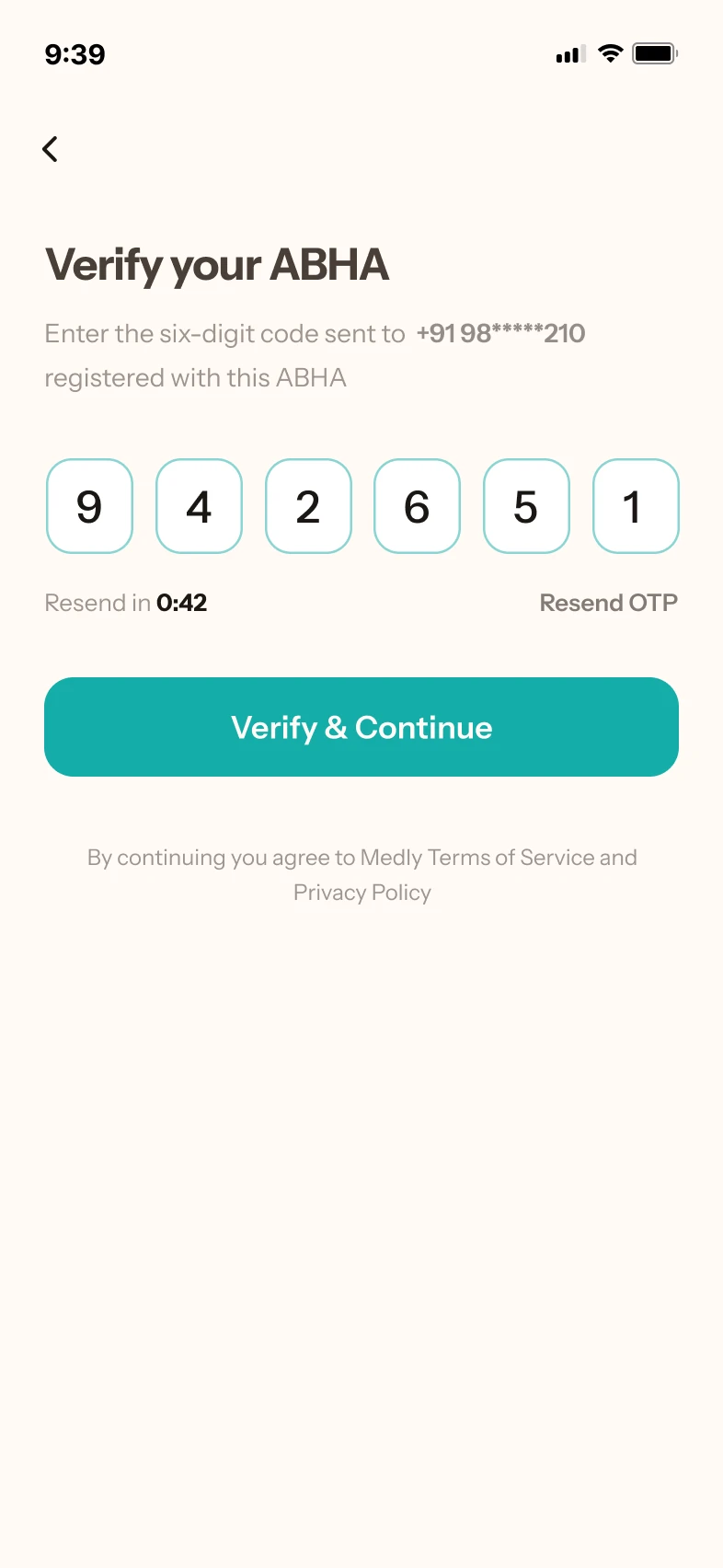
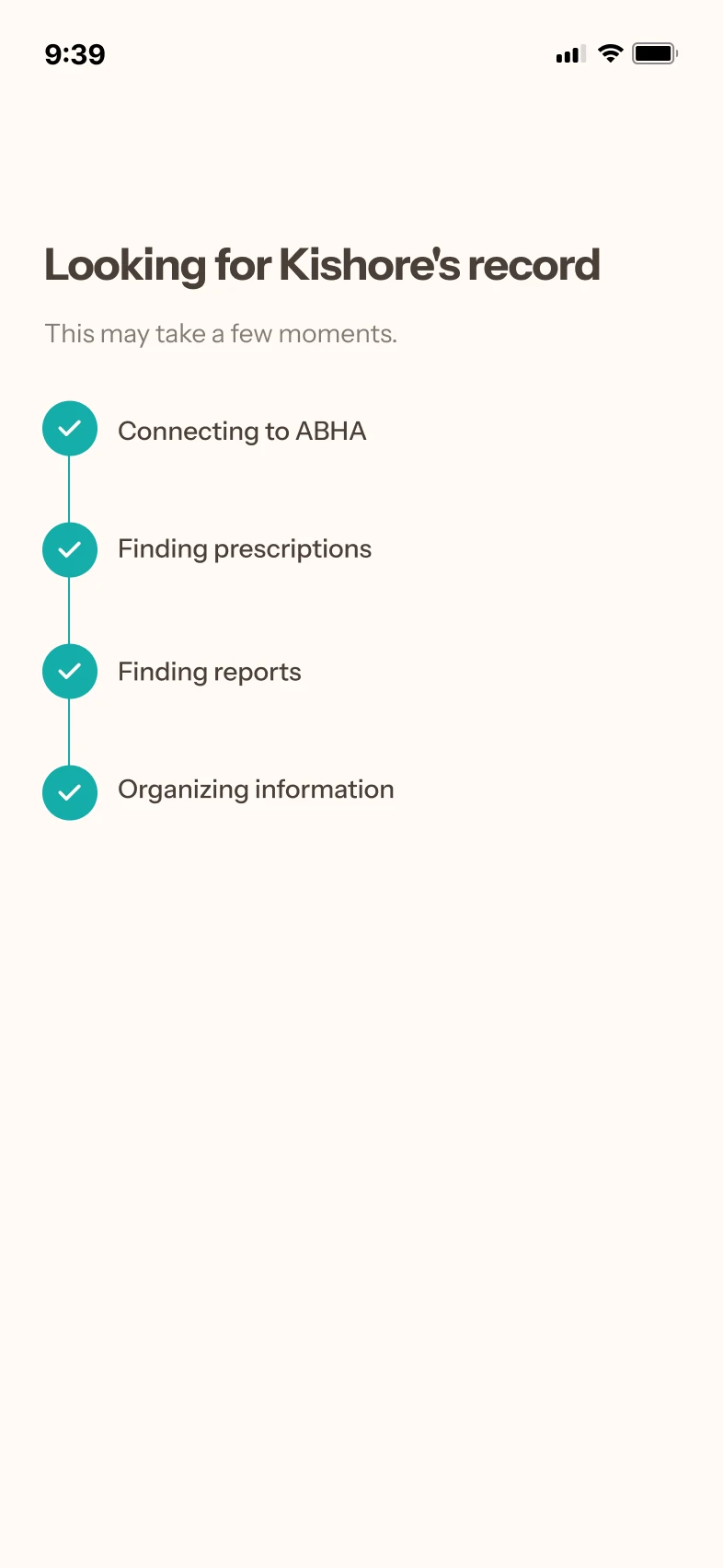
Enter ABHA number
Verify the code
Looking for records
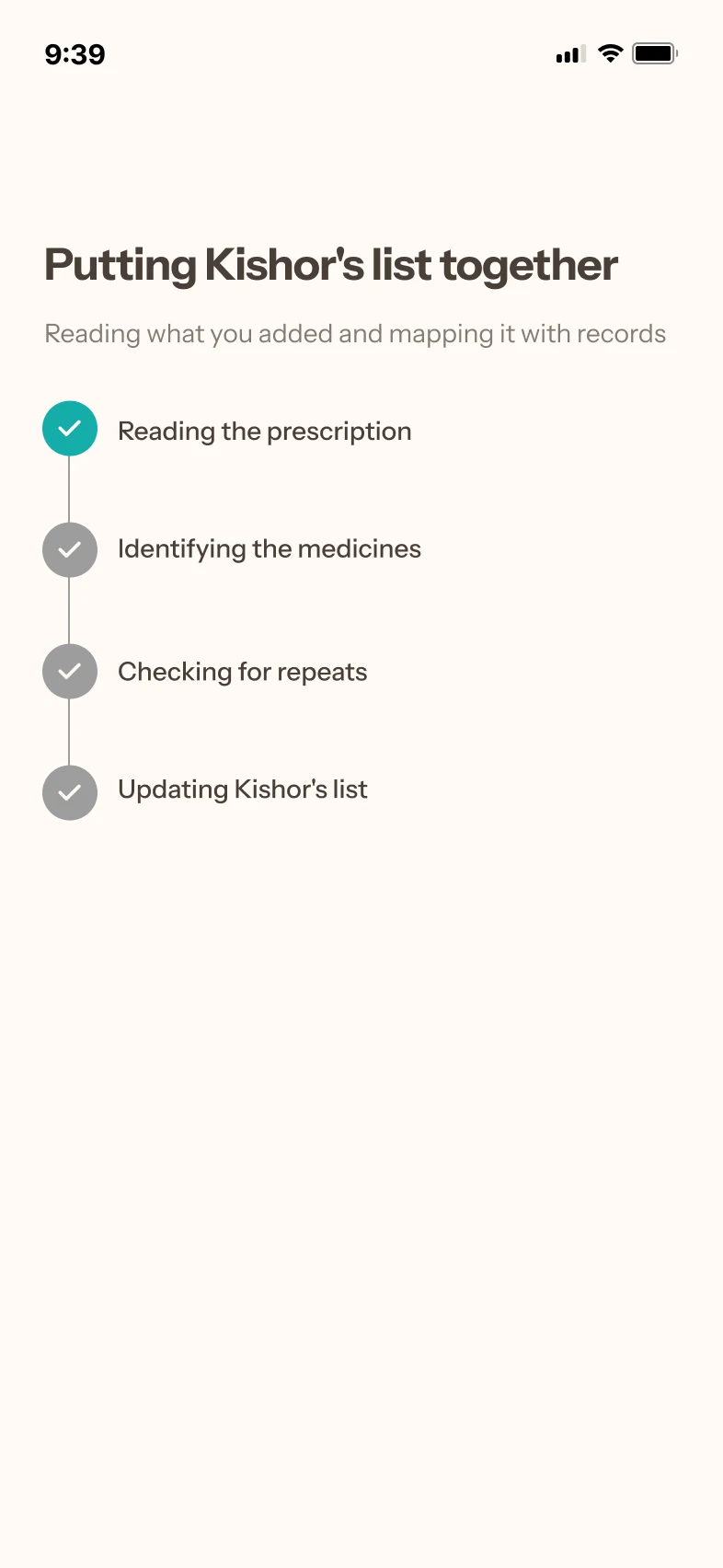
Putting it together
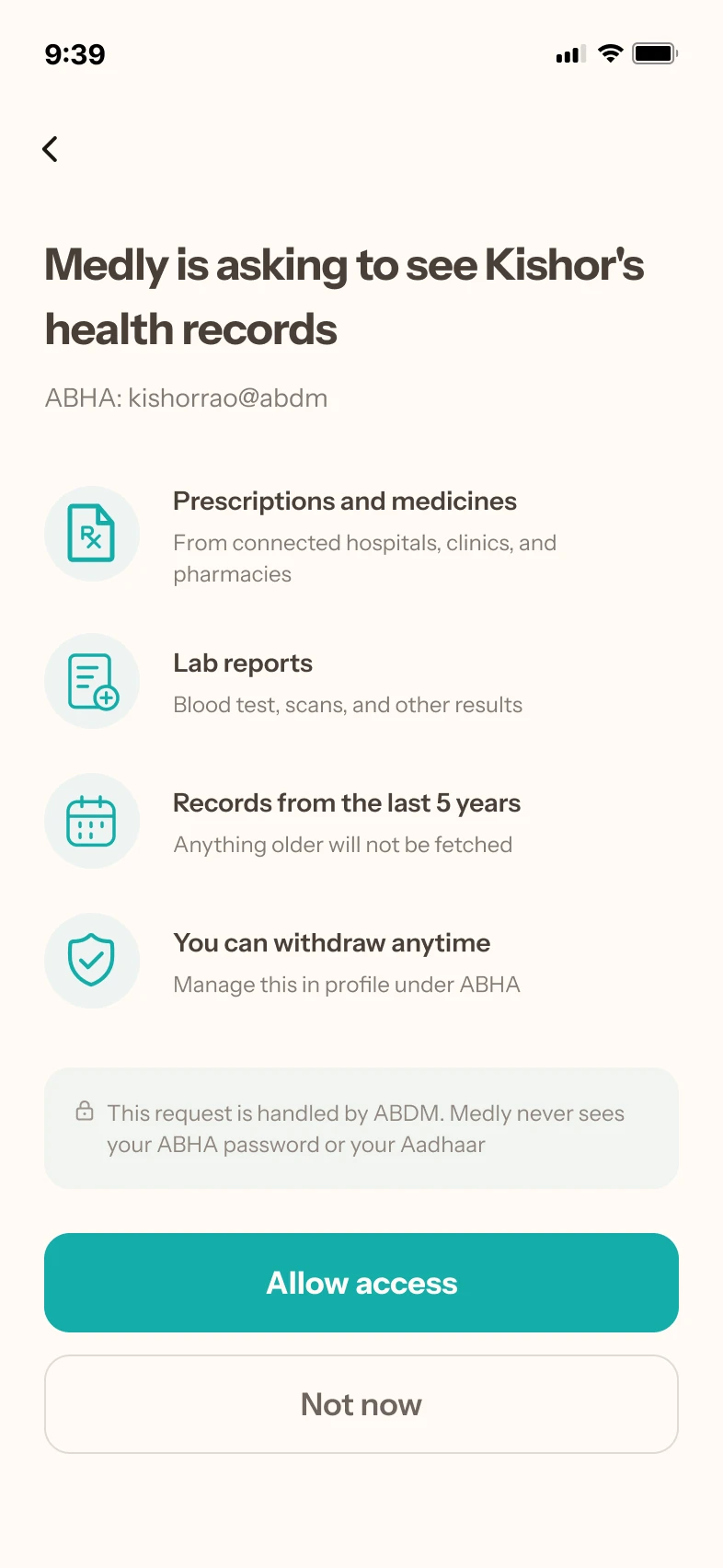
Allow access
Consent, in plain words.
What will be read, how far back, and that access can be withdrawn. The request is handled by ABDM, not by the app.
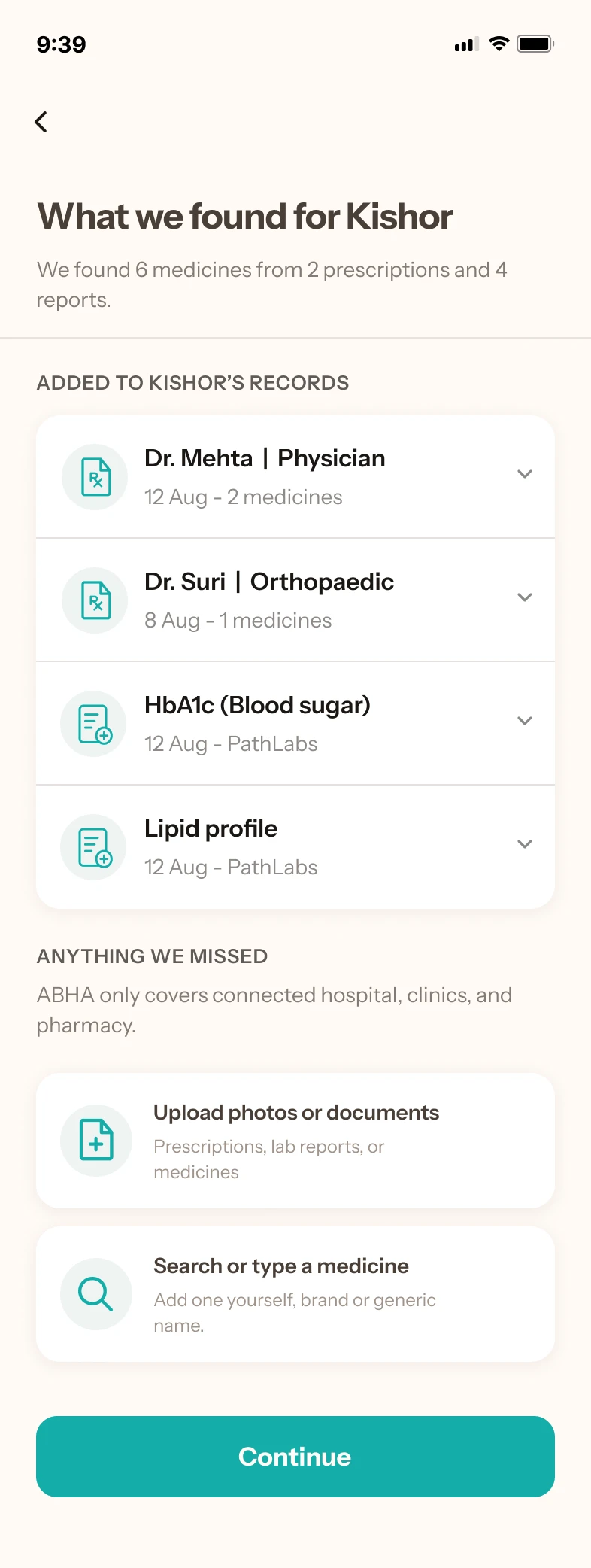
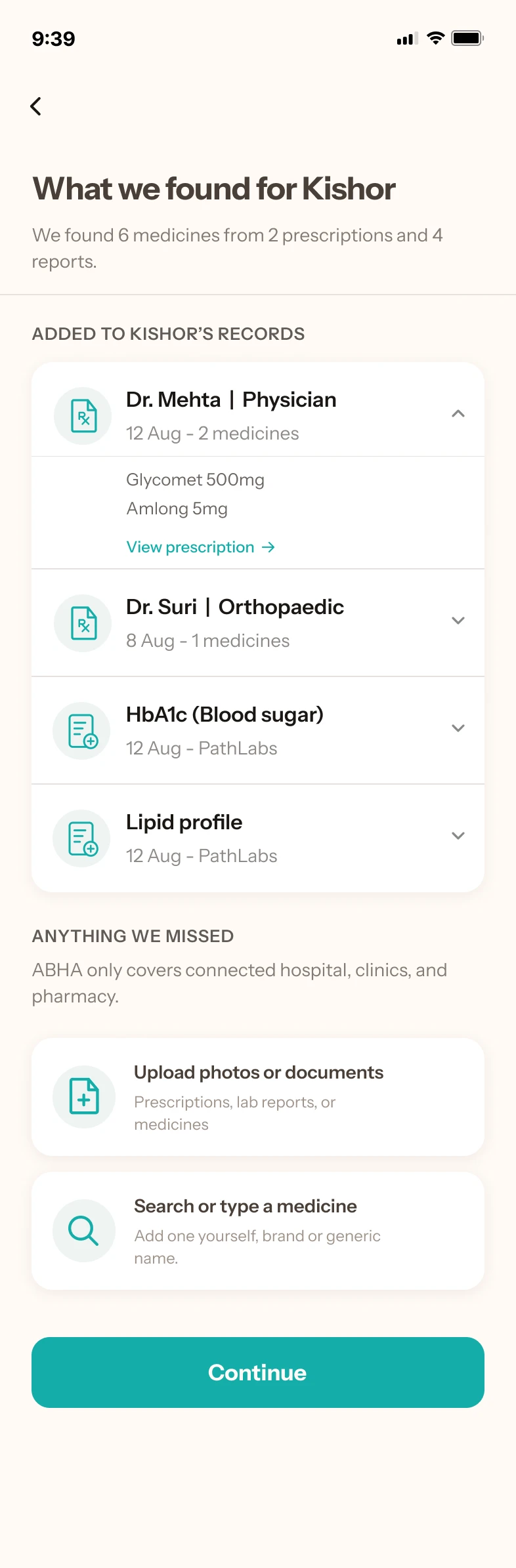
What we found
A source, opened
Records become a list, not a folder.
Each source arrives closed. Opening it shows which medicines came from it, with the original prescription one tap away.
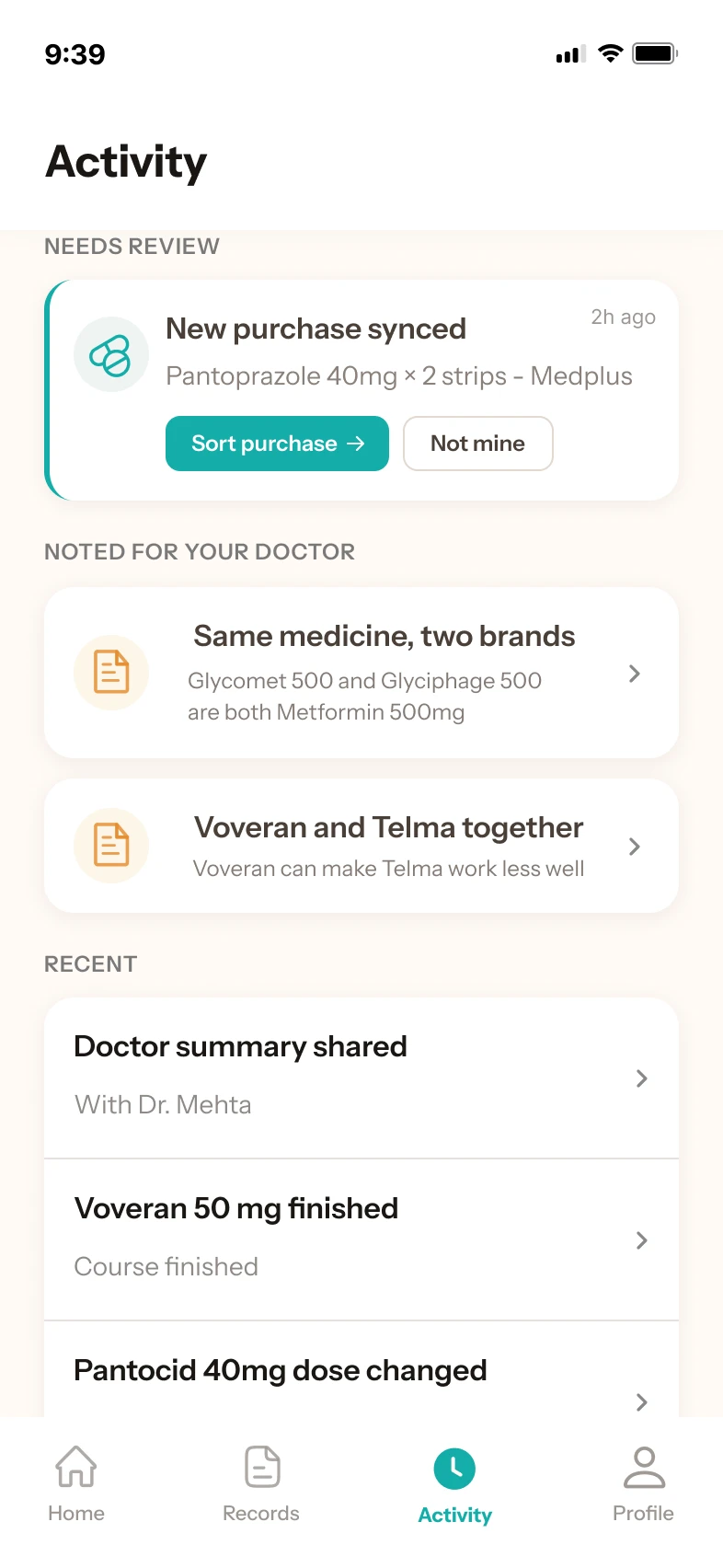
Activity
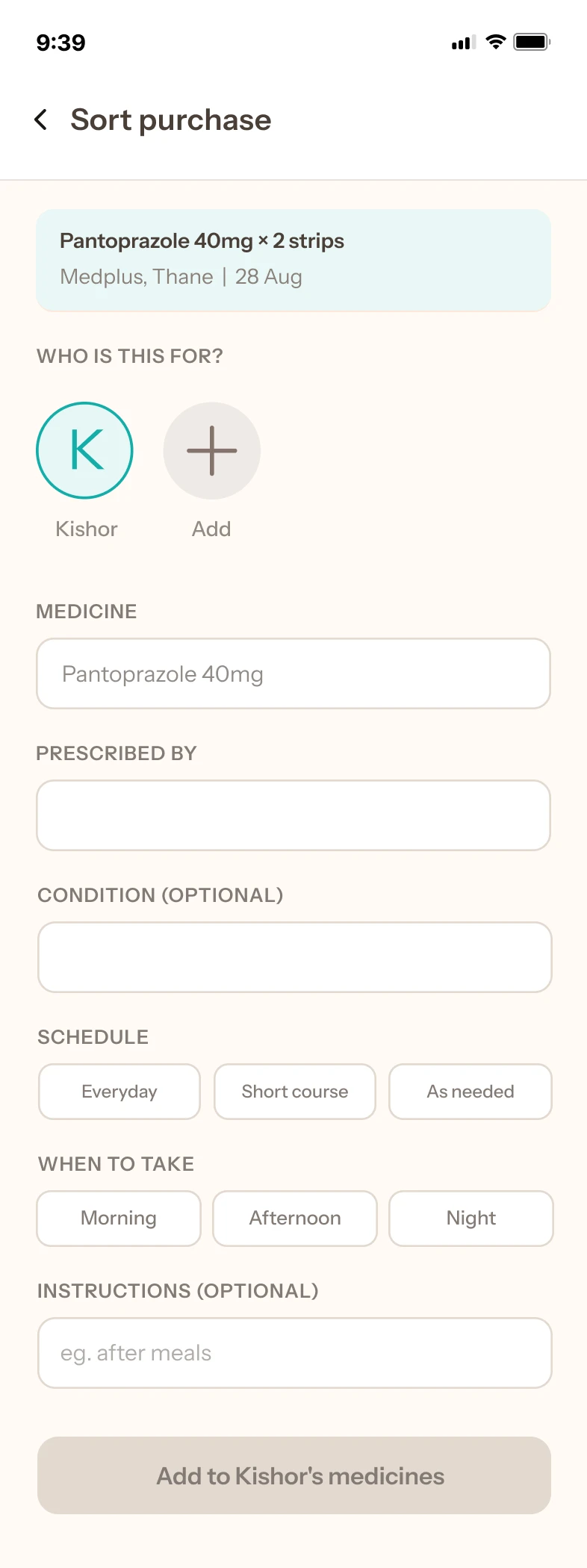
Sort purchase
It arrives. It does not land.
A synced purchase waits under Needs review, with Not mine one tap away. Sorting starts with what was bought and where, then who it is for.
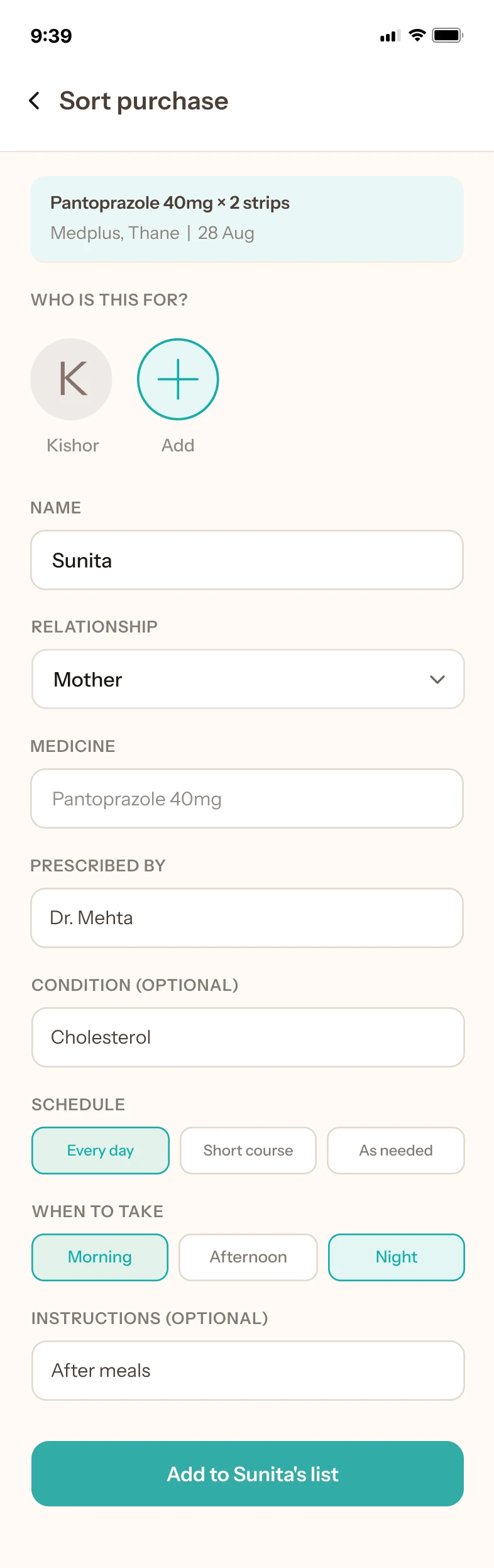
Add Sunita
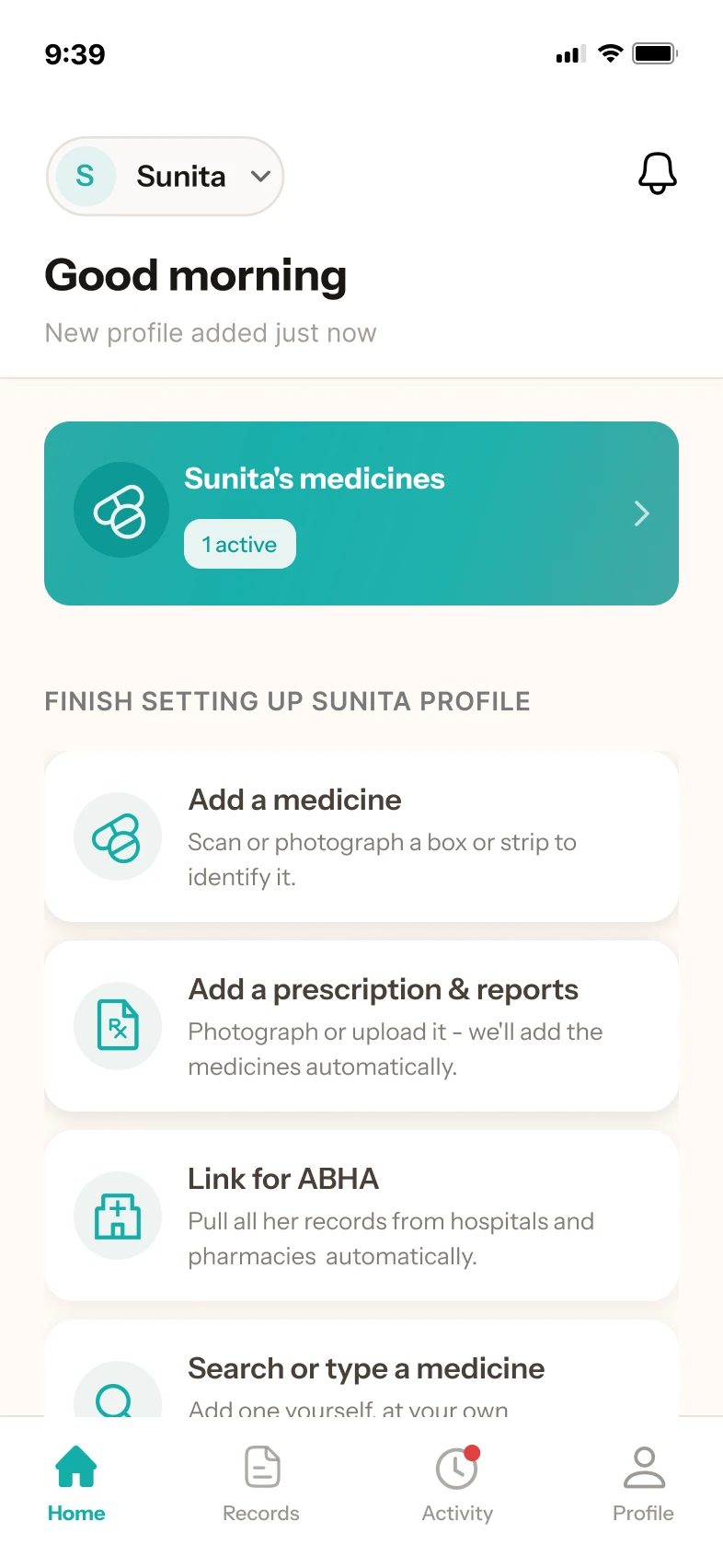
Sunita’s home
A new person, without a new setup.
This strip is for Sunita, who is not in the app yet. Add grows two fields here, and her home starts with a short finish-setting-up list.
Profile
Records
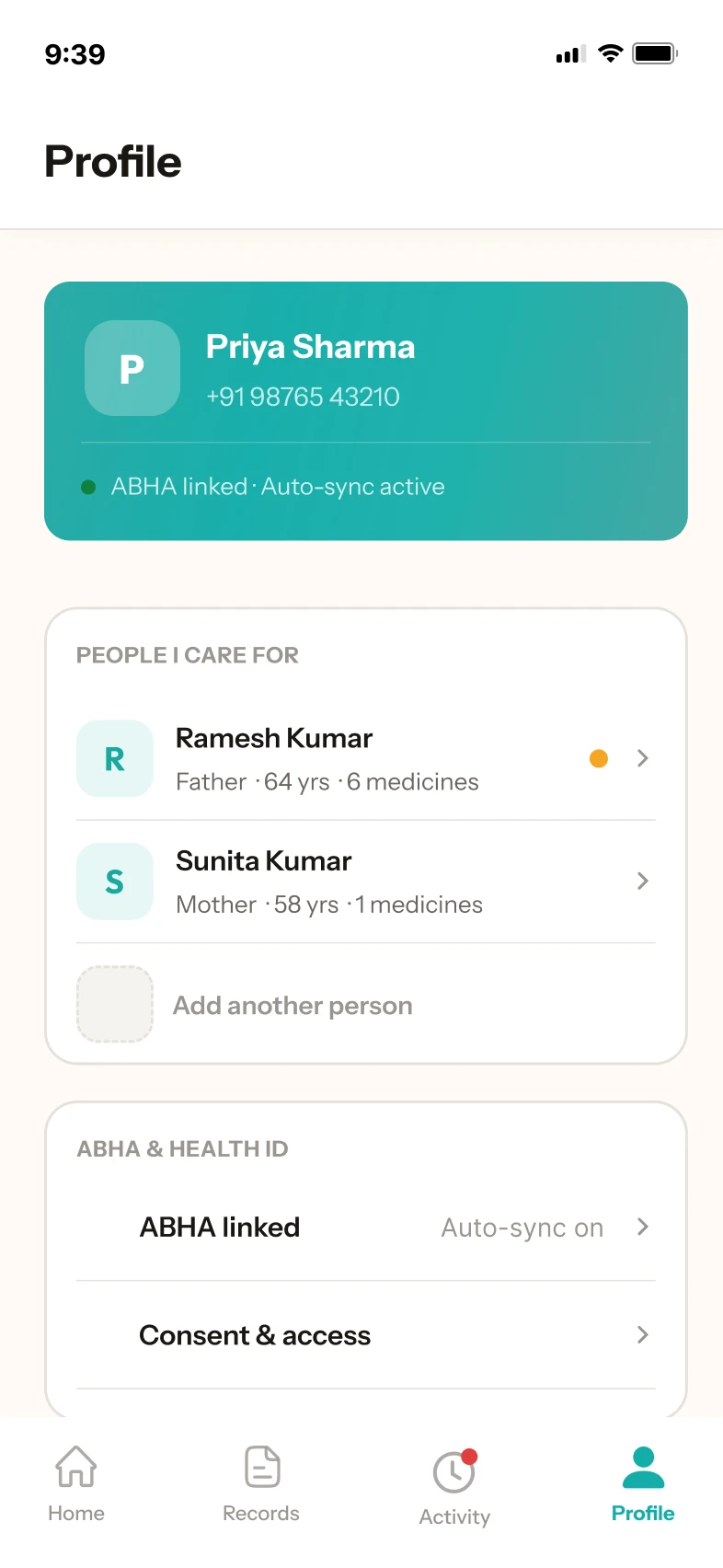
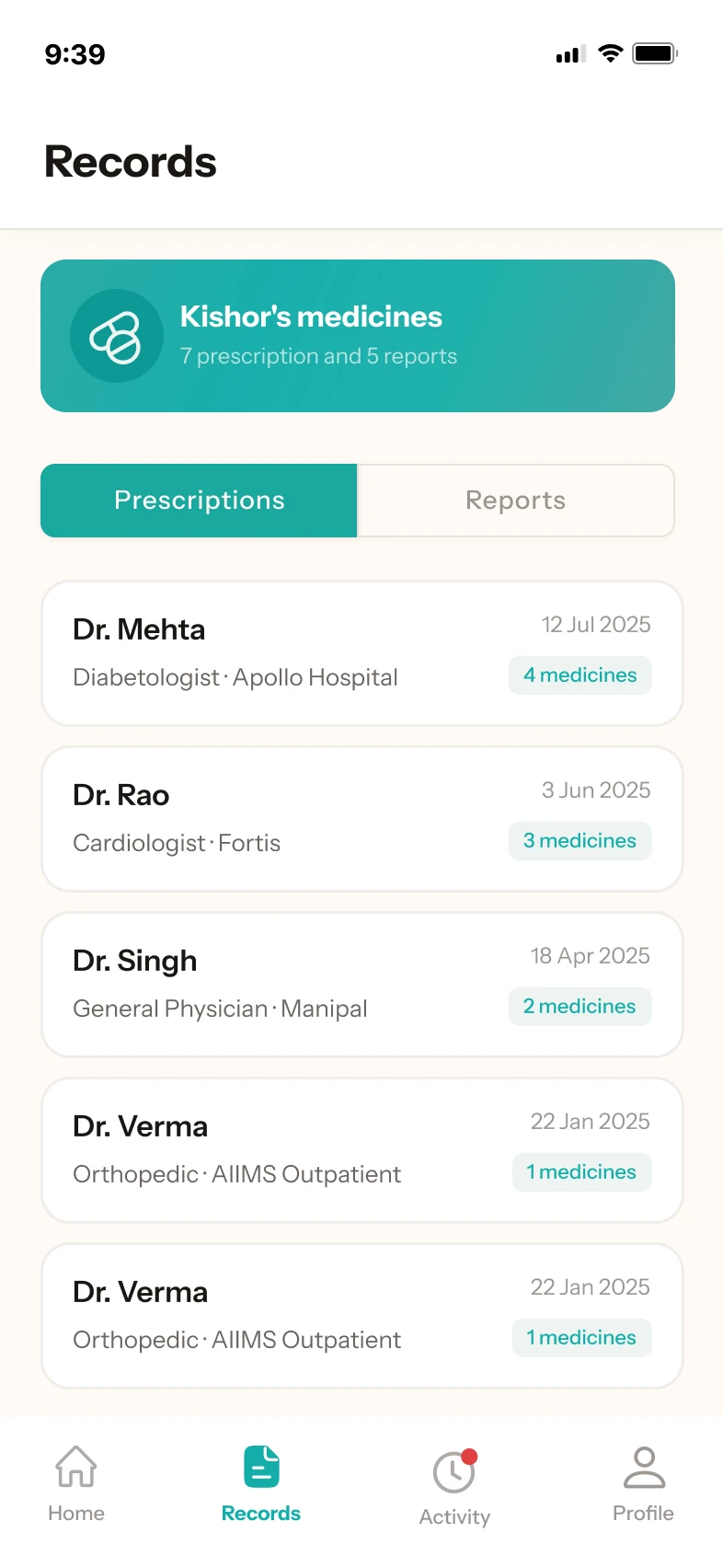
One account, several people.
Profile lists everyone being cared for, and Records keeps each person’s prescriptions by doctor and date.
IN TESTING
10 of 11 completed
PLACEHOLDER · replace with the real count
WHERE PEOPLE PAUSED
The purchase card. Its first wording read as an alert that something had gone wrong, not as news that something had arrived.
WHAT CHANGED
Rewritten as plain information: what was bought, where, and two real actions.
WHY ABHA shares only by consent, so the consent has to be readable.
WHY what is recorded is filed, not combined (cause 02).
WHY a counter sale leaves a bill at the shop and nothing anywhere else (cause 01).
WHY a purchase for someone new should not be lost to a full onboarding.
WHY everyone I spoke to kept the list for somebody else.
TASK 02
The list fills itself,
from ABHA and from the counter.
Two routes bring records in without anyone typing them. Both stop and wait for a person before anything reaches a list.
Records arrive without typing
Where from?
Link existing ABHA
Enter the ABHA number
Verify the code
Allow access?
Add by hand instead, Task 01
Looking for linked records
What we found
Grouped by source
Open a source in place
Its medicines, the original
Review
Same screen as Task 01
Bought at a connected pharmacy
Synced to Activity
Needs review
Whose purchase?
Not mine: removed, logged
Sort purchase
What was bought, where
Who is this for?
Add the details
Two fields grow
Name, relationship
Added to Kishor’s medicines
Added to Sunita’s list
Sunita’s home
Finish setup later
On the right person’s list, confirmed by a person
ABHA
The counter
Allow
Not now
Not mine
Sort it
Kishor
Add someone
2
Swipe sideways to see the whole diagram.
Enter ABHA number
Verify the code
2
Looking for records
Putting it together
Consent, in plain words.
What will be read, how far back, and that access can be withdrawn. The request is handled by ABDM, not by the app.
WHY ABHA shares only by consent, so the consent has to be readable.
Allow access
Records become a list, not a folder.
Each source arrives closed. Opening it shows which medicines came from it, with the original prescription one tap away.
WHY what is recorded is filed, not combined (cause 02).
2
What we found
A source, opened
It arrives. It does not land.
A synced purchase waits under Needs review, with Not mine one tap away. Sorting starts with what was bought and where, then who it is for.
WHY a counter sale leaves a bill at the shop and nothing anywhere else (cause 01).
Activity
2
Sort purchase
A new person, without a new setup.
This strip is for Sunita, who is not in the app yet. Add grows two fields here, and her home starts with a short finish-setting-up list.
WHY a purchase for someone new should not be lost to a full onboarding.
2
Add Sunita
Sunita’s home
One account, several people.
Profile lists everyone being cared for, and Records keeps each person’s prescriptions by doctor and date.
WHY everyone I spoke to kept the list for somebody else.
Profile
2
Records
IN TESTING
10 of 11 completed
PLACEHOLDER · replace with the real count
WHERE PEOPLE PAUSED
The purchase card. Its first wording read as an alert that something had gone wrong, not as news that something had arrived.
WHAT CHANGED
Rewritten as plain information: what was bought, where, and two real actions.
TASK 03
Resolve what the app flagged,
without the app deciding for anyone.
A duplicate asks for a choice and stays open until a doctor answers. An interaction asks for nothing and goes where the doctor will see it.
Activity: Noted for your doctor
Which flag?
Same medicine, two brands
Which one is he taking?
The other comes off the list
Check with the doctor first
Save and confirm later
The item stays open
At the visit, the doctor decides
What did the doctor say?
Answer picked?
Update stays off
Resolved, moved to Recent
Voveran and Telma together
Worth your doctor knowing
Not a warning
Got it
Doctor summary opens
The note on top
Every flag answered, or waiting on the doctor
The duplicate

The interaction

One brand

Both, or not sure

No

Yes





Same medicine, two brands
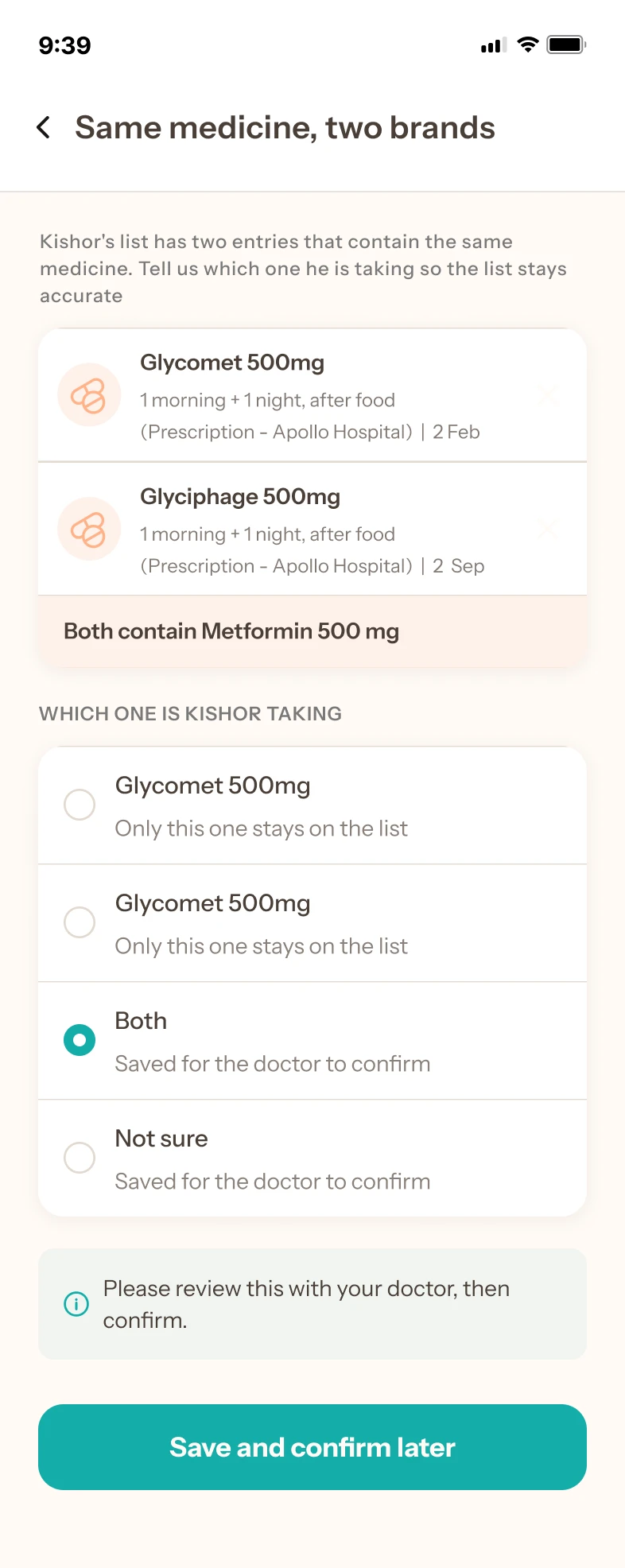
Both, saved for the doctor
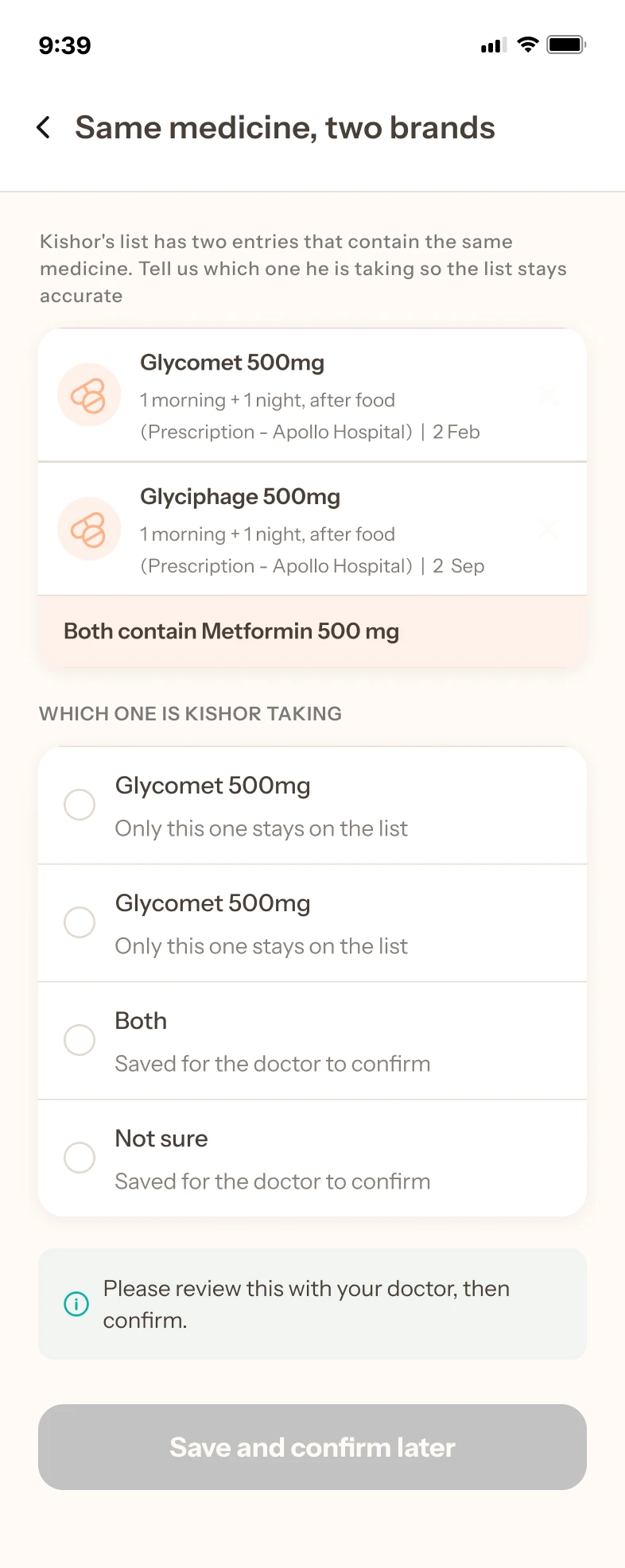
Two brands, equal weight.
Neither box is shown as the right one, and each option says what happens if it is picked. Both or Not sure asks the person to check with the doctor first.
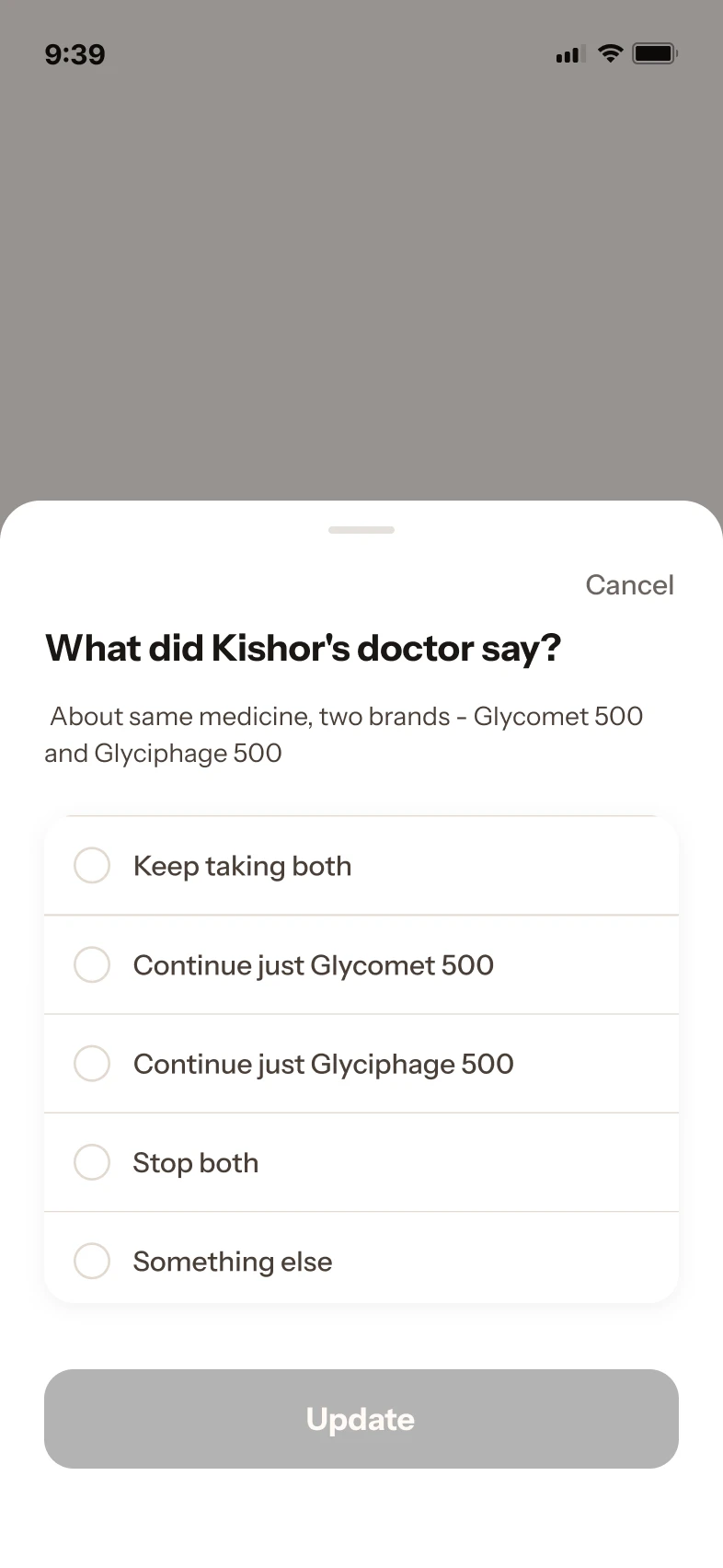
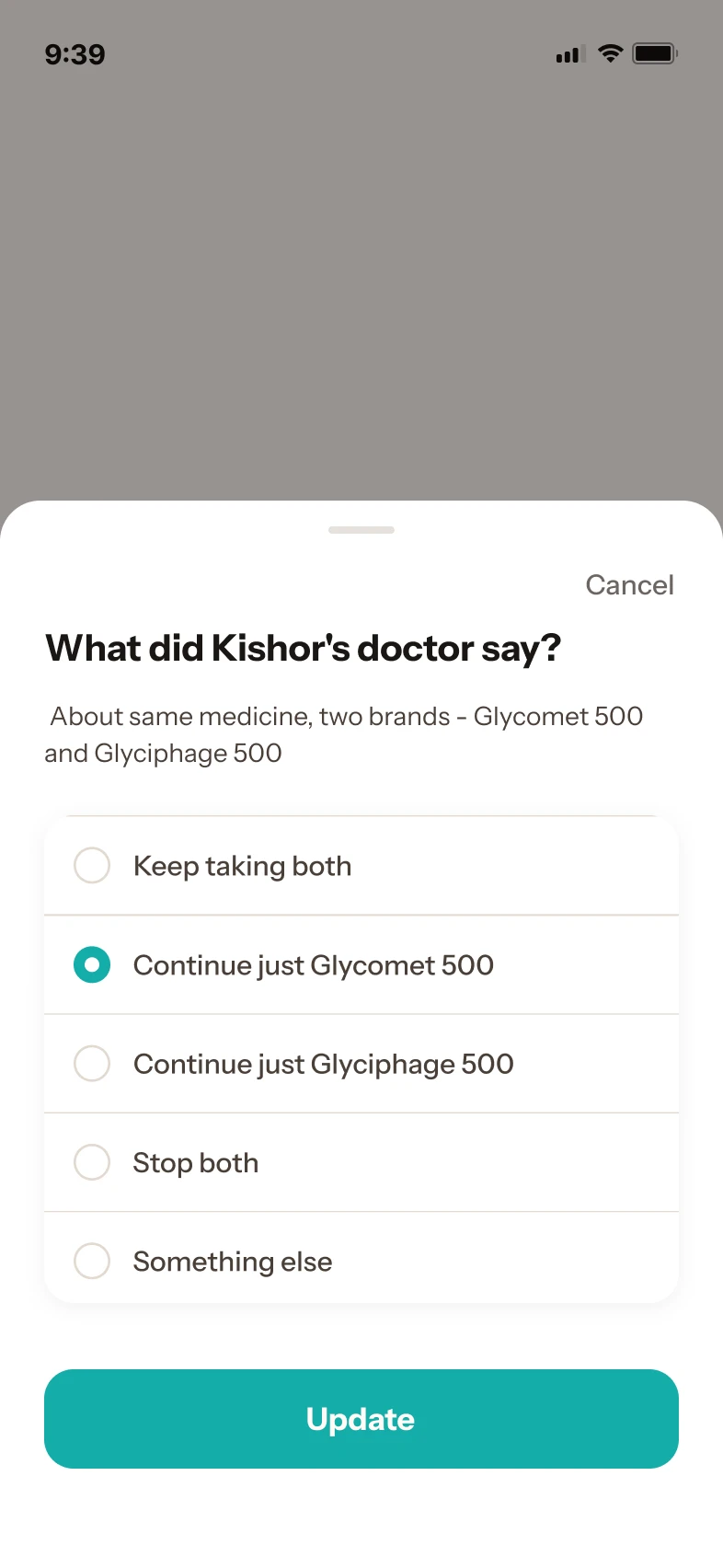
What did the doctor say?
Continue just Glycomet
Open until a doctor answers.
Saving Both does not close the item. It stays open until what the doctor said is recorded.
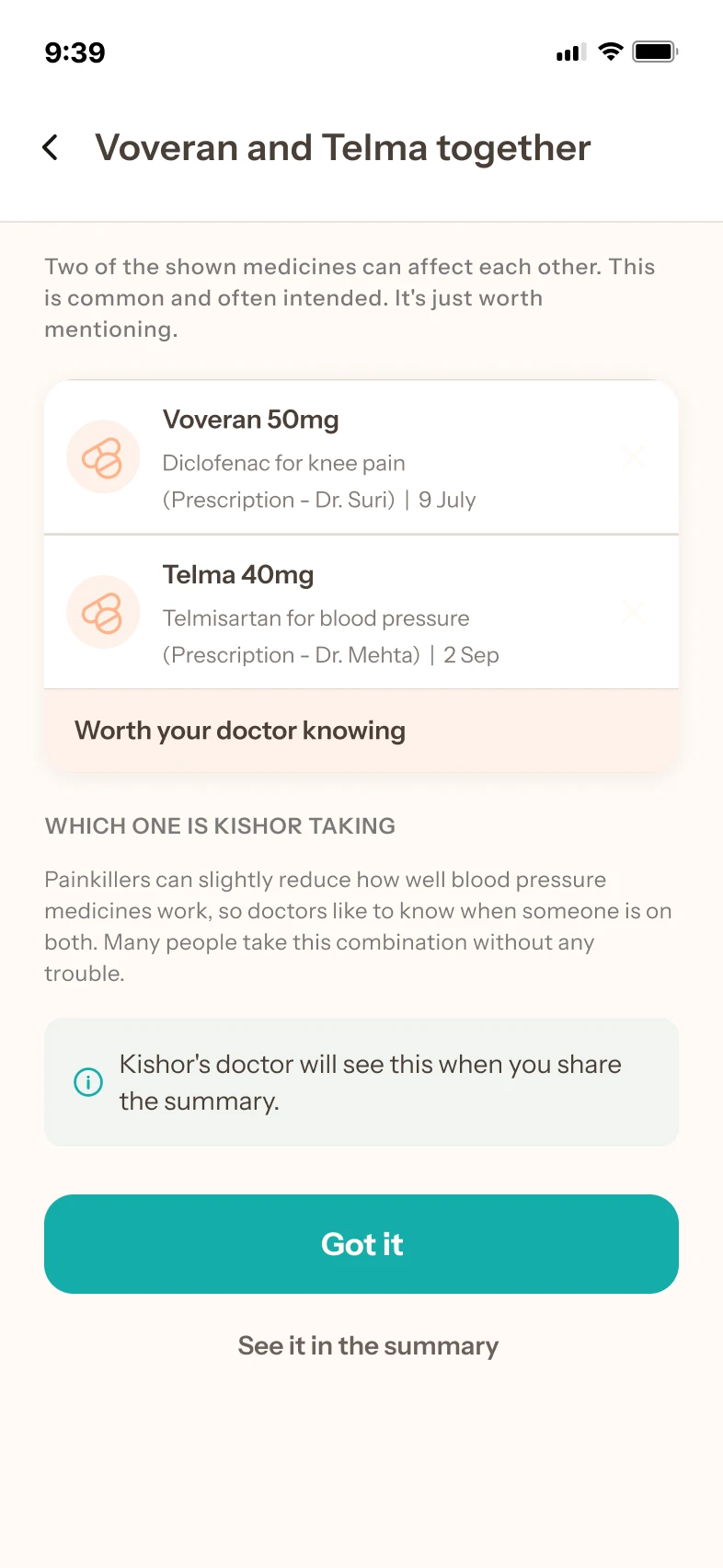
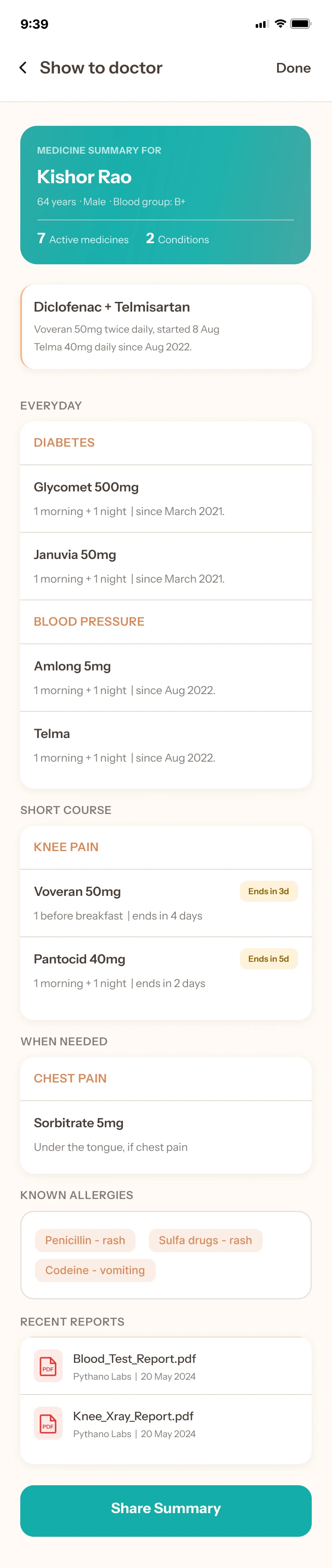
Voveran and Telma together
The note, in the summary
The calmest screen in the app.
Worth your doctor knowing, not a warning, because there is nothing for the person to do differently. Got it opens the doctor summary with the note already in place.
IN TESTING
8 of 11 completed
PLACEHOLDER · replace with the real count
WHERE PEOPLE PAUSED
After Got it on the interaction note. People could not say what had happened to it: it had been saved somewhere they could not see.
WHAT CHANGED
Got it now opens the doctor summary, with the new line above the condition groups.
WHY the same medicine came home twice (insight 02).
WHY the app asks first, and never settles a clinical question on its own.
WHY nobody knew two medicines could clash (insight 06). The family should know; the doctor decides.
TASK 03
Resolve what the app flagged,
without the app deciding for anyone.
A duplicate asks for a choice and stays open until a doctor answers. An interaction asks for nothing and goes where the doctor will see it.
Activity: Noted for your doctor
Which flag?
Same medicine, two brands
Which one is he taking?
The other comes off the list
Check with the doctor first
Save and confirm later
The item stays open
At the visit, the doctor decides
What did the doctor say?
Answer picked?
Update stays off
Resolved, moved to Recent
Voveran and Telma together
Worth your doctor knowing
Not a warning
Got it
Doctor summary opens
The note on top
Every flag answered, or waiting on the doctor
The duplicate
The interaction
One brand
Both, or not sure
No
Yes
2
Swipe sideways to see the whole diagram.
Two brands, equal weight.
Neither box is shown as the right one, and each option says what happens if it is picked. Both or Not sure asks the person to check with the doctor first.
WHY the same medicine came home twice (insight 02).
Same medicine, two brands
2
Both, saved for the doctor
Open until a doctor answers.
Saving Both does not close the item. It stays open until what the doctor said is recorded.
WHY the app asks first, and never settles a clinical question on its own.
2
What did the doctor say?
Continue just Glycomet
The calmest screen in the app.
Worth your doctor knowing, not a warning, because there is nothing for the person to do differently. Got it opens the doctor summary with the note already in place.
WHY nobody knew two medicines could clash (insight 06). The family should know; the doctor decides.
Voveran and Telma together
2
The note, in the summary
IN TESTING
8 of 11 completed
PLACEHOLDER · replace with the real count
WHERE PEOPLE PAUSED
After Got it on the interaction note. People could not say what had happened to it: it had been saved somewhere they could not see.
WHAT CHANGED
Got it now opens the doctor summary, with the new line above the condition groups.
USABILITY TESTING
Eleven people, three tasks,
on the clickable prototype, in order.
Each person was given the three tasks one after another, then filled in the System Usability Scale. Where people paused is marked on each task’s flow above.
NUMBERS TAGGED PLACEHOLDER ARE STAND-INS UNTIL THE REAL COUNTS ARE ADDED
TASK 01
Build the list, then show a doctor


9 of 11
PLACEHOLDER
Paused choosing which card to photograph with
TASK 02
A purchase arrives, sort it
10 of 11
PLACEHOLDER
Paused on the wording of the purchase card
TASK 03
Resolve what the app flagged
8 of 11
PLACEHOLDER
Paused after Got it, unsure where the note went
SYSTEM USABILITY SCALE
72.5
PLACEHOLDER · 11 RESPONSES
Ten standard statements, each answered on a five-point scale, scored from 0 to 100. 68 is the published average, so a score above it is better than most software tested this way.
68 · average
0
100
LOWEST-SCORING STATEMENTS
[ The statement that scored lowest, word for word from the SUS form ]
[ The second lowest ]
PLACEHOLDER · FILL FROM THE SUS SHEETS
USABILITY TESTING
Eleven people, three tasks,
on the clickable prototype, in order.
Each person was given the three tasks one after another, then filled in the System Usability Scale. Where people paused is marked on each task’s flow above.
NUMBERS TAGGED PLACEHOLDER ARE STAND-INS UNTIL THE REAL COUNTS ARE ADDED
TASK 01
Build the list, then show a doctor
9 of 11
PLACEHOLDER
Paused choosing which card to photograph with
TASK 02
A purchase arrives, sort it
10 of 11
PLACEHOLDER
Paused on the wording of the purchase card
2
TASK 03
Resolve what the app flagged
8 of 11
PLACEHOLDER
Paused after Got it, unsure where the note went
SYSTEM USABILITY SCALE
72.5
PLACEHOLDER · 11 RESPONSES
Ten standard statements, each answered on a five-point scale, scored from 0 to 100. 68 is the published average, so a score above it is better than most software tested this way.
68 · average
0
100
2
LOWEST-SCORING STATEMENTS
[ The statement that scored lowest, word for word from the SUS form ]
[ The second lowest ]
PLACEHOLDER · FILL FROM THE SUS SHEETS
WHAT TESTING CHANGED
What the first version got wrong,
and what replaced it.
Five changes, each traced to where it came from, and one that has not happened yet. The earlier versions were not kept in the file, so they are described here, not redrawn.
FROM TESTING · TASK 01
Adding paper
BEFORE
Four cards: prescription, report, medicine and search, each opening the same camera. People stopped to decide what kind of paper they were holding.
NOW
One Upload photos or documents button, plus search. The app works out what each photo is.
FROM TESTING · TASK 02
The purchase card
BEFORE
Its wording read as an alarm about something that had gone wrong.
NOW
What was bought, where, and two real actions: Sort purchase, or Not mine.
FROM TESTING · TASK 03
Where Got it goes
BEFORE
The note was saved somewhere nobody could see, so people thought nothing had happened.
NOW
Got it opens the doctor summary, with the note at the top.
FROM FEEDBACK
The daily list
BEFORE
One long list grouped by schedule, which people called overwhelming.
NOW
Morning, afternoon or night in one tap, with When needed always at the bottom.
FROM FEEDBACK
ABHA sources
BEFORE
Each source pushed to a new screen just to show its medicines.
NOW
It opens in place, with a link to the original prescription.
NOT CHANGED YET
Food timing
BEFORE
Still optional free text, so a medicine can be added with no timing at all.
NEXT
It should be a required before food or after food choice, so every row can show it.
WHAT TESTING CHANGED
What the first version got wrong,
and what replaced it.
Five changes, each traced to where it came from, and one that has not happened yet. The earlier versions were not kept in the file, so they are described here, not redrawn.
FROM TESTING · TASK 01
Adding paper
BEFORE
Four cards: prescription, report, medicine and search, each opening the same camera. People stopped to decide what kind of paper they were holding.
NOW
One Upload photos or documents button, plus search. The app works out what each photo is.
2
FROM TESTING · TASK 02
The purchase card
BEFORE
Its wording read as an alarm about something that had gone wrong.
NOW
What was bought, where, and two real actions: Sort purchase, or Not mine.
FROM TESTING · TASK 03
Where Got it goes
BEFORE
The note was saved somewhere nobody could see, so people thought nothing had happened.
NOW
Got it opens the doctor summary, with the note at the top.
2
FROM FEEDBACK
The daily list
BEFORE
One long list grouped by schedule, which people called overwhelming.
NOW
Morning, afternoon or night in one tap, with When needed always at the bottom.
FROM FEEDBACK
ABHA sources
BEFORE
Each source pushed to a new screen just to show its medicines.
NOW
It opens in place, with a link to the original prescription.
2
NOT CHANGED YET
Food timing
BEFORE
Still optional free text, so a medicine can be added with no timing at all.
NEXT
It should be a required before food or after food choice, so every row can show it.
WHAT I LEARNED
What this project taught me,
beyond this one app.
01
Look for what is already being written down.
I spent weeks asking how to get people to keep a list. The answer was a phone number already typed at a pharmacy counter. Building on a habit that exists beat inventing a new one.
from the ideation
02
Ask, do not guess.
Every confirm card exists because one silent wrong guess about a medicine costs more trust than any number of extra taps.
from the review screen
03
Every action needs a visible result.
Got it worked, and people still thought it had failed, because nothing changed on screen. Now it opens the summary.
from testing, task 03
04
Do not hand the app’s job to the person.
Asking people to sort a paper before photographing it was the slowest step in testing. Sorting is the app’s work.
from testing, task 01
05
Tone is a design decision.
The duplicate asks for a choice, so it can carry weight. The interaction note asks nothing, so it must carry none.
from task 03
06
Put the holes on the page.
I could not confirm that a vendor would agree, or that ABDM can carry a dispense. Saying so myself is stronger than being caught.
from the research
07
Design for the role, not the age.
“Myself” in the relationship list means the patient can be the one managing. The job matters, not the demographic.
from setup
08
Small research, said out loud.
Six conversations and eleven testers were enough to find problems, not to prove the design is right. The next round is where that gets earned.
from the whole project
WHAT I LEARNED
What this project taught me,
beyond this one app.
01
Look for what is already being written down.
I spent weeks asking how to get people to keep a list. The answer was a phone number already typed at a pharmacy counter. Building on a habit that exists beat inventing a new one.
from the ideation
02
Ask, do not guess.
Every confirm card exists because one silent wrong guess about a medicine costs more trust than any number of extra taps.
from the review screen
03
Every action needs a visible result.
Got it worked, and people still thought it had failed, because nothing changed on screen. Now it opens the summary.
from testing, task 03
04
Do not hand the app’s job to the person.
Asking people to sort a paper before photographing it was the slowest step in testing. Sorting is the app’s work.
from testing, task 01
05
Tone is a design decision.
The duplicate asks for a choice, so it can carry weight. The interaction note asks nothing, so it must carry none.
from task 03
06
Put the holes on the page.
I could not confirm that a vendor would agree, or that ABDM can carry a dispense. Saying so myself is stronger than being caught.
from the research
07
Design for the role, not the age.
“Myself” in the relationship list means the patient can be the one managing. The job matters, not the demographic.
from setup
08
Small research, said out loud.
Six conversations and eleven testers were enough to find problems, not to prove the design is right. The next round is where that gets earned.
from the whole project
WHAT COMES NEXT
Six things are still open.
Leaving them visible is more useful than a neat ending.
Talk to a billing vendor.
The automatic route depends on one of them agreeing to send a sale. Nothing in the design removes that assumption.
Confirm ABDM can carry a dispense.
Pharmacies are a registered facility type. Whether a dispensed medicine can be pushed like a lab report, I could not confirm.
Make food timing a required choice.
Before food or after food, so no medicine can be added without it.
Test the daily list against a single list.
Morning, afternoon or night answers today’s question. It also costs a tap before anything is shown.
Rename the Activity groups.
“Noted for your doctor” says where an item is going, not what it is.
Test with someone managing from another city.
The person away from home is the one with the least to go on. They were not in this round.
WHAT COMES NEXT
Six things are still open.
Leaving them visible is more useful than a neat ending.
Talk to a billing vendor.
The automatic route depends on one of them agreeing to send a sale. Nothing in the design removes that assumption.
Confirm ABDM can carry a dispense.
Pharmacies are a registered facility type. Whether a dispensed medicine can be pushed like a lab report, I could not confirm.
Make food timing a required choice.
Before food or after food, so no medicine can be added without it.
Test the daily list against a single list.
Morning, afternoon or night answers today’s question. It also costs a tap before anything is shown.
Rename the Activity groups.
“Noted for your doctor” says where an item is going, not what it is.
Test with someone managing from another city.
The person away from home is the one with the least to go on. They were not in this round.
SOURCES
Says who.
Every figure on this page, with where it came from.
THE SCALE
UNFPA, India Ageing Report 2023. 149 million people aged 60+ in 2022.
Bhagavathula et al., Frontiers in Pharmacology, 2021. Pooled polypharmacy 49 %, 27 Indian studies.
Antimicrobial Resistance and Infection Control, 2015. 174 of 261 Bangalore pharmacies (66.7 %) sold antibiotics with no prescription.
Cosgrave et al., Age and Ageing, 2025. Medicine-related harm causes up to 30 % of older adults’ admissions, international review.
Joint Commission Journal on Quality and Patient Safety, 2025. 1.37 unintentional discrepancies per patient at discharge, 200 inpatients, India.
PLOS One, 2026. 310 older patients, Mangalore: 28.4 % had a potential interaction rated severe.
THE SYSTEM
Press Information Bureau, ABDM Mission Steering Group, 10 July 2026. 93.95 crore ABHA numbers, 105 crore records linked, 5.33 lakh facilities registered.
GST e-invoicing notifications, October 2020 to August 2023. Threshold from ₹500 crore to ₹5 crore.
Sahamati / RBI Account Aggregator framework. 284.6 million linked accounts by March 2026.
Japan, okusuri techō (medicine notebook), filled in by the pharmacist at dispensing.
THE TOOLS
Store listings and help pages of Medisafe, Tata 1mg, PharmEasy, Apollo 24|7, Eka Care, DRiefcase and the ABHA app, read as desk research.
Marg ERP and eVitalRx, vendor claims, used as evidence that billing software exists, not as a count.
eVitalRx published API documentation (docs.evitalrx.in), read for what it does and does not expose.
Nobody in that room could answer it.
Now the list can.
PreSync · capstone, self-directed · 7 weeks · iOS · research, UX, UI
SOURCES
Says who.
Every figure on this page, with where it came from.
THE SCALE
UNFPA, India Ageing Report 2023. 149 million people aged 60+ in 2022.
Bhagavathula et al., Frontiers in Pharmacology, 2021. Pooled polypharmacy 49 %, 27 Indian studies.
Antimicrobial Resistance and Infection Control, 2015. 174 of 261 Bangalore pharmacies (66.7 %) sold antibiotics with no prescription.
Cosgrave et al., Age and Ageing, 2025. Medicine-related harm causes up to 30 % of older adults’ admissions, international review.
Joint Commission Journal on Quality and Patient Safety, 2025. 1.37 unintentional discrepancies per patient at discharge, 200 inpatients, India.
PLOS One, 2026. 310 older patients, Mangalore: 28.4 % had a potential interaction rated severe.
THE SYSTEM
Press Information Bureau, ABDM Mission Steering Group, 10 July 2026. 93.95 crore ABHA numbers, 105 crore records linked, 5.33 lakh facilities registered.
GST e-invoicing notifications, October 2020 to August 2023. Threshold from ₹500 crore to ₹5 crore.
Sahamati / RBI Account Aggregator framework. 284.6 million linked accounts by March 2026.
Japan, okusuri techō (medicine notebook), filled in by the pharmacist at dispensing.
THE TOOLS
Store listings and help pages of Medisafe, Tata 1mg, PharmEasy, Apollo 24|7, Eka Care, DRiefcase and the ABHA app, read as desk research.
Marg ERP and eVitalRx, vendor claims, used as evidence that billing software exists, not as a count.
eVitalRx published API documentation (docs.evitalrx.in), read for what it does and does not expose.
Nobody in that room could answer it.
Now the list can.
PreSync · capstone, self-directed · 7 weeks · iOS · research, UX, UI